


Client Overview
The Challenge
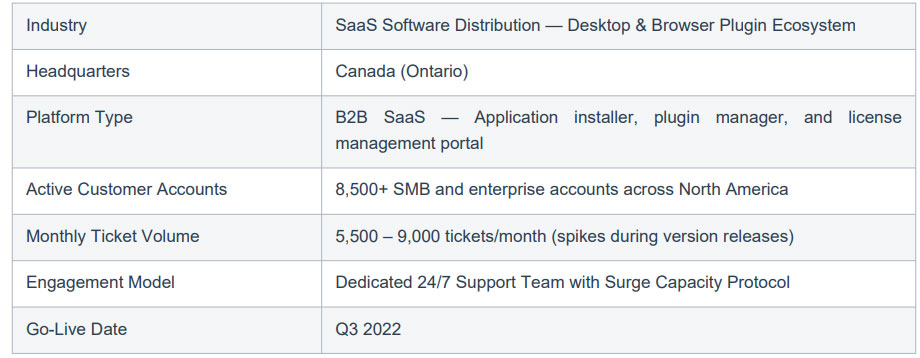
This Canada-based SaaS company delivers a plugin management and application distribution platform used by IT departments and power users across North American enterprises. The ecosystem supports Windows, macOS, and Linux environments and integrates with more than 400 third-party plugins, with frequent releases requiring continuous technical oversight.
When the customer base surpassed 8,500 accounts, support demand increased sharply in both volume and complexity. The small internal team relied primarily on asynchronous email workflows, which limited their ability to troubleshoot highly technical, environment-specific installation failures at scale.
Enterprise customers operated across diverse OS builds, proxy configurations, and firewall restrictions. Generic troubleshooting scripts failed in these environments because installation errors rarely followed a predictable pattern. Each case demanded structured diagnostic investigation and independent technical judgment.
Frontline teams escalated more than 66% of incoming tickets to engineering. Most of these cases did not require code fixes. L1 agents lacked the technical depth to isolate configuration conflicts and security-layer restrictions on their own, which forced engineering teams to handle routine troubleshooting tasks instead of focusing on product development.
Environment Variability
Customers operated across widely varied OS configurations, proxy environments, and enterprise firewall setups. In these complex enterprise environments, standardized troubleshooting scripts quickly became ineffective. Because installation failures rarely followed a predictable pattern, each case demanded genuine diagnostic capability and structured problem-solving rather than scripted responses.
High Escalation Rate
At the same time, over 66% of frontline tickets were being escalated to engineering. Importantly, these escalations were not driven by the need for code changes or product fixes. Rather, they stemmed from the L1 agents’ limited technical depth and lack of confidence in diagnosing environment-specific issues independently. Consequently, engineering bandwidth was diverted toward routine troubleshooting instead of core product development, creating operational bottlenecks and slowing overall response times.
Version Release Chaos
Every major version release triggered a 3x spike in installation failure and compatibility tickets. Without surge capacity, SLAs collapsed within 48 hours of each release.
License & Activation Complexity
Customers frequently encountered license validation failures tied to machine fingerprinting changes, VPN usage, or domain migrations — requiring systematic, multi-step troubleshooting.
No Structured Knowledge Base
There was no centralized runbook or KB. Tribal knowledge lived with two senior engineers who were being pulled into support daily, creating a bottleneck and retention risk.
Our Solution
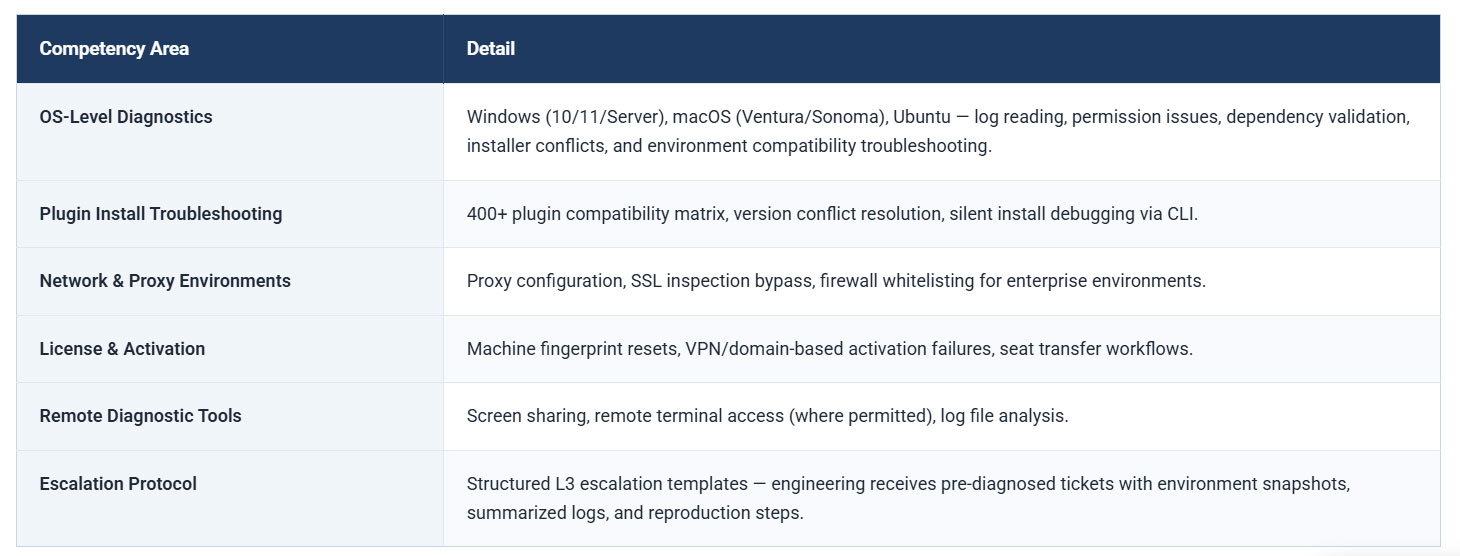
We built a specialized frontline tech support team with deep competency in application installation, OS-level diagnostics, plugin compatibility, and license management. The approach was built around technical depth first not just ticket throughput.Technical Competency Framework
Release Surge Protocol
We developed a Release Readiness Protocol triggered 72 hours before each scheduled version release. This included pre-release training on known compatibility changes, pre-built response templates for anticipated failure modes, and temporary surge agents on standby — enabling the team to absorb 3x volume spikes without SLA degradation.Results & Impact
| Metric | Outcome |
|---|---|
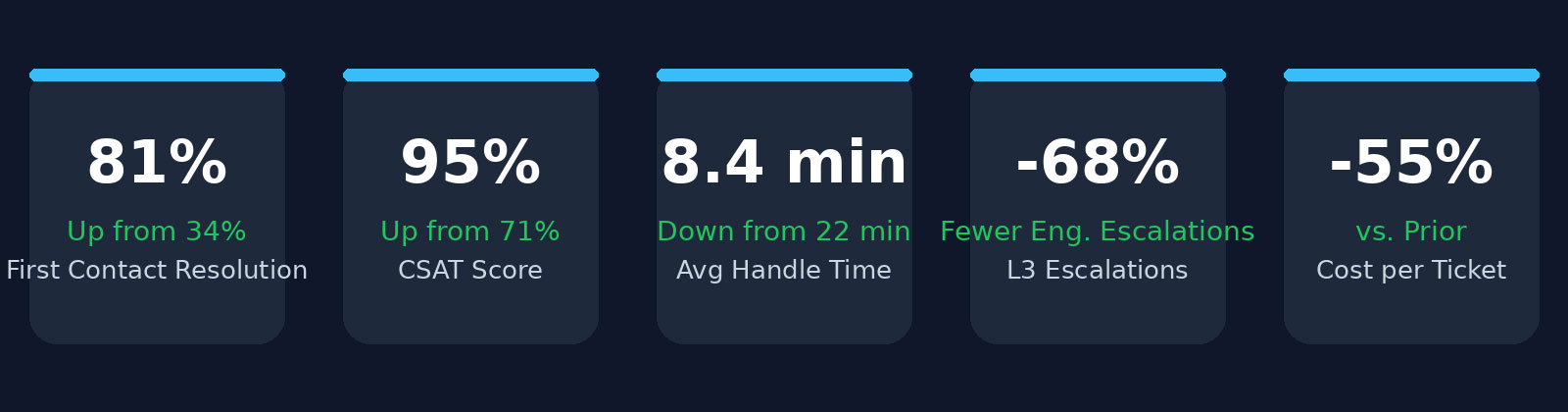
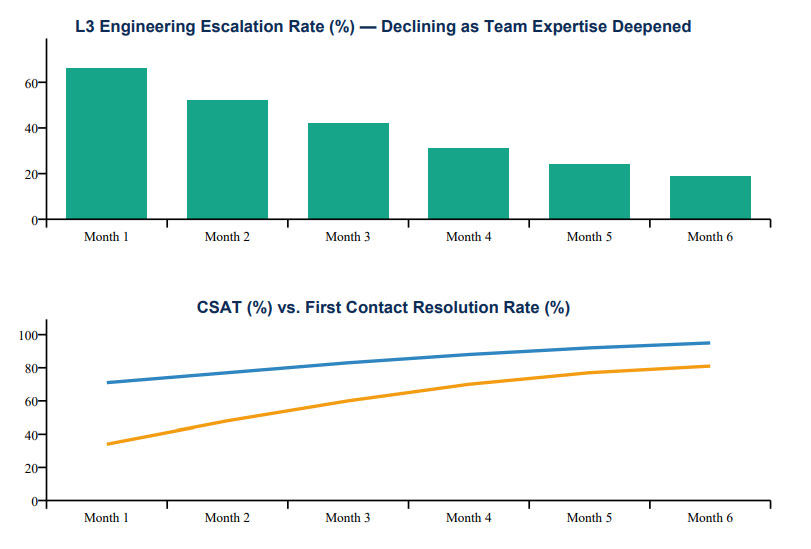
| First Contact Resolution | Improved from 34% to 81% in 6 months — the single most impactful metric for engineering capacity recapture. |
| L3 Escalation Rate | Dropped from 60% to 19%, freeing engineering teams from an estimated 18 hours/week of support burden. |
| Average Handle Time | Reduced from 22 minutes to 8.4 minutes through structured diagnostic runbooks and remote tooling proficiency. |
| CSAT Score | Reached 95% by Month 6 — the highest recorded in the client’s company history. |
| Version Release Stability | Zero SLA breaches during the three major version releases following engagement start, compared to full SLA collapse in prior releases. |
| Knowledge Base | Delivered 210+ runbook articles covering the full plugin compatibility matrix, enterprise environment configs, and license resolution workflows. |
| Cost Efficiency | Cost per resolved ticket reduced by 55% through higher FCR and reduced escalation overhead. |