




Client Over View
| Industry | Digital Publishing / eBook SaaS Platform |
| Headquarters | United States (Pacific Coast) |
| Platform Type | B2C & B2B SaaS — eBook reading, authoring, and distribution |
| Active Users | 220,000+ registered readers and 4,500+ independent authors |
| Monthly Ticket Volume | 3,200 – 4,800 tickets/month (seasonal spikes during launches) |
| Engagement Model | Dedicated 24/7 Support Team (Retainer) |
| Go-Live Date | Q2 2023 |
The Challenge
This US-based digital publishing platform had grown rapidly, initially onboarding independent authors and readers across North America, the UK, and Australia. As a result of this expansion, their catalog grew to over 180,000 titles. At the same time, new features such as audio narration, interactive annotations, and DRM-managed downloads were launching every quarter.
However, while product innovation accelerated, their support infrastructure did not scale at the same pace. Consequently, a lean internal team of four agents was left managing an increasingly overwhelming ticket queue. In addition, these same agents were frequently pulled into product QA cycles, further stretching their capacity. Ultimately, this imbalance between growth and operational support created mounting pressure on both customer experience and internal efficiency.
Reader Experience Breakdowns
Readers reported download failures, sync errors between devices, and playback issues with audio titles. With no 24/7 coverage, US West Coast users frequently waited until the following business day.Author Onboarding Friction
First-time authors uploading manuscripts encountered formatting errors, metadata validation failures, and royalty dashboard confusion — each requiring guided, screen-share support.Unmanageable Ticket Backlog
A backlog exceeding 1,400 open tickets had accumulated, with average first response time hitting 11 hours. CSAT had declined to 68%, drawing negative app store reviews.New Feature Launch Crises
Each platform release generated support surges the internal team could not absorb, leading to SLA breaches and compounding backlog issues.Engineering Overload
Product engineers were spending ~12 hours/week triaging escalated support tickets — time that directly competed with the product roadmap.
Key Insight: The platform’s growth was outpacing its support capacity. Without intervention, increasing churn from frustrated readers and authors threatened to reverse hard-won market share gains.
Our Solution
We deployed a dedicated, 24/7 L1/L2 support team specializing in digital publishing workflows. The engagement was structured in three phases:| Phase | Duration | Key Activities |
|---|---|---|
| Phase 1: Discovery & Training | Weeks 1–2 | Stakeholder alignment workshops; platform deep-dive; knowledge base audit and gap analysis; SOP and runbook development; agent onboarding and certification; SLA definition and reporting framework setup. |
| Phase 2: Backlog Rescue | Weeks 3–4 | Deployment of surge support team; structured ticket triage and prioritization; resolution of 1,400+ legacy tickets; customer re-engagement outreach; process stabilization and performance tracking against SLAs. |
| Phase 3: Steady-State Operations | Month 2 onward | Dedicated 24/7 omnichannel support (email, live chat, ticketing); proactive monitoring and escalation management; weekly QA audits and coaching; KPI reporting and continuous improvement initiatives; launch surge planning and seasonal scaling. |
Support Coverage & Channels
| Channel | Coverage | Primary Use Case |
|---|---|---|
| Live Chat | 24/7 | Reader real-time troubleshooting, download issues |
| Email / Ticketing (Zendesk) | 24/7 response, <90 min SLA | Author onboarding, billing, account issues |
| Screen Share | Scheduled on-demand | Manuscript upload errors, royalty dashboard walkthroughs |
| Knowledge Base | Continuously updated | Self-service deflection for common reader & author queries |
Results & Impact
| Metric | Outcome |
|---|---|
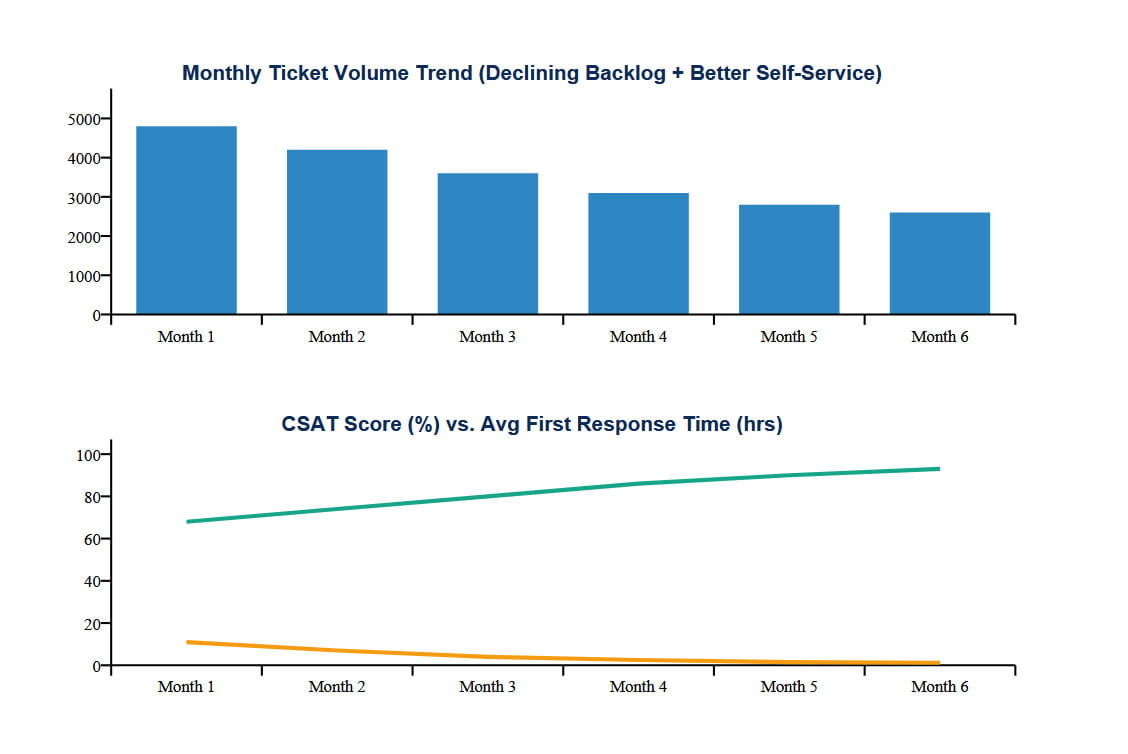
| First Response Time | Reduced from 11 hours to under 90 minutes within the first 60 days of steady-state operations. |
| CSAT Score | Climbed from 68% to 93% over 6 months, with reader satisfaction driving a 4.4-star average on app store reviews (up from 3.1). |
| Ticket Backlog | 1,400+ ticket backlog cleared within 30 days of engagement start; maintained <200 open tickets thereafter. |
| Engineering Rescue | Product engineering reclaimed 12+ hours per week previously spent on support escalations, directly accelerating feature delivery. |
| Author Onboarding | New author activation rate improved by 38% as guided onboarding support reduced setup abandonment. |
| Cost Efficiency | Total annual support cost 62% lower than the equivalent in-house team build-out the client had originally budgeted. |
| Churn Reduction | Platform-attributed churn (support-related cancellations) declined 21% year-over-year. |
“We had convinced ourselves that nobody outside our team could learn our platform deeply enough to support our authors. We were completely wrong. Within three weeks they were handling manuscript upload issues we thought required an engineer.”
— VP of Product, US ePublishing Platform
Key Learnings & Best Practices
- Deep product certification (40+ hours per agent) is non-negotiable for publishing platforms — generic helpdesk scripts fail with authors who expect expert guidance.
- Proactive knowledge base development during the first 30 days creates compounding self-service deflection, reducing ticket volume organically over time.
- Screen-sharing capability is a decisive differentiator for author support — complex formatting and upload issues cannot be resolved via text chat alone.
- Backlog rescue must be treated as a dedicated sprint, not absorbed into steady-state operations. Surge staffing in the first month sets the foundation for sustainable SLA performance.
- Weekly reporting on ticket category trends delivered actionable product insights — the client’s development team used the data to reprioritize two high-impact bug fixes.