




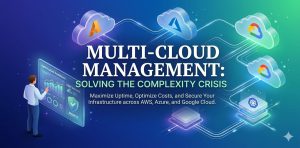
Multi-cloud management is the architectural practice of overseeing and optimizing IT resources across multiple public cloud providers, such as AWS, Azure, and Google Cloud, to prevent vendor lock-in and enhance system resilience. This approach matters because it allows businesses to distribute workloads based on specific feature strengths and geographic availability, effectively solving the “complexity crisis” where fragmented visibility leads to spiraling costs and security vulnerabilities. By implementing a unified management layer, organizations can achieve a seamless operational flow, ensuring that diverse cloud assets function as a single, cohesive infrastructure.
What is Multi-Cloud Management?
In the current landscape of 2026, multi-cloud management has evolved from a luxury to a baseline requirement for enterprise stability. Multi-cloud management is the strategic orchestration of services from different vendors within one architecture. It differs from hybrid cloud, which mixes on-premises private hardware with public services. Instead, a multi-cloud strategy leverages the unique strengths of multiple public platforms. For example, you might run high-performance computing on one provider. Simultaneously, you could use another for its superior AI and machine learning tools.
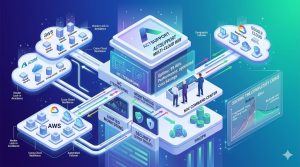
The goal of this management style is to provide a “single pane of glass” view into the entire digital estate. Without this centralized oversight, engineers are forced to toggle between different consoles, each with its own proprietary logic, API structures, and billing cycles. Effective management abstracts these differences, allowing teams to deploy applications, monitor health, and enforce security policies consistently across the entire environment. This abstraction is what enables DevOps infrastructure management to scale without being bogged down by provider-specific nuances.
Why the Complexity Crisis Happens: Root Causes
The “Complexity Crisis” in cloud computing is rarely the result of a single bad decision; rather, it is the natural byproduct of rapid organic growth and technical debt. As companies move away from monolithic architectures, different departments often procure cloud services independently to meet immediate project goals. This “Shadow IT” results in a fragmented ecosystem where security teams have no visibility into shadow buckets, and finance teams cannot accurately predict monthly expenditures.
From a technical perspective, the crisis is fueled by the lack of interoperability between cloud providers. AWS CloudWatch metrics do not natively talk to Azure Monitor, and a load balancer configuration that works in one environment may fail in another due to different ingress controller logic. This fragmentation creates “operational silos” where engineers become specialists in one platform but are blind to issues occurring in another. When a latency spike occurs, the lack of cross-platform telemetry makes it nearly impossible to pinpoint whether the root cause is a provider outage, a regional network bottleneck, or a code-level memory leak.
How Engineers Solve Multi-Cloud Complexity
Senior infrastructure engineers solve the complexity crisis by shifting away from manual console management and toward “Infrastructure as Code” (IaC) and unified abstraction layers. By using vendor-neutral tools like Terraform or Pulumi, engineers can define their entire multi-cloud environment in version-controlled configuration files. This ensures that a database cluster deployed in Frankfurt on AWS is architecturally identical to one deployed in Singapore on Google Cloud, reducing the “snowflake server” problem where individual instances have unique, undocumented configurations.
The step-by-step resolution usually begins with establishing a centralized identity and access management (IAM) framework. By linking all cloud providers to a single “Source of Truth,” such as Okta or Azure AD, engineers ensure that a single security policy follows a user across all platforms. Next, teams implement a “Global Load Balancing” strategy that can shift traffic between providers in real-time if one goes offline. This level of managed cloud support transforms the cloud from a collection of isolated servers into a resilient, self-healing network.
Real-World Production Scenarios and Challenges
In a production environment, multi-cloud management is put to the test during “Grey Failures” scenarios where a provider isn’t fully down, but performance has degraded to the point of being unusable. For example, a senior engineer might observe a sudden increase in 5xx errors on a web tier. While the instances appear “Healthy” in the local console, cross-cloud monitoring reveals that the latency between the AWS-hosted frontend and the Azure-hosted database has jumped from 10ms to 500ms due to an undersea cable issue.
In this scenario, the engineer’s debugging mindset is critical. They don’t just look at CPU spikes; they investigate the “Four Golden Signals”: latency, traffic, errors, and saturation. By analyzing these across providers, they can initiate a “failover” where the frontend is temporarily migrated to the same provider as the database to eliminate cross-cloud latency. This proactive server monitoring and maintenance is what keeps global applications running during regional internet instabilities.
Tools, Monitoring Systems, and Engineering Approaches
To maintain a multi-cloud estate, engineers rely on a sophisticated stack of monitoring and observability tools. While provider-specific tools like CloudWatch are useful for deep-dives, a multi-cloud strategy requires an external “Observability Hub.” Tools like Prometheus for metrics collection and Grafana for visualization are industry standards because they can ingest data from any source via exporters. This allows an engineer to see a side-by-side comparison of resource utilization across AWS, Azure, and private Linux nodes.
For deeper health checks, engineers deploy Zabbix or Nagios to monitor specific service states, such as whether a custom Python daemon is running or if a specific port is listening. In 2026, these tools are often integrated with AI-driven anomaly detection. Instead of setting static thresholds (e.g., “Alert if CPU > 80%”), these systems learn the baseline behavior of the application. If the CPU hits 70% at 3:00 AM—a time when traffic is usually zero the system triggers an alert for a potential security breach or a runaway background process, even if it hasn’t hit the traditional “Critical” threshold.
Performance, Security, and Cost Impact
The impact of multi-cloud management on a business’s bottom line is profound. Without proper management, “Cloud Sprawl” leads to massive waste as orphaned volumes and over-provisioned instances continue to bill the company long after their project has ended. Expert outsourced hosting support solves this by implementing “automated tagging” and “lifecycle policies” that identify and terminate idle resources across all platforms simultaneously.
Security is the other side of the coin. In a multi-cloud environment, the “Attack Surface” is significantly larger. Each provider has different default security groups and firewall rules. A unified management strategy enforces a “Security-as-Code” model where firewall rules are pushed from a central repository. This ensures that if a vulnerability is discovered, a single patch can be propagated across the entire global infrastructure in minutes, rather than requiring an engineer to manually log into ten different consoles.
Best Practices Used by Real Infrastructure Teams
Top-tier infrastructure teams follow the principle of “Cloud Agnosticism” wherever possible. This means avoiding proprietary “locked-in” services in favor of open-source equivalents that can run anywhere. For instance, instead of using a provider-specific message queue, an engineer might deploy RabbitMQ or Apache Kafka. This makes the “exit strategy” from a cloud provider much simpler and gives the business more leverage during contract negotiations.
Another best practice is the implementation of 24/7 NOC services (Network Operations Center). Even with the best automation, human oversight is required to handle “Edge Cases” that AI cannot yet resolve. A dedicated NOC team provides continuous surveillance, handling initial triage for Linux server management services and ensuring that incident response starts the moment a metric drifts from the norm. This combination of automated “Self-Healing” and human expertise is the hallmark of a mature cloud operation.
Multi-Cloud vs. Hybrid Cloud: Comparison Insights
It is important to distinguish between multi-cloud and hybrid cloud management, as the engineering requirements differ. A hybrid cloud involves maintaining a bridge between a local data center and a public cloud. This often requires complex networking, such as AWS Direct Connect or Azure ExpressRoute, to maintain high-speed, private links. The primary challenge here is “Latency” and “Hardware Lifecycle Management.”
In contrast, multi-cloud management is purely virtual. The challenge is “Context Switching” and “Data Gravity.” Since both environments are public, the data transfer costs (egress fees) between providers can be high. Engineers solve this by placing “Data-Heavy” workloads in a central hub and using “Lightweight” edge services to interact with users. Understanding these nuances is key to selecting the right cloud infrastructure management services for your specific business model.
Case Study: Solving the 99.9% Uptime Challenge
A global SaaS provider recently faced a crisis when their primary cloud provider suffered a 12-hour regional outage. Because their entire infrastructure was “Single Cloud,” their service went dark for millions of users. We transitioned them to a managed multi-cloud architecture, distributing their application across AWS and Google Cloud.
We implemented a “Warm Standby” model where a minimal version of the app runs on the secondary cloud at all times. Using an Intelligent DNS service, we configured the system to automatically detect a failure in the primary cloud and reroute all global traffic to the secondary provider within 60 seconds. In the six months since this migration, they have maintained 100% availability, and their page load speeds improved by 15% because we began serving users from the cloud data center geographically closest to them.
Quick Summary:
Multi-cloud management is the process of using tools and strategies to control IT resources across multiple cloud providers (like AWS and Azure) from a single interface. It solves the Complexity Crisis by providing unified visibility, which prevents security gaps and uncontrolled costs. Key engineering solutions include Infrastructure as Code (IaC) for consistent deployments, Prometheus/Grafana for cross-platform monitoring, and 24/7 NOC services for continuous uptime. This approach is essential in 2026 for businesses seeking to avoid vendor lock-in and maximize system resilience.
Struggling with Traffic Spikes and Downtime?
Partner with our experts for reliable cloud auto-scaling, proactive monitoring, and high-availability infrastructure solutions.
Conclusion: The Future of Cloud Freedom
The complexity crisis is not a permanent state. It is a hurdle that can be cleared with the right engineering approach. By moving away from proprietary silos, businesses can embrace a unified, automated infrastructure model. This shift finally delivers the true promise of the cloud: infinite scalability without the administrative nightmare. As we move deeper into 2026, the ability to manage diverse cloud assets effectively will be the primary factor for success. It will determine which companies lead their industries and which ones are left behind by technical debt.