




Why Modern Infrastructure Requires Predictive Server Monitoring
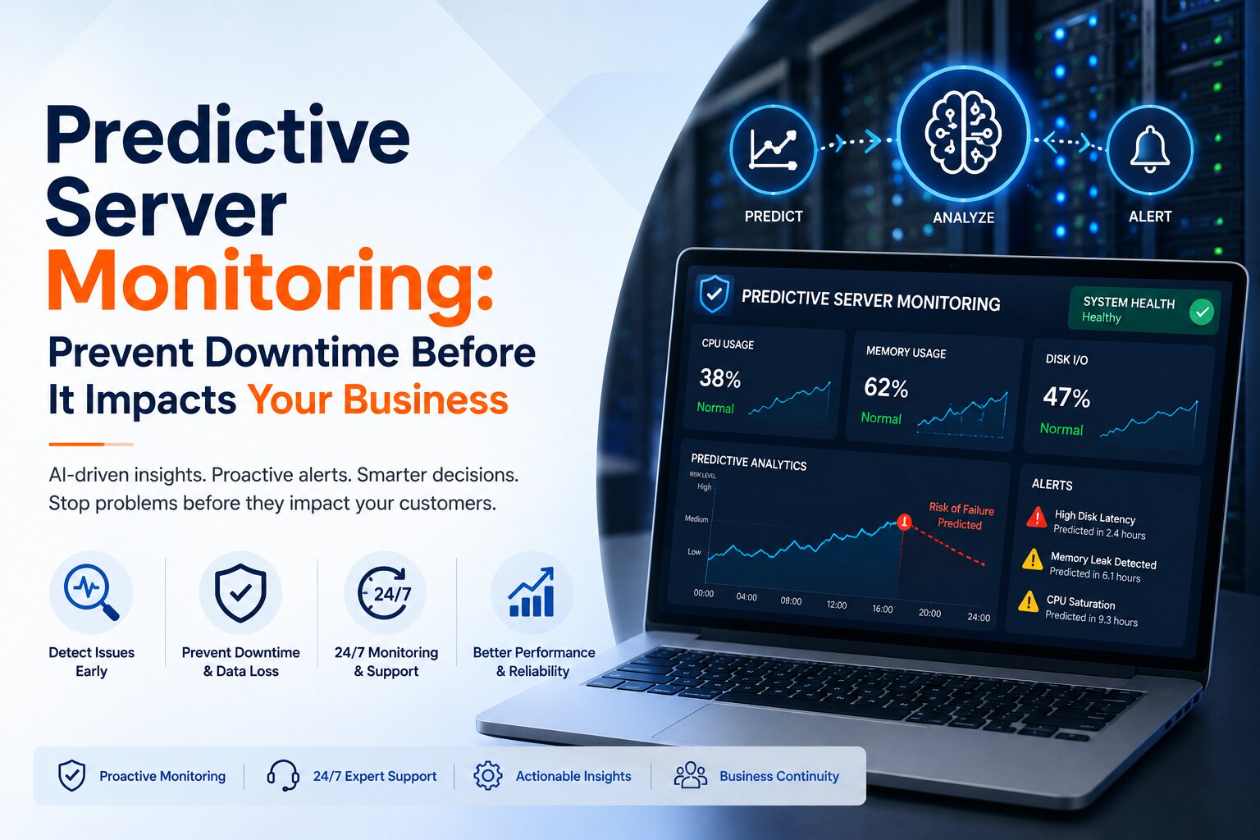
Modern businesses rely on servers to deliver websites, applications, databases,
cloud services, and customer-facing platforms around the clock. Even a few minutes
of unexpected downtime can interrupt operations, reduce customer confidence,
affect revenue, and create unnecessary pressure on IT teams.
Traditional server monitoring identifies issues only after predefined thresholds
are exceeded or services become unavailable. While this approach is useful,
it often provides limited time to respond before users experience service degradation.
Predictive server monitoring takes a different approach. Instead of waiting for
failures to occur, it continuously analyzes system behavior, identifies unusual
patterns, and highlights potential infrastructure issues before they become
service-impacting incidents.
For organizations managing Linux servers, Windows servers, cloud environments,
virtualization platforms, or hosting infrastructure, predictive monitoring enables
IT teams to shift from reactive troubleshooting to proactive infrastructure management.
At ACTSupport, proactive monitoring is an important part of maintaining stable
hosting environments, enterprise infrastructure, and business-critical services.
By combining continuous monitoring, performance analysis, and operational expertise,
potential issues can often be identified earlier, reducing operational risk and
helping maintain service availability.
What Is Predictive Server Monitoring?
Predictive server monitoring is an advanced monitoring methodology that evaluates
historical performance trends, real-time infrastructure metrics, and behavioral
patterns to identify indicators of future failures.
Rather than generating alerts only when CPU usage reaches 100% or disk space is
exhausted, predictive monitoring continuously evaluates:
- CPU utilization trends
- Memory consumption patterns
- Storage performance
- Disk health indicators
- Network latency
- Application response times
- Database performance
- Process stability
- System logs
- Hardware health metrics
Instead of reacting to isolated alerts, monitoring platforms correlate multiple
metrics to identify unusual behavior.
Example of Early Warning Indicators
A Linux server may continue operating normally while gradually experiencing:
- Increasing disk latency
- Rising I/O wait
- Growing inode usage
- Frequent PHP-FPM restarts
- Increasing MySQL query execution time
Individually, none of these metrics may exceed traditional alert thresholds.
Together, however, they often indicate an infrastructure problem that deserves
investigation before customers notice degraded performance.
Best Practices for Implementing Predictive Server Monitoring
Organizations looking to maximize the benefits of predictive monitoring should follow
several practical best practices. A structured monitoring strategy helps improve
visibility, reduce alert fatigue, and ensure infrastructure teams can proactively
address potential issues before they impact business operations.
Monitor Infrastructure Holistically
Rather than monitoring servers individually, organizations should collect and analyze
performance metrics across the entire technology stack, including:
- Physical servers
- Virtual machines
- Cloud instances
- Containers
- Databases
- Web servers
- Network devices
- Storage systems
Infrastructure components rarely fail in isolation. Correlating metrics across
multiple systems provides a more complete view of overall infrastructure health
and helps identify dependencies that may contribute to service disruptions.
Establish Meaningful Performance Baselines
Every infrastructure environment has unique performance characteristics and usage
patterns. Predictive monitoring platforms should establish normal operating
baselines before generating anomaly-based alerts.
For example:
- Backup servers often experience predictable overnight activity.
- Database servers may show consistent morning resource spikes.
- Web servers frequently experience seasonal or campaign-driven traffic fluctuations.
Understanding normal behavior helps monitoring systems distinguish between expected
activity and genuine infrastructure risks.
Review Long-Term Performance Trends
While real-time alerts provide operational visibility, long-term analytics support
strategic infrastructure planning and resource optimization.
Organizations should regularly review:
- Capacity growth trends
- Application performance metrics
- Storage utilization patterns
- Database health indicators
- Overall resource efficiency
These insights enable proactive planning for infrastructure expansion and help
organizations avoid unexpected performance bottlenecks or resource shortages.
Combine Automation with Human Expertise
Automation significantly improves monitoring efficiency, but experienced engineers
remain essential for accurate analysis, root cause identification, and corrective action.
The most effective infrastructure management strategies combine intelligent monitoring
technologies with skilled technical professionals who can interpret alerts, prioritize
risks, and recommend practical solutions.
How ACTSupport Helps Businesses Maintain Reliable Infrastructure
ACTSupport provides managed server support and infrastructure management services
for organizations operating Linux, Windows, cloud, and virtualization environments.
Our technical teams continuously monitor infrastructure health, investigate
performance anomalies, analyze system behavior, and help businesses maintain
stable and secure hosting environments.
Our managed support services include:
- 24×7 infrastructure monitoring
- Linux and Windows server management
- Performance analysis
- Database optimization
- Security monitoring
- Server hardening
- Backup monitoring
- Incident response
- Root cause analysis
- Preventive maintenance
Rather than responding only after outages occur, our proactive approach focuses
on identifying infrastructure risks early, minimizing operational disruptions,
and helping organizations maintain reliable, high-performing environments.
Conclusion
Modern IT environments generate enormous volumes of operational data every second.
Organizations that rely solely on reactive monitoring frequently discover
infrastructure problems only after users begin experiencing performance degradation
or service interruptions.
Predictive server monitoring transforms infrastructure management from reactive
troubleshooting to proactive prevention by continuously analyzing system behavior,
identifying unusual trends, and providing early warning signs of potential failures.
For hosting providers, SaaS companies, enterprises, and managed service providers,
predictive monitoring improves service reliability, optimizes infrastructure
performance, strengthens capacity planning, and reduces the risk of unexpected downtime.
When combined with experienced technical expertise and continuous infrastructure
management, predictive monitoring becomes a critical component of building resilient,
secure, and business-critical IT environments that support long-term operational success.
Need Proactive Server Monitoring?
Reduce downtime and catch infrastructure risks before they impact your customers. ACTSupport delivers 24×7 managed server monitoring and technical support to keep your IT environment reliable, secure, and high-performing.
Frequently Asked Questions
What is predictive server monitoring?
Predictive server monitoring analyzes historical trends and real-time infrastructure metrics to identify potential failures before they impact applications or users.
How is predictive monitoring different from traditional monitoring?
Traditional monitoring alerts administrators after predefined thresholds are exceeded. Predictive monitoring identifies unusual behavior earlier, allowing proactive investigation before outages occur.
Which metrics are most important for predictive monitoring?
Important metrics include CPU utilization, memory usage, disk latency, storage health, network performance, database response time, application availability, and system logs.
Can predictive monitoring reduce server downtime?
Yes. While no monitoring solution can eliminate every failure, early detection significantly improves an organization’s ability to resolve issues before they become service-impacting incidents.
Is predictive monitoring suitable for cloud environments?
Yes. Predictive monitoring is widely used for public cloud, private cloud, hybrid cloud, virtual machines, and containerized infrastructure.
Which businesses benefit most from predictive monitoring?
Hosting providers, managed service providers, SaaS companies, financial institutions, healthcare organizations, eCommerce businesses, and enterprises operating critical applications benefit from predictive monitoring.
Does predictive monitoring replace system administrators?
No. Predictive monitoring provides intelligent insights and early warnings, but experienced engineers remain essential for diagnosing issues, implementing fixes, and optimizing infrastructure.
How can ACTSupport help with predictive server monitoring?
ACTSupport provides 24×7 server monitoring, infrastructure management, performance optimization, preventive maintenance, and technical support for Linux, Windows, cloud, and enterprise environments.