




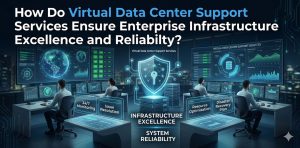
Introduction to Virtual Data Center Support
Virtual Data Center Support refers to the end-to-end management of virtualized IT environments that include compute, storage, and network resources. Modern enterprises rely heavily on virtual infrastructure management to achieve scalability, efficiency, and resilience. These environments are powered by technologies such as VMware, Hyper-V, KVM, and Proxmox. A structured Virtual Data Center Support model ensures continuous optimization, monitoring, and security of mission-critical workloads.
Importance of Virtualized Infrastructure in Modern Enterprises
Virtualization has become a foundation for modern IT operations. Businesses use cloud infrastructure management and virtual data centers to reduce hardware dependency and improve resource utilization. This approach enables faster deployment of applications, improved disaster recovery, and better workload distribution across environments. Enterprises also achieve reduced operational costs while maintaining high availability and performance.
Core Virtual Data Center Support Services
Virtual Data Center Support includes a wide range of services designed to manage enterprise-grade infrastructure environments efficiently. These services ensure stability, scalability, and continuous performance optimization across virtual platforms.
Virtualization Planning and Architecture Design
Virtualization planning involves selecting the right hypervisor such as VMware ESXi, KVM, Hyper-V, Citrix Xen, or Proxmox. It includes capacity planning, cluster design, and high availability architecture. Proper planning ensures optimized workload distribution and prevents resource bottlenecks in enterprise environments.
Virtual Machine Operations and Migration
Virtual machine management includes lifecycle operations such as provisioning, monitoring, and migration. Services include P2V (Physical to Virtual) and V2V (Virtual to Virtual) migration with minimal downtime. Live and hot migration techniques ensure business continuity during infrastructure transitions.
Hypervisor Deployment and Management
Hypervisor management involves deploying and maintaining virtualization platforms like VMware vSphere, Microsoft Hyper-V, KVM clusters, and Proxmox VE. It includes VM templates, resource allocation, network configuration, and storage integration for optimized performance and scalability.
Data Center Infrastructure Optimization
Data center optimization focuses on improving server utilization and reducing operational costs through server consolidation and resource balancing. It includes SAN integration, VLAN configuration, NIC teaming, and performance tuning to ensure SLA compliance and operational efficiency.
Business Continuity and Disaster Recovery
A strong disaster recovery strategy ensures uninterrupted operations during failures. Virtual Data Center Support includes failover mechanisms, backup orchestration, replication strategies, and high availability configurations. These measures reduce downtime and protect critical workloads.
Is Your Virtual Infrastructure Fully Optimized for Performance and Uptime?
Modern virtual environments require continuous monitoring, proactive optimization, and strong disaster recovery planning to maintain stability. With proper virtual data center management, organizations can improve scalability, reduce downtime, enhance security, and optimize resource utilization across VMware, Hyper-V, KVM, and Proxmox environments. Ensure your infrastructure is always ready to support business growth and high availability requirements.
Benefits of Virtual Data Center Support Services
Virtual Data Center Support provides enterprises with improved scalability, reduced infrastructure costs, and enhanced operational reliability. Businesses benefit from flexible resource allocation, improved uptime, and faster disaster recovery capabilities.
Cost Efficiency and Resource Optimization
Through virtualization and consolidation, enterprises significantly reduce both CAPEX and OPEX. Efficient resource allocation ensures maximum utilization of existing infrastructure while minimizing hardware dependency.
Scalability and Infrastructure Flexibility
Virtual environments allow organizations to scale compute, storage, and network resources dynamically. This flexibility supports growing workloads and evolving business demands without infrastructure redesign.
High Availability and Reliability
High availability configurations ensure continuous uptime for mission-critical systems. Load balancing, failover clusters, and redundancy mechanisms reduce the risk of downtime and service disruption.
Supported Virtualization Technologies
Modern Virtual Data Center Support services cover multiple enterprise-grade platforms including VMware ESXi, Microsoft Hyper-V, KVM-based environments, Citrix XenServer/XCP-ng, and Proxmox VE. These platforms provide flexible virtualization capabilities for different infrastructure requirements.
Virtual Data Center Support Process Lifecycle
The support lifecycle begins with infrastructure assessment and planning, followed by design, deployment, migration, monitoring, and ongoing support. Each phase ensures optimal performance, scalability, and reliability of the virtual infrastructure environment.
Why Virtual Data Center Support is Essential in 2026
As enterprises adopt hybrid cloud and multi-cloud strategies, the complexity of infrastructure management increases. Virtual Data Center Support ensures centralized control, enhanced security, and operational efficiency across distributed environments. It enables businesses to maintain uptime, reduce risks, and improve overall IT agility.
FAQ:
What is Virtual Data Center Support?
Virtual Data Center Support involves managing and optimizing virtualized infrastructure environments, including servers, storage, and networking, to ensure performance, security, and high availability.
Which virtualization platforms are supported?
It supports VMware, Microsoft Hyper-V, KVM, Proxmox VE, and Citrix XenServer/XCP-ng for flexible infrastructure management.
Does Virtual Data Center Support include 24/7 monitoring?
Yes, it includes 24/7 monitoring, alerting, incident response, and performance optimization for continuous uptime.
Can VM migration be handled with minimal downtime?
Yes, P2V and V2V migrations are performed using live migration techniques to minimize downtime and ensure seamless transitions.
How fast can Virtual Data Center Support be activated?
Support can typically be activated within 24–48 hours depending on infrastructure complexity and requirements.