




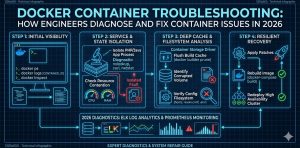
What is Docker Container Troubleshooting and How Engineers Resolve It in Production
Docker container troubleshooting is the process of identifying, analyzing, and resolving issues that prevent containers from running efficiently within a production environment. In real-world infrastructure, engineers approach troubleshooting as a layered investigation rather than a surface-level fix. A container failure rarely exists in isolation; it is often the result of misconfigured images, missing dependencies, resource exhaustion, or underlying host-level issues. Engineers begin by understanding the container lifecycle, from image build to runtime execution, and systematically validate each layer to ensure that the application, container runtime, and infrastructure are aligned. This structured approach allows engineers to resolve issues permanently instead of applying temporary fixes that fail under production load.
Why Docker Container Failures Are Increasing in Modern Cloud Infrastructure
In 2026, containerized environments operate across distributed and highly dynamic infrastructures, which significantly increases the complexity of troubleshooting. Docker container failures commonly occur due to misaligned configurations between development and production environments, where containers behave differently under real workloads. Engineers frequently encounter issues related to missing environment variables, incorrect entrypoint definitions, and incompatible library dependencies within container images. Resource constraints such as limited CPU shares or memory allocation also play a critical role, especially in multi-tenant environments where multiple containers compete for system resources. Networking complexities, including bridge misconfigurations and service discovery failures, further contribute to instability. Engineers recognize that these issues are interconnected and require a holistic troubleshooting approach rather than isolated fixes.
How Engineers Diagnose Docker Container Failures Using Logs and Runtime Analysis
When troubleshooting Docker container issues, engineers rely heavily on log analysis and runtime inspection to identify the root cause. Instead of guessing, they analyze container logs to understand application-level errors, dependency failures, or unexpected terminations. They also inspect the container state to determine whether it exited immediately, entered a restart loop, or failed to initialize. By correlating log data with system-level metrics such as CPU and memory usage, engineers can determine whether the issue originates within the container or from the host system. This data-driven approach enables precise troubleshooting and eliminates unnecessary configuration changes.
Step-by-Step Docker Container Troubleshooting Approach Used by Engineers
Engineers follow a disciplined troubleshooting workflow to resolve Docker container problems effectively. They start by verifying the container status and identifying whether the container is running, stopped, or restarting. They then analyze logs to detect runtime errors or misconfigurations. If the container fails during startup, engineers inspect the image build process and validate that all dependencies are included. They also review environment variables and mounted volumes to ensure that the container has access to required resources. Networking is then tested to confirm that services are reachable and properly exposed. Finally, engineers evaluate resource usage to identify bottlenecks that may affect performance or stability. This structured approach ensures that every potential failure point is examined thoroughly.
Common Docker Container Issues and Their Root Causes in Production
In production environments, Docker container issues often manifest as application crashes, restart loops, or connectivity failures. Containers that exit immediately typically indicate incorrect startup commands or missing dependencies within the image. Restart loops are commonly caused by failing health checks or insufficient system resources. Networking issues arise when containers cannot communicate due to incorrect network configurations or blocked ports. Volume-related errors occur when file permissions or mount paths are misconfigured. Engineers resolve these issues by analyzing logs, validating configurations, and aligning container settings with application requirements.
Advanced Troubleshooting Using Docker Inspect and Configuration Analysis
For deeper troubleshooting, engineers utilize advanced tools such as container inspection and configuration analysis. By examining container metadata, they gain insight into environment variables, network settings, and resource allocations. This allows them to identify inconsistencies between expected and actual configurations. Engineers also analyze container dependencies and runtime behavior to detect subtle issues that may not appear in logs. This level of inspection is critical for resolving complex problems in high-availability environments.
Real-World Scenario: Diagnosing a Container Crash in a Production Environment
In a real-world production scenario, a container crash can disrupt critical services and impact business operations. Engineers respond by quickly analyzing logs to identify the failure point, whether it is due to missing dependencies, incorrect configurations, or resource limitations. They then apply targeted fixes, such as updating environment variables, rebuilding images, or adjusting resource limits. After implementing the fix, they monitor the container to ensure stability and prevent recurrence. This proactive and structured response minimizes downtime and ensures service continuity.
Impact of Docker Container Issues on Performance, Stability, and SEO
Docker container issues have a direct impact on application performance and user experience. Unstable containers increase response times and reduce system reliability, which can negatively affect key performance metrics such as Time to First Byte (TTFB). For web applications, this directly influences SEO rankings, as search engines prioritize fast and reliable websites. Frequent container failures can also lead to downtime, which further impacts search visibility and user trust. Engineers therefore prioritize container stability as a critical component of both performance optimization and SEO strategy.
Best Practices Followed by Infrastructure Engineers for Container Stability
Experienced infrastructure engineers implement best practices to maintain stable and secure container environments. They use optimized and minimal base images to reduce attack surface and improve performance. They define proper resource limits to prevent containers from consuming excessive system resources. Continuous monitoring allows engineers to detect anomalies early and respond before issues escalate. They also automate deployments to ensure consistency across environments and reduce configuration errors. By following these practices, engineers create reliable and scalable container infrastructures.
Monitoring Docker Containers Using Prometheus, Grafana, and Advanced Tools
Monitoring plays a crucial role in maintaining container health and performance. Engineers use tools such as Prometheus to collect metrics, Grafana to visualize system behavior, and other monitoring solutions to track container performance. These tools provide visibility into CPU usage, memory consumption, and network activity, enabling engineers to identify performance bottlenecks and potential failures. By integrating monitoring with alerting systems, engineers ensure that issues are detected and resolved proactively.
Struggling with Traffic Spikes and Downtime?
Partner with our experts for reliable cloud auto-scaling, proactive monitoring, and high-availability infrastructure solutions.
Final Thoughts: Building Resilient Docker Infrastructure in 2026
Docker container troubleshooting requires a deep understanding of container architecture, system dependencies, and infrastructure behavior. Engineers combine structured diagnostics, advanced monitoring, and best practices to build resilient container environments. By proactively identifying issues and optimizing configurations, organizations can ensure high availability, improved performance, and strong SEO outcomes. In 2026, mastering Docker troubleshooting is essential for maintaining modern cloud-native applications and delivering reliable services at scale.