




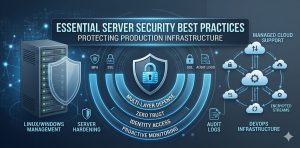
Server security best practices involve implementing a multi-layered defense strategy including regular patching, robust identity management, network micro-segmentation, and continuous monitoring. These measures protect critical data from unauthorized access while ensuring system availability across Linux and Windows environments. By adopting a “Zero Trust” approach, infrastructure architects can mitigate modern cyber threats and maintain a resilient production environment.
Introduction: The Foundation of Modern Infrastructure Security
Server security is no longer a peripheral concern; it is the core of modern infrastructure reliability. As environments scale across hybrid and multi-cloud platforms, the attack surface expands exponentially. A single misconfiguration or an unpatched vulnerability can lead to catastrophic data breaches or prolonged system downtime.
For senior architects, securing a server means more than just installing a firewall. It requires a holistic understanding of how hardware, operating systems, and applications interact. Effective security measures ensure that your DevOps infrastructure remains compliant and trustworthy. Implementing these practices correctly reduces operational risk and protects the organization’s most valuable digital assets.
The Problem: Why Production Servers Fail Under Attack
Most production security failures stem from “Configuration Drift” and the “Human Element.” In fast-paced deployment cycles, security often takes a backseat to speed. This leads to servers running with default credentials, open management ports (like RDP or SSH) exposed to the public internet, and outdated software packages.
Attackers identify these weaknesses through automated scanning. Once they find an entry point—often a known vulnerability in an unpatched service they exploit it to gain a foothold. From there, they move laterally across the network. This happens because many internal environments lack internal barriers, operating under a “Crunchy Outside, Soft Inside” model that is no longer viable for server hardening.
Step-by-Step Resolution: Hardening the Production Environment
Securing a server requires a logical, sequential approach to eliminate low-hanging fruit and build sophisticated defenses.
1. Establishing a Secure Access Baseline
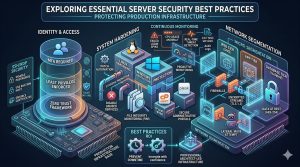
The first step involves securing the management plane. We must eliminate password-based authentication for SSH on Linux and enforce Multi-Factor Authentication (MFA) for all administrative sessions on Windows. Implementing a “Bastion Host” or “Jump Server” architecture ensures that direct access to production nodes remains impossible from the public web.
2. Reducing the Attack Surface
Every active service is a potential entry point. We conduct a thorough audit of running processes and network listeners. By disabling non-essential services and closing unnecessary ports, we drastically reduce the surface area an attacker can target. This is a fundamental aspect of Linux/Windows server management.
3. Implementing Automated Patch Management
Vulnerabilities are discovered daily. A manual patching process cannot keep pace with the threat landscape. Architects must implement automated patch pipelines that test updates in a staging environment before promoting them to production. This ensures that the environment remains protected against “Zero Day” exploits without disrupting service availability.
4. Network Micro-segmentation
We no longer rely on a single perimeter firewall. By implementing micro-segmentation, we create isolated zones for different application tiers (e.g., Web, App, and Database). Even if the web tier is compromised, the attacker cannot easily reach the database tier, significantly limiting the “Blast Radius” of any security incident.
Comparison Insight: Managed Cloud Security vs. On-Premise Control
Architects must decide where the “Shared Responsibility” boundary lies based on their organizational needs.
-
Managed Cloud Security (AWS/Azure/GCP): Cloud providers offer high-level abstractions like Security Groups and managed IAM. This is ideal for managed cloud support as it offloads the physical and hypervisor security to the provider. However, users often struggle with complex identity permissions and unexpected egress costs.
-
On-Premise/Self-Managed Control: This offers total data sovereignty and granular control over the entire stack. It is the preferred route for highly regulated industries. The downside is the massive operational overhead required for hardware maintenance and physical security audits.
-
Hybrid Strategy: Most mature organizations use a hybrid approach, keeping sensitive data in controlled private environments while using the public cloud for scalable web-facing workloads.
Real-World Case Study: Deflecting a Brute-Force Campaign
A mid-sized enterprise experienced a sustained brute-force attack targeting their administrative portals. Their legacy server management strategy relied on complex passwords, but the attackers were using a massive distributed botnet.
The Diagnosis: Security analysts noticed a surge in failed login attempts and high CPU usage on the authentication servers. The logs indicated that the attempts were originating from thousands of different IP addresses, making simple IP blocking ineffective.
The Resolution: The team shifted to a Zero Trust architecture. They implemented certificate-based authentication and moved the management interface behind a VPN with mandatory MFA. Within minutes of the switch, the attack became irrelevant. The unauthorized attempts dropped to zero because the management ports were no longer visible to the botnet.
Best Practices: Proactive Maintenance and Hardening
To maintain a high-security posture, follow these professional standards for server hardening:
Enforce the Principle of Least Privilege (PoLP)
Users and applications should only have the minimum permissions necessary to perform their tasks. Never run applications as the “Root” or “Administrator” user. If a process is compromised, PoLP prevents the attacker from taking over the entire system.
Encrypt Everything
Encryption is the final line of defense. Ensure that all data at rest is encrypted using AES-256 and all data in transit uses TLS 1.3. This ensures that even if a physical disk is stolen or network traffic is intercepted, the data remains unreadable.
Utilize Proactive Monitoring
Security is not a one-time setup. It requires proactive monitoring to detect anomalies. Use File Integrity Monitoring (FIM) to alert you if critical system files are modified. This is often the first sign of a sophisticated intrusion.
Leverage White Label Technical Support
For many businesses, keeping a full-time security team is cost-prohibitive. Utilizing white label technical support or 24/7 NOC services allows you to leverage expert eyes on your infrastructure around the clock, ensuring that threats are mitigated the moment they appear.
FAQ: Common Server Security Questions
Is a firewall enough to protect my server?
No. A firewall is just one layer. Modern threats often bypass firewalls through legitimate ports (like 80/443). You need deep packet inspection, host-based intrusion detection, and strong identity management.
How often should I audit my server security?
We recommend a full security audit at least quarterly. However, automated vulnerability scanning should occur weekly or even daily in dynamic DevOps infrastructure.
What is the “Zero Trust” model?
Zero Trust is a security framework based on the realization that “trust” is a vulnerability. It assumes that threats exist both inside and outside the network. Every access request must be authenticated, authorized, and continuously validated.
Does server hardening affect performance?
When done correctly, hardening can actually improve performance by removing unnecessary background processes and “bloatware” that consume CPU and RAM.
Should I use a VPN for server management?
Yes. You should never expose management interfaces like SSH, RDP, or cPanel/WHM directly to the internet. A VPN or an encrypted tunnel provides an essential layer of isolation.
Struggling with Traffic Spikes and Downtime?
Partner with our experts for reliable cloud auto-scaling, proactive monitoring, and high-availability infrastructure solutions.
Conclusion: The ROI of a Secure Infrastructure
Server security is a continuous engineering discipline that requires vigilance and expertise. By moving away from reactive “patching” to a proactive server hardening strategy, organizations can scale their digital operations without fear. The investment in robust security protocols pays for itself by preventing the catastrophic costs of data loss, legal penalties, and reputation damage.
A well-secured infrastructure is not just a defensive measure; it is a business enabler. It provides the confidence needed to innovate and the reliability required to sustain a global customer base.