





The Rise of Serverless Cloud Computing for SaaS Platforms
The modern Software-as-a-Service ecosystem is evolving at an extraordinary pace. Organizations launching SaaS platforms must handle unpredictable traffic, rapid feature deployment, and the constant demand for cost efficiency. Traditional server-based architectures often struggle to keep up with these demands. As a result, businesses are increasingly shifting toward serverless cloud computing for SaaS platforms as a scalable and efficient alternative.
Serverless SaaS infrastructure has become a transformative approach for organizations that want to eliminate server management while maintaining performance and reliability. Instead of provisioning and maintaining virtual machines or physical servers, developers can focus entirely on building applications while the cloud provider manages infrastructure operations automatically.
This shift represents a significant milestone in cloud computing evolution. The combination of serverless architecture benefits, automated scaling, and serverless DevOps practices enables SaaS companies to build highly resilient systems that adapt dynamically to changing workloads.
Understanding Serverless in Modern SaaS Platforms
At its core, serverless cloud computing is an architecture model where developers deploy application code without directly managing servers. Cloud providers automatically allocate computing resources when the code runs and scale them based on demand.
This approach differs significantly from traditional infrastructure where system administrators must configure operating systems, maintain servers, and constantly monitor resource usage.
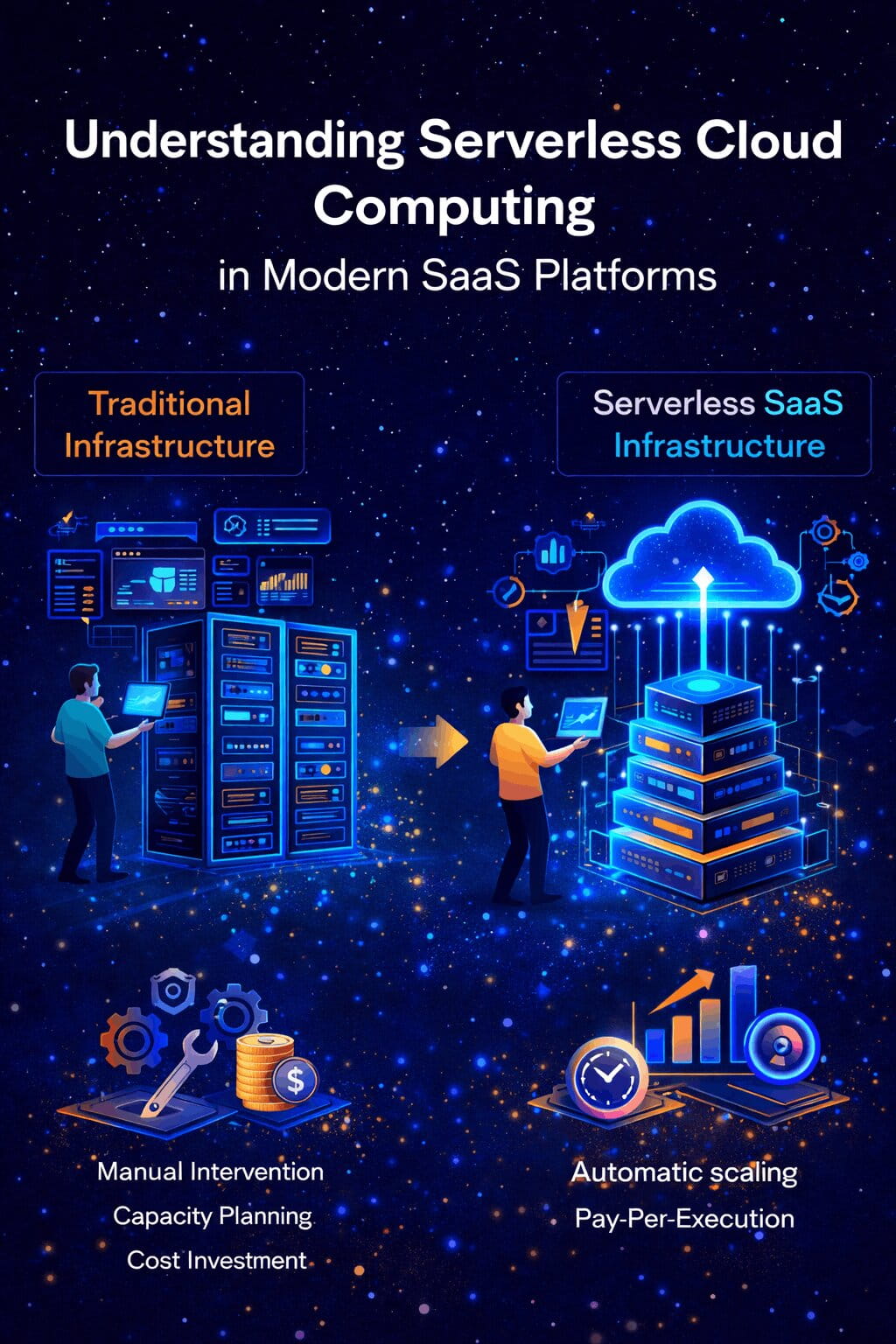
For SaaS companies, this difference is profound. A startup launching a new SaaS product may experience minimal traffic initially, followed by sudden spikes due to marketing campaigns or product adoption. With traditional infrastructure, scaling requires manual intervention, capacity planning, and significant cost investment.
By contrast, serverless SaaS infrastructure automatically scales resources based on incoming requests. This ensures that applications maintain performance without requiring dedicated server management teams.
Why SaaS Companies Are Adopting Serverless Architecture:
The rapid adoption of serverless architecture for SaaS applications is largely driven by its ability to simplify operations while improving scalability and cost efficiency.
One of the most compelling serverless architecture benefits is the elimination of infrastructure management. Development teams no longer need to patch operating systems, manage container orchestration clusters, or perform capacity planning.
Instead, cloud platforms automatically provision compute resources, run the application functions, and scale them according to workload requirements.
Another key advantage is cost optimization. In traditional environments, companies pay for servers even when applications are idle. With serverless cloud computing, organizations only pay for the actual compute time used by their application functions.
This pay-as-you-go model makes serverless SaaS infrastructure particularly attractive for startups and rapidly growing SaaS businesses.
The Role of Serverless DevOps in Application Scaling:
Modern SaaS development relies heavily on automation, continuous integration, and continuous deployment. This is where serverless DevOps practices become essential.
Traditional DevOps pipelines require infrastructure provisioning, environment configuration, and container orchestration management. Serverless environments simplify this process by abstracting infrastructure layers.
With serverless DevOps pipelines, developers can deploy application functions directly through automated CI/CD workflows. These workflows integrate seamlessly with cloud services, enabling faster deployment cycles and improved development productivity.
Another significant advantage of serverless DevOps infrastructure automation is improved system resilience. Since applications run in distributed cloud environments, failures in individual components rarely affect the entire application.
This architecture significantly enhances reliability for SaaS platforms serving global customers.
Serverless Architecture vs Traditional Infrastructure
The contrast between traditional hosting infrastructure and serverless environments illustrates why many organizations are transitioning to this modern architecture.
| Feature | Traditional Infrastructure | Serverless Infrastructure |
| Server Management | Requires manual management | Fully managed by cloud provider |
| Scalability | Manual scaling required | Automatic scaling |
| Cost Model | Pay for running servers | Pay per execution |
| Deployment | Complex configuration | Simple function deployment |
| DevOps Complexity | Higher infrastructure overhead | Simplified serverless DevOps |
This comparison highlights how serverless SaaS infrastructure significantly simplifies application deployment and scaling.
Key Benefits of Serverless SaaS Infrastructure:
The growing popularity of serverless architecture can be attributed to several transformative advantages.
First, automatic scalability ensures that SaaS applications can handle traffic spikes without manual intervention. This is particularly important for SaaS products experiencing unpredictable growth patterns.
Second, reduced operational complexity allows development teams to focus on application innovation rather than infrastructure maintenance.
Third, cost efficiency ensures organizations only pay for compute resources when code is executed.
Fourth, improved deployment speed enables faster product updates and feature releases.
Together, these advantages create an environment where SaaS companies can innovate faster while maintaining operational stability.
Security and Reliability in Serverless Cloud Computing:
Security is a critical concern for any SaaS platform. Fortunately, serverless cloud computing environments often provide strong built-in security controls.
Cloud providers implement automatic patching, identity management integration, and network isolation. These features reduce the attack surface compared to self-managed servers.
Furthermore, serverless SaaS infrastructure distributes workloads across multiple availability zones, ensuring high availability even during infrastructure failures.
For SaaS applications handling sensitive customer data, this reliability is crucial.
Real-World Applications of Serverless SaaS Platforms:
Many modern SaaS products rely on serverless architecture for high-traffic applications.
Common examples include:
SaaS analytics platforms processing millions of events per day.
E-commerce SaaS services handling dynamic order processing.
AI-driven SaaS platforms performing real-time data analysis.
Event-driven SaaS systems responding instantly to customer actions.
In each of these scenarios, serverless cloud computing enables rapid scaling without infrastructure constraints.
Challenges and Considerations in Serverless DevOps:
While serverless architecture benefits are substantial, organizations should also understand potential challenges.
Cold start latency may affect applications with sporadic traffic patterns. Additionally, debugging distributed serverless systems can be more complex than traditional applications.
However, modern observability tools and monitoring platforms are rapidly solving these issues.
By adopting best practices in serverless DevOps monitoring and performance optimization, companies can overcome these challenges effectively.
The Future of SaaS Application Infrastructure:
The long-term trajectory of SaaS development clearly points toward greater adoption of serverless SaaS infrastructure.
As cloud platforms continue evolving, serverless technologies will integrate deeper with artificial intelligence, edge computing, and distributed data processing.
This convergence will allow SaaS companies to build highly scalable applications that automatically adapt to user demand across global regions.
Organizations that adopt serverless cloud computing architectures early will likely gain a competitive advantage in performance, scalability, and operational efficiency.
Need Reliable Enterprise SaaS Support for Your Platform?
Running a SaaS platform requires 24/7 monitoring, rapid incident resolution, and scalable cloud operations. With experienced L2/L3 engineers, proactive monitoring, and SLA-driven support, ActSupport helps SaaS companies maintain uptime, performance, and customer satisfaction.
What is serverless architecture in SaaS applications?
Serverless architecture allows SaaS applications to run code without managing servers. Cloud providers automatically allocate resources and scale applications based on demand.
What are the main serverless architecture benefits?
The key benefits include automatic scaling, cost optimization, reduced infrastructure management, and faster deployment cycles.
Is serverless cloud computing secure for SaaS platforms?
Yes. Most cloud providers implement strong security measures including automatic patching, identity management, and network isolation.
How does serverless DevOps improve application deployment?
Serverless DevOps simplifies CI/CD pipelines by eliminating infrastructure provisioning, enabling faster application deployment and updates.
When should SaaS companies adopt serverless infrastructure?
Organizations launching scalable applications, handling variable traffic, or seeking cost-efficient infrastructure management can benefit greatly from serverless architecture.