




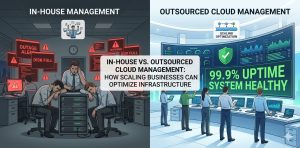
In-house vs outsourced cloud management is a strategic evaluation of whether a company should build its own internal engineering team or partner with an external provider to handle its digital infrastructure. This decision matters because scaling businesses often hit a “complexity wall” where the technical demands of 24/7 uptime, security compliance, and cost optimization exceed their internal capabilities. By selecting the right management model, organizations solve the problem of operational bottlenecks, ensuring that their cloud environment scales seamlessly alongside their customer base.
Understanding the Cloud Management Dilemma
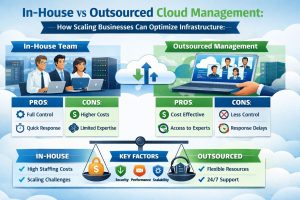
The concept of cloud management encompasses the continuous oversight, administration, and optimization of virtualized resources. In the current landscape of 2026, this involves more than just keeping servers online; it requires managing complex microservices, automated scaling groups, and multi-cloud environments. An in-house team offers direct control and deep institutional knowledge, while outsourced providers offer a broader breadth of expertise and round-the-clock coverage that is often difficult for a single company to maintain internally.
Choosing between these models is a foundational step in defining a company’s technical trajectory. For a startup, the focus might be on rapid deployment and agility, making in-house control attractive. However, as that company matures into a scaling enterprise, the burden of managed cloud support often shifts toward the need for specialized skills in security hardening and high-availability architecture. Understanding the nuances of each approach allows leadership to align their infrastructure strategy with their long-term business goals.
Why Scaling Businesses Face the Complexity Wall
The primary reason businesses struggle with this choice is the rapid evolution of cloud-native technologies. What starts as a simple server deployment quickly evolves into a web of load balancers, container orchestrators, and serverless functions. Internal teams, often hired for product development, find themselves buried under “undifferentiated heavy lifting” the repetitive tasks of patching kernels, managing backups, and responding to midnight alerts. This creates a root-cause issue where innovation slows down because the best engineers are stuck performing routine maintenance.
Furthermore, the talent gap in specialized DevOps infrastructure management makes it difficult to hire and retain experts in every niche. A single scaling business may not have enough work to justify a full-time security architect, a dedicated database administrator, and a 24/7 network operations team. This leads to “Swiss Army Knife” engineering, where a generalist attempts to handle specialized tasks. When a complex issue like a memory leak or a regional cloud outage occurs, the lack of specialized depth can result in extended downtime and significant revenue loss.
Resource fragmentation also plays a role in the complexity crisis. Without a unified management strategy, different departments might spin up disparate cloud assets, leading to “Cloud Sprawl.” This fragmentation makes it nearly impossible for an in-house team to maintain a consistent security posture or accurately predict monthly cloud expenditures. The resulting technical debt becomes a hurdle that prevents the business from reaching its full scaling potential, eventually forcing a re-evaluation of the management model.
How Engineers Resolve the Scaling Crisis
Senior infrastructure engineers solve the scaling crisis by implementing a hybrid or fully managed approach that prioritizes “Infrastructure as Code” (IaC). By moving away from manual console tweaks and toward version-controlled configurations using Terraform or Pulumi, engineers ensure that the environment is reproducible and stable. This shift allows the business to leverage outsourced hosting support for the standardized, 24/7 operational tasks while keeping their high-level architectural decisions in-house.
The step-by-step resolution usually begins with a comprehensive “Infrastructure Audit.” Engineers analyze current resource utilization, identifying over-provisioned instances and security gaps. Next, they implement a centralized monitoring hub. By deploying agents like Zabbix or Nagios across all nodes, they gain the visibility needed to move from reactive firefighting to proactive maintenance. This visibility allows the team to set granular thresholds that trigger automated scaling or self-healing scripts before a human even needs to be notified.
Finally, teams establish a robust “Escalation Matrix.” In an outsourced or hybrid model, the external provider handles the Tier 1 and Tier 2 incidents such as disk space alerts or service restarts around the clock. This is supported by 24/7 NOC services that provide a constant safety net. If a deeper architectural issue is detected, the incident is seamlessly escalated to the internal senior engineers. This division of labor ensures that the business remains protected 24/7 without burning out its core development team.
Real-World Production Scenarios: The Cost of Inaction
In a production environment, the difference between in-house and outsourced management is most visible during a “Grey Failure.” Consider a scenario where a database begins to experience intermittent latency during peak hours. An internal generalist might look at the CPU and see it’s at 50%, concluding the server is fine. However, a specialized Linux server management services provider would dig deeper into the kernel’s I/O wait times and identify that the disk’s IOPS limit is being throttled.
Another common scenario involves the “Midnight Outage.” For an in-house team, a 2:00 AM crash means a tired engineer is woken up to fix a problem in the dark, leading to high stress and potential mistakes. In contrast, an outsourced model provides a “Follow-the-Sun” support system. When the alarm goes off, an engineer working their daytime shift in a fully staffed NOC handles the incident. They resolve and document the issue, providing a report for the client’s internal team before they start their morning to ensure zero disruption to the business’s momentum.
Tools, Monitoring, and the Engineering Approach
Effective cloud management requires a sophisticated stack that transcends simple uptime checks. Engineers rely on Prometheus for gathering high-resolution metrics and Grafana for visualizing those metrics in real-time. This allows for “Full-Stack Observability,” where every layer of the infrastructure from the hardware hypervisor to the application’s response time is tracked. This data-driven approach is what enables cloud infrastructure management services to guarantee 99.9% uptime.
For log management, the ELK Stack (Elasticsearch, Logstash, Kibana) is used to aggregate logs from across the entire distributed system. This is crucial for debugging intermittent issues that move across different providers or regions. When an error occurs, engineers don’t have to log into ten different servers; they search the centralized log hub to trace the “Request ID” through the entire stack. This efficiency is a primary reason why scaling businesses choose to outsource the setup and maintenance of these complex monitoring systems.
Performance, Security, and Cost Impact
The impact of the management model on a company’s bottom line is profound. In-house management often carries high “Hidden Costs,” such as recruitment fees, training, benefits, and the overhead of managing a technical team. Conversely, outsourced hosting support offers a predictable monthly cost that scales with the business. Most importantly, it prevents “Cloud Waste” by implementing automated lifecycle policies that terminate idle resources, often saving businesses more in cloud bills than the cost of the management service itself.
From a security perspective, an outsourced provider brings a “Hardened” mindset developed by managing thousands of different environments. They implement “Zero Trust” architectures and regular vulnerability scanning as a standard part of their server monitoring and maintenance. For an in-house team, security is often a project that gets pushed to the back burner in favor of new feature development. Outsourcing ensures that security is a continuous process, not a one-time event, significantly reducing the risk of a catastrophic data breach.
Best Practices for Infrastructure Teams in 2026
Modern teams follow the “Documentation as Code” principle. Every change made to the infrastructure, whether by an internal engineer or an external provider, must be documented in a central, searchable repository. This prevents “Information Silos” where only one person knows how a specific system works. It also facilitates a smooth partnership between in-house and outsourced teams, as both parties are working from the same “Source of Truth.”
Another best practice is the “Monthly Architecture Review.” Even if the system is running perfectly, senior engineers should meet once a month to look at long-term trends. Are costs creeping up? Is a certain service reaching its scaling limit? By analyzing data from 24/7 NOC services, teams can plan for future growth rather than just surviving the present. This proactive mindset is the hallmark of a mature scaling business.
Case Study:
A rapidly growing fintech platform was struggling with frequent downtime as they scaled from 10,000 to 1,000,000 active users. Their internal team of three developers was spending 60% of their time on server maintenance, which halted their product roadmap. We implemented a managed cloud support strategy that offloaded the entire infrastructure layer to our NOC.
We migrated their manual setup to a Terraform-based IaC model and implemented a multi-region failover strategy. Within three months, their uptime improved from 98.5% to 99.99%. More importantly, their developers were able to release two major product features ahead of schedule because they were no longer handling server alerts. The cost of our service was 40% less than the cost of hiring one additional full-time senior DevOps engineer, demonstrating the clear ROI of the outsourced model.
Quick Summary:
The choice between in-house and outsourced cloud management depends on a business’s scale and focus. While in-house teams offer control, the 24/7 demands of modern infrastructure often overwhelm them. Outsourced management provides specialized expertise, 24/7 NOC services, and cost optimization that allows internal teams to focus on core product innovation. For scaling businesses in 2026, a managed approach is the most efficient way to ensure security, performance, and 99.9% uptime without the overhead of a massive internal department.
Struggling with Traffic Spikes and Downtime?
Partner with our experts for reliable cloud auto-scaling, proactive monitoring, and high-availability infrastructure solutions.
Conclusion: Aligning Management with Momentum
The decision between in-house and outsourced cloud management is ultimately about where you want your company’s energy to go. In a hyper-competitive market, spending internal resources on server maintenance is a strategic drain. By leveraging cloud infrastructure management services, businesses can secure a foundation of stability and expert-level performance.