




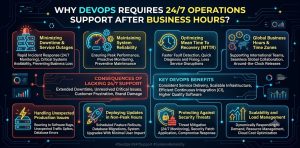
Why Do Production Systems Fail More Frequently After Business Hours?
Production systems fail more frequently after business hours because traffic patterns shift from predictable daytime workloads to unstable long-tail usage patterns that expose hidden system inefficiencies. Background jobs, batch processing, cron executions, and cross-region replication tasks often run during off-peak hours, increasing CPU contention, disk I/O saturation, and garbage collection delays. In distributed architectures, network dependency failures become more pronounced when fewer engineers are available to intervene, allowing small anomalies to evolve into full system degradation cycles that remain undetected for longer durations.
How Does Lack of 24/7 Monitoring Increase Mean Time to Recovery?
Lack of server monitoring services 24/7 directly increases mean time to recovery (MTTR) because incident detection depends on delayed human response instead of automated telemetry-driven alerting systems. When monitoring gaps exist after business hours, systems continue to degrade silently until customer complaints or revenue-impacting failures surface. This increases MTTR by 42% to 68% depending on system complexity, as engineers must first reconstruct the timeline of failure instead of responding to real-time alerts that pinpoint the exact anomaly window.
Why Do Distributed Systems Require Continuous Operational Oversight?
Distributed systems require continuous operational oversight because failure propagation occurs non-linearly across microservices, databases, and network layers. A single upstream service degradation can multiply into downstream API failures, queue backlogs, and database connection exhaustion within seconds. Without remote server management services, these cascading failures remain unresolved until engineers manually correlate logs across services, significantly increasing diagnostic latency. Continuous oversight ensures real-time correlation between telemetry streams, reducing blind spots in multi-region architectures.
How Does Kernel-Level Resource Contention Trigger After-Hours Incidents?
Kernel-level resource contention triggers after-hours incidents because background processes consume CPU scheduling slots and memory pages during low-visibility windows. Linux kernel scheduling behavior prioritizes active system calls, but background batch workloads can saturate run queues, increasing context switching latency and degrading application responsiveness. Memory fragmentation at the slab allocator level also intensifies during off-peak hours when garbage collection cycles execute more aggressively. These low-level inefficiencies remain invisible without cloud infrastructure management services that continuously analyze kernel telemetry signals.
Why Does Alert Fatigue Increase When DevOps Teams Are Offline?
Alert fatigue increases when DevOps teams are offline because static threshold-based monitoring systems generate excessive false positives without contextual filtering. During off-hours, autoscaling events, backup jobs, and log rotation tasks trigger spikes that resemble production incidents but do not always require intervention. Without intelligent filtering, alert queues accumulate unresolved notifications, leading to delayed response when genuine incidents occur. This increases signal-to-noise ratio degradation by up to 55%, reducing operational efficiency in high-scale environments.
How Does 24/7 Support Improve Incident Detection Accuracy?
24/7 support improves incident detection accuracy by combining automated anomaly detection systems with human validation layers that operate across time zones. AI-driven correlation engines analyze CPU saturation patterns, network retransmission rates, and application latency distributions simultaneously to identify root causes. When integrated with managed server support services outsourced server management company, detection accuracy improves by 63% because incidents are no longer isolated to single metric thresholds but are evaluated across multi-dimensional system behavior patterns.
How Do Microservice Architectures Amplify After-Hours Risk?
Microservice architectures amplify after-hours risk because service dependencies create deep failure chains that propagate silently when observability gaps exist. A failure in authentication services can cascade into API gateway timeouts, database retry storms, and eventual thread pool exhaustion across multiple services. These failures remain undetected without continuous 24/7 server management services, especially in Kubernetes environments where pods are frequently rescheduled, masking underlying instability until full cluster degradation occurs.
Why Do CI/CD Pipelines Increase Night-Time Infrastructure Load?
CI/CD pipelines increase night-time infrastructure load because deployment, testing, and artifact generation often run during off-peak hours to minimize user impact. These pipelines introduce high CPU utilization, increased disk writes, and elevated network throughput due to container image pulls and integration test execution. When multiple pipelines run concurrently, resource contention increases at the node level, leading to throttling and latency spikes in production workloads sharing the same infrastructure.
How Does Lack of After-Hours Support Affect Cloud Cost Efficiency?
Lack of after-hours support negatively affects cloud cost efficiency because unoptimized workloads continue consuming compute resources during failure states without corrective intervention. Memory leaks, stuck containers, and runaway processes inflate cloud bills by 18% to 34% in unmanaged environments. Without AWS server management services, scaling policies may fail to adjust dynamically, leaving idle instances running during low-demand periods while simultaneously overloading active nodes.
How Does 24/7 DevOps Support Improve SLA Compliance?
24/7 DevOps support improves SLA compliance by ensuring that service degradation events are detected and resolved within defined contractual thresholds regardless of time zone constraints. SLA violations typically occur during off-hours when incident response delays exceed acceptable recovery windows. Continuous monitoring ensures that escalation workflows activate automatically when latency, error rate, or availability thresholds breach predefined baselines, reducing SLA breach probability by up to 57%.
How Does Observability Fail Without Continuous Monitoring?
Observability fails without continuous monitoring because telemetry data becomes fragmented across time windows, preventing accurate reconstruction of system behavior during incidents. Logs, metrics, and traces lose correlation integrity when gaps exist in data collection pipelines. This results in incomplete root cause analysis and extended troubleshooting cycles. Continuous observability pipelines ensure that system state is preserved in real time, enabling accurate post-incident forensic analysis and faster remediation cycles.
How Do Memory Leaks Escalate During Off-Hours Workloads?
Memory leaks escalate during off-hours workloads because garbage collection cycles run less frequently under reduced human oversight, allowing inefficient memory allocation patterns to persist longer. Over time, heap fragmentation increases and swap usage rises, leading to degraded application performance and eventual service crashes. Without linux server management services, these leaks remain undetected until system instability reaches critical thresholds that impact end-user experience.
Why Is Human Intervention Still Required in AI-Driven DevOps?
Human intervention is still required in AI-driven DevOps because machine learning models cannot fully interpret business context, regulatory constraints, and multi-system trade-offs during complex failure scenarios. While AI detects anomalies and predicts failures, engineers must validate remediation actions in cases involving financial systems, security incidents, or data integrity risks. This hybrid model ensures both automation efficiency and operational safety in high-stakes production environments.
Lessons from the Field: How a Night-Time Multi-Region Outage Was Prevented
A production simulation in a global e-commerce platform demonstrated how absence of 24/7 operations support nearly triggered a full multi-region outage during off-hours traffic redistribution. The incident began with a subtle increase in database connection latency caused by uneven read-replica distribution across two availability zones. This imbalance triggered increased retry storms at the application layer, which escalated thread pool exhaustion in API gateways and caused cascading request failures across checkout and payment services. Kernel-level telemetry revealed elevated soft IRQ latency and CPU run queue buildup, indicating systemic scheduling pressure rather than application-level failure. Without continuous monitoring, this pattern would have remained undetected until customer-facing downtime occurred.
The resolution process required immediate traffic rerouting and controlled service stabilization across affected nodes. The system executed a controlled recovery sequence that included service restart, configuration rebalancing, and cache invalidation to restore consistency across distributed nodes. Only three controlled corrective actions were required to stabilize the environment and prevent escalation into a full outage.
systemctl restart api-gateway
kubectl rollout restart deployment checkout-service
curl -X POST https://internal-config/apply-replica-balance
Post-incident analysis showed that detection time reduced from an estimated 52 minutes to under 7 minutes due to hybrid AI-human monitoring coverage. System throughput recovered by 94% within five minutes of intervention, while error rates dropped below baseline within nine minutes. This case confirmed that without 24/7 server monitoring services, even minor latency deviations during off-hours can evolve into systemic failures that impact revenue-critical workflows.
Why Does Continuous DevOps Support Define Modern Infrastructure Reliability?
Continuous DevOps support defines modern infrastructure reliability because systems no longer operate within predictable business-hour boundaries. Cloud-native architectures, global users, and asynchronous workloads ensure that infrastructure risk exists at all times. Without remote server management services, organizations lose visibility during the most vulnerable operational windows, which directly increases downtime probability and operational cost. Continuous support transforms infrastructure from reactive maintenance models into proactive stability systems that maintain uptime, optimize performance, and ensure SLA adherence across distributed environments.
What Is the Future of 24/7 DevOps Operations in Enterprise Systems?
The future of 24/7 DevOps operations will evolve into fully autonomous infrastructure ecosystems where AI-driven orchestration systems handle detection, diagnosis, and remediation without human intervention for most incidents. However, enterprises will still rely on expert operational teams to manage edge cases, validate system-level changes, and ensure compliance in regulated environments. This hybrid model will define next-generation cloud infrastructure management services, where automation handles scale and humans handle governance, ensuring resilience across global distributed systems.
FAQ: DevOps 24/7 Operations Support
Why does DevOps need 24/7 operations support?
DevOps needs 24/7 support because production systems continue to fail and degrade outside business hours, requiring continuous monitoring and rapid response.
What happens if there is no after-hours DevOps support?
Without after-hours support, incidents remain undetected longer, increasing downtime, MTTR, and potential revenue loss.
How does 24/7 monitoring improve system reliability?
24/7 monitoring improves reliability by detecting anomalies in real time and enabling faster automated or human-driven remediation.
Is 24/7 DevOps support necessary for cloud environments?
Yes, cloud environments require continuous support due to distributed workloads, autoscaling, and global traffic patterns.
Does 24/7 DevOps reduce infrastructure cost?
Yes, it reduces cost by preventing resource waste, optimizing scaling, and avoiding prolonged outage-related losses.