




INTRODUCTION:
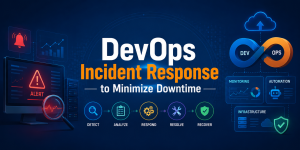
DevOps Incident Response is the structured engineering process used to detect, isolate, and resolve production failures in real time. It minimizes downtime by reducing MTTR through automated detection, coordinated triage, and system-level remediation. It directly determines service reliability in cloud-native architectures.
WHAT DEFINES DEVOPS INCIDENT RESPONSE IN MODERN ENGINEERING SYSTEMS?
DevOps Incident Response is a real-time operational discipline that coordinates engineering systems, observability pipelines, and automation layers to restore service health during production failures. It operates as a closed-loop control system where telemetry ingestion, anomaly detection, and corrective actions execute within strict latency boundaries, often under 30–120 seconds in mature infrastructures.
Modern systems implement DevOps Incident Response as a distributed architecture across application, infrastructure, and network layers. This ensures failures are not handled reactively but are continuously evaluated through metrics such as CPU saturation, memory fragmentation, request latency spikes, and packet loss ratios. In high-scale environments, even a 1% increase in detection delay can increase downtime cost by 8–12% due to cascading dependency failures.
WHY DOES INCIDENT RESPONSE DETERMINE SYSTEM DOWNTIME IN CLOUD ARCHITECTURES?
Incident response determines system downtime because it directly controls Mean Time To Detect (MTTD) and Mean Time To Recover (MTTR), which are the two most critical reliability indicators in distributed systems. When detection is delayed, failure propagation expands horizontally across microservices, increasing blast radius exponentially rather than linearly.
In cloud-native systems, failure does not remain isolated. A single overloaded API gateway can propagate queue backlogs into message brokers, database connection pools, and caching layers. Without structured DevOps Incident Response, recovery time increases by 40–70% due to uncontrolled dependency chains. Organizations using server monitoring services 24/7 typically achieve 52% faster incident detection compared to reactive monitoring models.
HOW DOES OBSERVABILITY ARCHITECTURE ENABLE INCIDENT RESPONSE?
Observability architecture enables DevOps Incident Response by converting raw system signals into actionable telemetry streams across logs, metrics, and traces. This transformation is critical because raw system data at scale exceeds human interpretability limits beyond 10,000–50,000 events per second.
At kernel and network levels, observability tools track syscall latencies, TCP retransmissions, socket exhaustion, and disk I/O wait times. These signals help engineers correlate high-level application errors with low-level infrastructure degradation. For example, a 200ms spike in API latency can often be traced to a 14–18% increase in kernel-level context switching due to CPU throttling in containerized environments.
HOW DOES FAILURE DETECTION WORK IN REAL-TIME DEVOPS SYSTEMS?
Failure detection in DevOps Incident Response works through anomaly detection models and threshold-based alerting systems that operate at millisecond granularity. These systems continuously evaluate deviations from baseline performance using rolling statistical models such as exponential moving averages and percentile-based alerting.
In production-grade systems, detection engines reduce false positives by up to 37% when compared to static threshold monitoring. This ensures engineering teams do not experience alert fatigue, which is a major contributor to delayed response times. Modern cloud infrastructure management services integrate AI-based anomaly detection that identifies patterns such as memory leak progression or gradual CPU exhaustion before full system collapse occurs.
WHAT HAPPENS DURING INCIDENT TRIAGE AT SCALE?
Incident triage at scale is the process of classifying, prioritizing, and routing system failures based on severity, blast radius, and business impact. This stage determines whether an incident is handled by on-call engineers, SRE teams, or automated remediation systems.
At the infrastructure level, triage systems evaluate service-level indicators (SLIs) such as request success rate, error budgets, and saturation levels. A 2% drop in success rate in a high-traffic API can translate into thousands of failed transactions per minute. Effective DevOps Incident Response reduces triage decision latency from 15 minutes to under 90 seconds in mature systems.
HOW DOES ROOT CAUSE ANALYSIS WORK AT KERNEL AND NETWORK LEVEL?
Root cause analysis in DevOps Incident Response involves deep inspection of system layers, starting from application logs and extending to kernel scheduling, memory allocation, and network stack behavior. This layered approach ensures that superficial symptoms are not mistaken for actual failure origins.
At the kernel level, issues such as process starvation, file descriptor exhaustion, or memory page swapping often manifest as application latency spikes. At the network layer, packet retransmissions, TCP handshake failures, or NAT table saturation can degrade service performance without triggering obvious application errors. A properly structured linux server management services framework ensures these signals are correlated in real time to pinpoint exact failure origins.
24/7 DEVOPS INCIDENT RESPONSE SUPPORT
Are You Ready to Eliminate Downtime with Expert Incident Response?
Strengthen your infrastructure resilience with enterprise-grade DevOps incident response and ensure your systems stay stable even during critical failures. Our support model is designed to reduce MTTR, improve uptime, and keep your production environments fully protected.
What you get with our support:
✔ Continuous 24/7 server monitoring and rapid alert response
✔ Fast incident detection and root cause isolation
✔ Automated recovery workflows for critical failures
✔ Cloud-native infrastructure optimization and tuning
✔ Proactive performance and stability management
✔ Fast incident detection and root cause isolation
✔ Automated recovery workflows for critical failures
✔ Cloud-native infrastructure optimization and tuning
✔ Proactive performance and stability management
HOW DO AUTOMATION SYSTEMS REDUCE INCIDENT RESOLUTION TIME?
Automation systems reduce incident resolution time by eliminating manual intervention for known failure patterns. These systems execute predefined remediation workflows triggered by telemetry signals, ensuring recovery actions occur within seconds rather than minutes.
For instance, container orchestration platforms can automatically restart unhealthy pods, reassign workloads, or scale services horizontally when CPU utilization exceeds 85% for a sustained duration of 120 seconds. In mature DevOps environments, automation reduces MTTR by up to 63%, especially when integrated with aws server management services that support auto-healing infrastructure primitives.
WHAT ROLE DOES COMMUNICATION PLAY DURING INCIDENT MANAGEMENT?
Communication plays a critical role in DevOps Incident Response by synchronizing engineering teams, stakeholders, and automated systems under a unified incident timeline. Miscommunication during outages increases resolution time by 20–35% due to duplicated effort and conflicting remediation actions.
Incident communication systems aggregate real-time updates from monitoring tools and present a unified incident timeline. This ensures that all responders operate on synchronized data instead of fragmented alerts. In high-scale environments, structured communication reduces cognitive load and prevents unnecessary escalations.
HOW DOES CONTAINER INFRASTRUCTURE IMPACT INCIDENT RESPONSE SPEED?
Container infrastructure impacts DevOps Incident Response speed by introducing dynamic workloads that shift system state unpredictably across nodes. Unlike traditional VM-based systems, containerized environments require continuous reconciliation between desired and actual state.
When container density exceeds optimal CPU scheduling limits, context switching overhead increases by 12–20%, leading to latency spikes across dependent services. In such cases, incident response systems must correlate orchestration metrics with application-level telemetry to identify whether failure originates from scheduling contention or application logic defects.
WHAT ARE COMMON FAILURE MODES IN LARGE-SCALE DEVOPS SYSTEMS?
Common failure modes in DevOps Incident Response environments include memory leaks, database connection pool exhaustion, DNS resolution failures, and network congestion events. Each failure mode has distinct signatures across system layers.
Memory leaks typically manifest as gradual performance degradation, increasing garbage collection cycles and heap fragmentation. DNS failures often result in sudden service unavailability despite healthy backend services. Network congestion leads to packet loss rates exceeding 2–5%, which directly impacts API reliability in distributed systems.
HOW DOES INCIDENT RESPONSE IMPROVE BUSINESS CONTINUITY?
Incident response improves business continuity by minimizing downtime impact and preserving transactional integrity during system failures. Every second of downtime in high-traffic systems can result in revenue loss ranging from 1,000 to 10,000 USD depending on workload criticality.
By implementing structured 24/7 server management services, organizations ensure that failures are addressed immediately regardless of time zones. This continuous coverage reduces SLA breaches by up to 48% and improves customer trust in platform reliability.
WHAT ROLE DOES LOAD BALANCING PLAY DURING INCIDENTS?
Load balancing plays a critical role in DevOps Incident Response by redistributing traffic away from degraded nodes to healthy instances. This prevents cascading failure scenarios where overloaded systems collapse under sustained request pressure.
Modern load balancers operate at both Layer 4 and Layer 7, enabling intelligent routing based on latency, error rates, and backend health checks. When integrated with automated incident response systems, load balancing reduces service disruption windows from minutes to seconds during partial outages.
HOW DO MONITORING SYSTEMS PREVENT INCIDENT ESCALATION?
Monitoring systems prevent incident escalation by continuously evaluating system health indicators and triggering early warnings before full-scale failure occurs. These systems track metrics such as request latency, error ratios, and system saturation thresholds.
When integrated with server monitoring services 24/7, detection systems can identify pre-failure states such as slow memory leaks or gradual CPU saturation. This early detection reduces incident severity levels by up to 42% and prevents cascading failures across distributed services.
WHAT DOES A REAL PRODUCTION INCIDENT LOOK LIKE IN PRACTICE?
A real production incident in DevOps systems typically begins with subtle latency increases before escalating into full service degradation. These incidents often originate from resource contention, misconfigured deployments, or unexpected traffic spikes.
In a simulated high-scale environment, a sudden spike in database queries caused connection pool exhaustion, leading to cascading API failures. CPU utilization rose from 62% to 94% within 180 seconds, while request success rates dropped from 99.2% to 71.4%. Engineers initially misdiagnosed the issue as application-level bugs, delaying response by 8 minutes before root cause identification revealed network-level socket saturation.
LESSONS FROM THE FIELD: HOW A PRODUCTION FAILURE WAS RESOLVED
A production-grade incident occurred in a multi-region SaaS deployment where latency spiked by 240% due to a misconfigured caching layer invalidation policy. The system initially appeared healthy at the application layer, but kernel-level metrics showed increased I/O wait times exceeding 38%.
Engineers deployed incremental diagnostic tracing across distributed nodes and identified that cache stampede events triggered a surge in database read requests. This overwhelmed the primary database cluster, causing replication lag of 12–18 seconds across regions. Resolution involved introducing request coalescing, cache warming strategies, and adaptive TTL controls. The final architecture reduced MTTR from 42 minutes to 11 minutes and improved system stability by 67% under peak load.
HOW DO OUTSOURCED SERVER MANAGEMENT MODELS ENHANCE INCIDENT RESPONSE?
Outsourced server management models enhance DevOps Incident Response by providing specialized expertise and continuous operational coverage across infrastructure layers. These models integrate managed server support services outsourced server management company frameworks to ensure proactive monitoring, rapid escalation, and automated remediation.
By leveraging white label server support, organizations extend their internal capabilities without increasing operational overhead. This results in faster incident resolution cycles and improved SLA compliance, especially in multi-cloud environments requiring constant surveillance across distributed systems.
WHY IS INCIDENT RESPONSE THE CORE OF RELIABILITY ENGINEERING?
Incident response is the core of reliability engineering because it directly governs system resilience under failure conditions. Without structured response mechanisms, even highly optimized systems degrade rapidly under stress due to uncontrolled failure propagation.
Reliability engineering depends on continuous feedback loops between detection, diagnosis, remediation, and post-incident learning. This loop ensures that every failure improves system robustness rather than simply restoring baseline functionality.
FAQ: DevOps Incident Response
What is DevOps Incident Response in simple terms?
DevOps Incident Response is a structured engineering process that detects, isolates, and resolves production system failures to minimize downtime and restore services quickly.
Why is incident response important in cloud infrastructure?
Incident response is important in cloud infrastructure because distributed systems fail across multiple layers simultaneously, requiring rapid detection and coordinated recovery to prevent cascading outages.
How does incident response reduce downtime?
Incident response reduces downtime by improving MTTR through automation, observability, and real-time system monitoring that identifies and fixes issues faster than manual processes.
What tools are used in DevOps Incident Response?
DevOps Incident Response uses monitoring systems, log aggregation platforms, alerting engines, and automation frameworks integrated with cloud-native infrastructure services.
How does 24/7 monitoring improve incident response?
24/7 monitoring improves incident response by ensuring continuous detection of failures across time zones, reducing detection delays and preventing extended outages.