




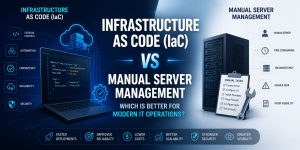
What Is Infrastructure as Code and Why Is It Transforming Modern IT Operations?
Infrastructure as Code (IaC) is the practice of provisioning, configuring, and managing infrastructure using machine-readable configuration files instead of manual administrative processes. Organizations increasingly rely on Infrastructure as Code because modern production environments demand consistency, scalability, repeatability, and rapid deployment across cloud platforms, virtual machines, Kubernetes clusters, and hybrid infrastructures. Rather than manually logging into servers to install software, configure operating systems, adjust firewall rules, or provision cloud resources, infrastructure engineers define the desired environment in version-controlled configuration files that can be deployed automatically whenever required. This approach minimizes human error, accelerates infrastructure deployment, and establishes a standardized operational model suitable for rapidly growing businesses.
Digital transformation has dramatically changed the way organizations manage infrastructure. Traditional data centers consisting of a few physical servers have evolved into globally distributed environments spanning multiple cloud providers, virtualization platforms, containers, managed databases, object storage, and software-defined networking. Enterprise applications often require hundreds or thousands of interconnected infrastructure components working together. Managing these environments manually introduces operational complexity that increases deployment time, configuration inconsistencies, security risks, and maintenance costs. Infrastructure as Code addresses these challenges by enabling infrastructure to be treated similarly to software, where every configuration change is documented, reviewed, versioned, tested, and deployed through automated workflows.
Why Did Manual Server Management Become the Industry Standard?
Manual server management became the preferred operational model because early enterprise infrastructures were relatively small, predictable, and easy to maintain. Before cloud computing transformed enterprise architecture, organizations typically managed a limited number of physical servers located within centralized data centers. System administrators configured operating systems manually, installed application software individually, adjusted network settings through graphical interfaces, applied security patches one server at a time, and documented infrastructure changes using spreadsheets or internal documentation systems. Since infrastructure rarely changed, this administrative approach remained practical for many years.
Traditional server management depended heavily on administrator expertise and procedural documentation. Experienced engineers maintained operational consistency by following internal checklists during server provisioning, operating system installation, application deployment, and infrastructure maintenance. Although this methodology functioned effectively in relatively static environments, it became increasingly difficult as organizations adopted virtualization, public cloud platforms, auto-scaling groups, containers, and globally distributed applications. Manual processes that once required only a few hours gradually expanded into operational bottlenecks as infrastructure complexity increased.
Why Is Manual Server Management Becoming Less Practical?
Modern cloud infrastructure changes far more rapidly than manual administrative processes can accommodate. Cloud-native environments automatically provision virtual machines, launch containers, replace failed workloads, expand storage volumes, and scale application resources according to changing business demand. Infrastructure components frequently exist for only minutes before automation replaces or updates them. Human administrators cannot realistically maintain consistent configurations across environments that change continuously throughout the day.
Configuration inconsistencies represent one of the most significant risks associated with manual administration. Two servers intended to perform identical workloads may gradually diverge because administrators install different software versions, apply inconsistent security patches, modify configuration files independently, or overlook required maintenance tasks. These inconsistencies frequently cause unexpected application failures, troubleshooting challenges, and deployment delays. Organizations providing managed server support services increasingly adopt Infrastructure as Code to eliminate configuration drift while maintaining standardized infrastructure across development, testing, staging, and production environments.
How Does Infrastructure as Code Actually Work?
Infrastructure as Code converts infrastructure requirements into executable configuration definitions that automation platforms interpret and deploy consistently. Engineers define compute resources, networking, storage, operating system settings, access controls, firewall policies, cloud services, and application dependencies within structured configuration files. These files describe the desired state of infrastructure rather than individual administrative actions. Automation engines compare the existing environment with the declared configuration and perform only the necessary modifications required to achieve the intended state.
Unlike traditional administrative procedures that rely upon memory or manually maintained documentation, Infrastructure as Code establishes infrastructure as a repeatable engineering artifact. Every deployment follows identical configuration standards regardless of who initiates the deployment or where the infrastructure is provisioned. Version control systems preserve every configuration change, enabling organizations to audit modifications, review proposed updates, reverse problematic deployments, and maintain comprehensive operational documentation throughout the infrastructure lifecycle.
Why Does Version Control Improve Infrastructure Reliability?
Version control provides complete visibility into infrastructure changes, making operational management more reliable and predictable. Traditional server administration often lacks comprehensive records describing when configuration changes occurred, which administrator performed the modification, or why specific settings were introduced. Troubleshooting production failures becomes significantly more difficult when infrastructure history depends upon fragmented documentation or individual administrator knowledge.
Infrastructure as Code integrates naturally with source code repositories that record every configuration modification. Engineering teams review infrastructure changes before deployment, maintain historical records for compliance purposes, and restore previous configurations whenever unexpected issues arise. This structured workflow reduces deployment risk while improving operational governance across enterprise environments. Businesses investing in cloud infrastructure management services increasingly prioritize version-controlled infrastructure because it enhances security, simplifies audits, and accelerates operational recovery.
Why Does Infrastructure Consistency Matter Across Production Environments?
Consistent infrastructure eliminates unpredictable behavior caused by configuration differences between environments. Many production incidents originate because development, testing, staging, and production servers differ in subtle but important ways. Different software versions, inconsistent kernel parameters, missing dependencies, incorrect firewall rules, or modified system libraries frequently cause applications to behave differently after deployment. Infrastructure as Code ensures every environment is provisioned using identical configuration definitions, greatly reducing deployment-related failures.
Operational consistency also improves disaster recovery readiness. Organizations can rapidly recreate complete production environments from version-controlled infrastructure definitions instead of rebuilding servers manually during emergencies. Recovery procedures become faster, more predictable, and less dependent upon individual administrator experience. Businesses delivering 24/7 server management services increasingly rely on Infrastructure as Code because standardized infrastructure enables faster incident recovery while maintaining higher service availability.
How Does Infrastructure as Code Improve Cloud Deployments?
Cloud platforms are designed for automation, making Infrastructure as Code the preferred deployment methodology for modern cloud environments. Public cloud providers continuously expose programmable interfaces allowing organizations to provision compute instances, networking components, databases, storage systems, identity services, monitoring platforms, and security controls automatically. Infrastructure as Code interacts directly with these interfaces to create entire production environments within minutes while maintaining complete deployment consistency.
Organizations operating large-scale AWS server management services frequently deploy hundreds of interconnected resources simultaneously. Infrastructure as Code enables engineers to define complete cloud architectures using declarative configuration files rather than manually provisioning individual services through administrative consoles. This automation accelerates infrastructure deployment, reduces operational errors, improves scalability, and supports continuous delivery pipelines that modern software development increasingly depends upon.
Why Are Enterprises Replacing Manual Provisioning with Automation?
Automation reduces operational risk by eliminating repetitive administrative activities that frequently introduce human error. Manual provisioning often requires administrators to repeat identical configuration procedures dozens or hundreds of times while maintaining complete accuracy throughout every deployment. Even experienced engineers occasionally overlook security settings, software dependencies, network configurations, or operating system updates during repetitive administrative work.
Infrastructure as Code automates these repetitive processes while ensuring every deployment follows standardized engineering practices. Engineering teams can focus on architectural improvements, infrastructure optimization, performance tuning, and security enhancements instead of spending valuable time performing repetitive provisioning tasks. As enterprise infrastructures continue expanding across hybrid cloud environments, automation has become a fundamental operational requirement rather than an optional engineering improvement.
How Do Terraform, Ansible, Puppet, and Chef Support Infrastructure as Code?
Infrastructure as Code relies on automation platforms that provision, configure, and maintain infrastructure consistently across multiple environments. Although the fundamental objective remains the same, different Infrastructure as Code platforms address different operational requirements. Terraform specializes in infrastructure provisioning by communicating directly with cloud provider APIs to create virtual machines, networking components, storage resources, load balancers, and managed cloud services. Ansible focuses primarily on configuration management, software deployment, operating system maintenance, and application provisioning without requiring software agents on managed systems. Puppet and Chef provide policy-driven configuration management that continuously verifies infrastructure compliance and automatically corrects unauthorized configuration changes. Modern enterprise organizations frequently combine these technologies to provision cloud resources, configure operating systems, deploy applications, and maintain configuration consistency throughout the infrastructure lifecycle.
One common command used to validate Terraform configuration before deployment is:terraform validate
This validation process checks configuration syntax and resource definitions before changes reach production, reducing deployment failures caused by configuration errors.
Why Does Configuration Drift Create Serious Operational Risks?
Configuration drift occurs when production servers gradually diverge from their intended configuration because of unmanaged manual changes. Two Linux servers may initially share identical operating system versions, security policies, installed packages, firewall rules, and application settings. Over time, administrators may manually install additional software, modify configuration files, adjust permissions, disable security controls, or apply patches inconsistently. These seemingly minor differences accumulate until servers no longer behave identically under production workloads. Configuration drift frequently causes application instability, inconsistent performance, failed deployments, security vulnerabilities, and extended troubleshooting efforts because engineers cannot easily determine why identical environments produce different operational outcomes.
Infrastructure as Code eliminates configuration drift by continuously enforcing the declared infrastructure state. Instead of depending upon manual documentation or administrator memory, automation platforms compare the current infrastructure against version-controlled configuration files and restore consistency whenever deviations occur. Organizations providing managed server support services increasingly depend on Infrastructure as Code because maintaining identical production environments dramatically improves operational stability and reduces incident frequency.
Why Is Infrastructure as Code Essential for Security and Compliance?
Consistent infrastructure improves cybersecurity by ensuring every server follows standardized security policies from the moment it is deployed. Manual provisioning frequently results in inconsistent firewall rules, outdated software packages, weak authentication policies, unnecessary services, and delayed security patching. These inconsistencies increase the attack surface available to malicious actors while complicating compliance audits. Infrastructure as Code enables organizations to define secure operating system baselines, encryption standards, identity management policies, network segmentation rules, and logging requirements directly within version-controlled infrastructure definitions. Every newly provisioned server automatically inherits these security controls without requiring manual administrator intervention.
Infrastructure as Code also strengthens regulatory compliance because every infrastructure modification becomes traceable. Version control records who introduced configuration changes, when those changes occurred, and why they were approved. This detailed audit trail simplifies compliance with industry standards while improving operational governance across enterprise infrastructure.
How Does Infrastructure as Code Integrate with CI/CD Pipelines?
Continuous Integration and Continuous Deployment pipelines extend automation beyond application development into infrastructure management. Modern software releases often require simultaneous updates to application code, operating system configuration, cloud networking, databases, storage services, and security policies. Manual infrastructure provisioning introduces delays that reduce deployment efficiency and increase operational risk. Infrastructure as Code integrates directly into deployment pipelines, enabling organizations to provision infrastructure automatically before application deployment begins.
Before production deployment, automated validation confirms that infrastructure definitions satisfy organizational standards and security requirements. Deployment pipelines then provision infrastructure, configure operating systems, install application dependencies, execute automated testing, and deploy application workloads using repeatable engineering processes. This automation reduces deployment duration while improving consistency across development, testing, staging, and production environments.
Why Does Kubernetes Depend on Infrastructure as Code?
Kubernetes environments require automation because containerized workloads continuously change according to application demand. Unlike traditional virtual machines that remain operational for extended periods, Kubernetes frequently creates, terminates, relocates, and replaces containers automatically. Attempting to manage this infrastructure manually becomes operationally impossible as clusters expand across multiple regions and cloud providers. Infrastructure as Code enables engineering teams to define Kubernetes clusters, networking policies, storage classes, ingress controllers, security settings, and application deployments using declarative configuration files. Every cluster follows identical architectural standards regardless of deployment location.
One commonly used command for validating Kubernetes resource status is:kubectl get nodes
Although this command confirms cluster node availability, mature production environments increasingly depend upon automated observability platforms that continuously monitor Kubernetes health without requiring manual verification.
Why Is Infrastructure as Code Important for Multi-Cloud Environments?
Multi-cloud infrastructure introduces operational complexity that manual administration cannot efficiently manage. Organizations increasingly distribute workloads across Amazon Web Services, Microsoft Azure, Google Cloud Platform, and private cloud environments to improve resilience, reduce vendor dependency, and optimize operational costs. Each cloud provider offers unique networking models, security controls, storage services, identity platforms, and infrastructure interfaces. Managing these environments manually creates inconsistencies that increase operational risk and deployment complexity.
Infrastructure as Code provides a consistent operational methodology regardless of cloud provider. Engineering teams define infrastructure using standardized configuration templates that automate resource provisioning while maintaining identical operational practices across heterogeneous cloud environments. Businesses offering cloud infrastructure management services increasingly rely on Infrastructure as Code because automation simplifies hybrid and multi-cloud operations while improving governance and scalability.
MODERNIZE YOUR INFRASTRUCTURE
Ready to Automate Your Infrastructure?
Eliminate manual server management with Infrastructure as Code. ActSupport helps businesses automate deployments, improve security, reduce configuration drift, and manage cloud infrastructure with expert 24/7 support.
How Does Infrastructure as Code Improve Disaster Recovery?
Automated infrastructure provisioning dramatically reduces disaster recovery time because production environments can be recreated consistently from version-controlled definitions. Traditional disaster recovery frequently depends upon lengthy documentation, manual provisioning procedures, and administrator experience. Restoring hundreds of production servers manually may require many hours or even days, particularly when complex networking, storage, databases, and application dependencies are involved.
Infrastructure as Code enables organizations to reconstruct complete production environments automatically using previously validated infrastructure definitions. Cloud resources, virtual machines, networking components, security policies, monitoring systems, and application platforms can all be recreated using standardized deployment workflows. This capability reduces recovery time, minimizes configuration errors, and improves business continuity during major infrastructure incidents.
Lessons from the Field: How Infrastructure as Code Prevented a Large-Scale Configuration Failure
Standardized infrastructure automation can prevent widespread production outages caused by inconsistent manual administration. During a simulated enterprise hosting engagement, a managed hosting provider maintained approximately 1,800 Linux virtual machines supporting shared hosting, VPS platforms, managed databases, and customer web applications. Several senior administrators independently maintained production servers across multiple regions. Over several months, emergency maintenance activities introduced inconsistent firewall rules, different package versions, modified PHP configurations, and varying kernel parameters between otherwise identical application servers.
The operational impact became visible following a routine software deployment. Approximately 18 percent of production servers began rejecting secure application requests while identical workloads running on neighboring servers continued operating normally. Traditional monitoring reported healthy processor utilization, sufficient memory, normal storage performance, and stable network connectivity. Engineers initially suspected application defects because infrastructure metrics appeared normal.
Detailed configuration comparison revealed substantial configuration drift introduced through repeated manual administrative changes. Firewall policies differed across server groups, TLS libraries existed in multiple versions, and security modules had been disabled on selected production systems during previous troubleshooting exercises. Engineering teams migrated infrastructure management to Infrastructure as Code, standardized operating system baselines, automated security policy deployment, and eliminated manual configuration updates outside approved deployment pipelines. Subsequent infrastructure deployments achieved complete configuration consistency across all production environments, deployment failures decreased by more than 82 percent, and average provisioning time dropped from nearly three hours to less than twenty minutes. Operational stability improved significantly because every production server followed identical engineering standards throughout its lifecycle.
How Does Infrastructure as Code Reduce Operational Costs?
Infrastructure as Code reduces operational expenditure by automating repetitive infrastructure tasks and minimizing configuration-related failures. Organizations managing hundreds of production servers often dedicate a substantial portion of engineering time to repetitive provisioning, operating system configuration, security patching, software installation, and infrastructure maintenance. These manual activities consume valuable engineering resources that could otherwise support architectural improvements, automation initiatives, and product innovation. Infrastructure as Code automates these routine operations through reusable templates, enabling infrastructure teams to provision consistent environments in minutes rather than hours. Industry studies have shown that mature automation practices can reduce provisioning time by more than 80%, decrease deployment-related failures by approximately 60%, and lower operational overhead through improved standardization. These measurable improvements allow engineering teams to focus on strategic infrastructure development rather than repetitive maintenance activities.
Why Do Organizations Outsource Infrastructure as Code Management?
Many organizations outsource Infrastructure as Code because maintaining modern automation platforms requires specialized engineering expertise. Building production-ready Infrastructure as Code frameworks involves much more than writing configuration files. Engineering teams must design reusable modules, establish version control workflows, integrate continuous deployment pipelines, implement infrastructure testing, enforce security policies, manage secrets securely, and maintain cloud governance standards across multiple environments. Businesses that lack dedicated platform engineering teams frequently partner with an experienced outsourced server management company capable of designing, implementing, and maintaining enterprise-grade Infrastructure as Code environments. Outsourcing also provides access to experienced cloud architects without the significant costs associated with recruiting, training, and retaining specialized infrastructure engineers.
Organizations offering managed server support services, remote server management services, linux server management services, and cloud infrastructure management services increasingly integrate Infrastructure as Code into their operational processes. This approach enables service providers to deliver faster deployments, stronger security, improved consistency, and more predictable infrastructure management while reducing operational complexity for their customers.
How Does Infrastructure as Code Improve Business Continuity?
Standardized infrastructure improves business continuity because production environments become repeatable and recoverable. Traditional disaster recovery often depends on administrator documentation, institutional knowledge, and manual rebuilding procedures that introduce delays during critical incidents. Infrastructure as Code transforms disaster recovery into a predictable engineering process by storing complete infrastructure definitions within version-controlled repositories. During major outages, organizations can recreate production infrastructure consistently without relying upon undocumented administrative knowledge. Cloud resources, networking components, storage systems, monitoring platforms, security controls, and application environments can all be redeployed using the same validated configurations that originally built the environment. Faster recovery directly improves customer satisfaction, minimizes downtime, and strengthens operational resilience.
What Are the Best Practices for Successfully Implementing Infrastructure as Code?
Successful Infrastructure as Code adoption requires disciplined engineering practices rather than simply automating existing manual processes. Organizations should store all infrastructure definitions within centralized version control repositories, establish peer-review processes for every infrastructure modification, implement automated validation before deployment, separate reusable modules from environment-specific configurations, enforce security policies within deployment pipelines, and regularly test disaster recovery procedures using production-equivalent infrastructure. Infrastructure documentation should evolve together with configuration files so operational knowledge remains synchronized with deployed environments. Engineering teams should also minimize manual production changes because every undocumented modification increases the likelihood of configuration drift and operational inconsistency.
How Will Infrastructure as Code Continue Evolving Beyond 2026?
Infrastructure as Code is evolving toward intelligent infrastructure orchestration powered by artificial intelligence and policy-based automation. Future Infrastructure as Code platforms will increasingly integrate machine learning to recommend architecture improvements, detect configuration anomalies, identify inefficient resource allocation, predict deployment failures, and automatically enforce organizational compliance policies before infrastructure reaches production. Artificial intelligence will assist engineers by analyzing infrastructure dependencies, optimizing cloud resource utilization, recommending security improvements, and validating deployment risks using historical operational data. As hybrid cloud, Kubernetes, edge computing, and distributed applications continue expanding, Infrastructure as Code will become the operational foundation supporting automated, self-healing infrastructure capable of adapting dynamically to changing business requirements.
Organizations investing in Infrastructure as Code today will be better positioned to adopt emerging technologies without rebuilding operational processes. Automation, version control, cloud-native deployment, and standardized infrastructure will continue forming the backbone of modern enterprise operations as infrastructure complexity increases throughout the coming decade.
What Should Businesses Remember About Infrastructure as Code?
Infrastructure as Code has become the preferred operational model for managing modern enterprise infrastructure because it delivers consistency, scalability, automation, and operational reliability that manual administration cannot consistently achieve. Traditional server management remains valuable for specialized administrative tasks and troubleshooting, but manual provisioning alone cannot efficiently support rapidly changing cloud-native environments. Infrastructure as Code enables organizations to provision standardized infrastructure, reduce configuration drift, strengthen security, improve disaster recovery, accelerate deployments, and simplify infrastructure governance across public cloud, hybrid cloud, and on-premises environments. Businesses seeking long-term operational efficiency should view Infrastructure as Code not simply as an automation technology but as a strategic engineering discipline that supports digital transformation, cloud adoption, and enterprise scalability.
Infrastructure as Code (IaC) FAQ
Have questions about Infrastructure as Code (IaC), manual server management, or cloud infrastructure automation? Here are answers to some of the most commonly asked questions from IT teams, DevOps engineers, hosting providers, and enterprise businesses.