




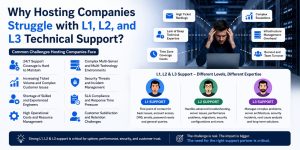
Introduction: The Growing Complexity of Hosting Support Operations
The web hosting industry has evolved dramatically over the past decade. Modern hosting providers are no longer responsible only for selling shared hosting accounts. Today, customers expect providers to manage VPS environments, dedicated servers, cloud infrastructure, email systems, DNS services, SSL certificates, website migrations, backups, cybersecurity controls, and application performance. As infrastructure complexity continues to increase, maintaining reliable L1 technical support, L2 technical support, and L3 technical support has become one of the most significant operational challenges for hosting companies.
Many hosting businesses enter the market with strong infrastructure capabilities but quickly discover that delivering continuous technical support around the clock requires specialized expertise, structured processes, and dedicated resources. Customer expectations have also changed significantly. Users now expect immediate responses, rapid issue resolution, proactive monitoring, and expert guidance regardless of whether the issue involves billing, DNS propagation, email delivery, Linux administration, virtualization, or cloud infrastructure. This growing demand places enormous pressure on support teams and often creates operational bottlenecks that impact customer satisfaction and business growth.
Understanding the Difference Between L1, L2, and L3 Technical Support
Before examining the challenges, it is important to understand how support operations are structured within a hosting environment. L1 technical support serves as the first point of contact for customers. These technicians handle common issues such as account access problems, email configuration, password resets, basic DNS changes, SSL installation assistance, hosting package information, and general troubleshooting requests. L1 teams are expected to provide fast responses while maintaining high customer satisfaction levels.
L2 technical support focuses on more advanced troubleshooting and infrastructure-related incidents. L2 engineers investigate server performance issues, mail delivery failures, database problems, application errors, virtualization issues, backup failures, and operating system-level concerns. They possess deeper technical expertise and frequently interact with system logs, monitoring systems, and infrastructure management tools.
L3 technical support represents the highest technical escalation level. These engineers typically handle kernel-level issues, server architecture decisions, advanced security incidents, infrastructure automation, disaster recovery planning, complex migrations, virtualization failures, and critical outages. L3 specialists are responsible for root cause analysis and long-term infrastructure improvements that prevent recurring incidents.
Why Hosting Customers Expect Immediate Technical Resolution
The hosting industry operates within a highly competitive environment where service interruptions directly impact customer revenue, reputation, and business continuity. A website outage can result in lost sales, reduced search engine rankings, customer complaints, and brand damage within minutes. Because of this, customers expect hosting providers to respond immediately when problems occur.
Unlike many industries where support requests can wait several hours or days, hosting customers often require assistance in real time. Business websites, eCommerce platforms, SaaS applications, and mission-critical services operate continuously and depend on infrastructure availability. Consequently, support teams must remain available 24 hours a day, seven days a week, throughout the year. Maintaining this level of responsiveness requires significant staffing investments and operational maturity that many hosting providers struggle to sustain.
The Challenge of Maintaining True 24/7 Technical Coverage
One of the biggest difficulties facing hosting providers is ensuring uninterrupted 24/7 hosting support coverage. While many companies advertise round-the-clock support, maintaining true continuous coverage across multiple time zones requires a substantial workforce. Support engineers must be available during nights, weekends, holidays, and peak traffic periods.
HOSTING SUPPORT & SERVER MANAGEMENT
Struggling to Maintain Reliable L1, L2, and L3 Technical Support Around the Clock?
As hosting infrastructures grow, maintaining skilled engineers for 24/7 technical support, server administration, monitoring, incident response, migrations, and infrastructure management becomes increasingly challenging. A dedicated support team can help reduce ticket backlogs, improve response times, strengthen infrastructure reliability, and ensure customers receive consistent technical assistance without operational bottlenecks.
Recruiting enough qualified personnel to maintain constant coverage can become expensive and operationally challenging. Staff shortages, employee turnover, vacation schedules, and unexpected absences often create support gaps. As ticket queues grow during these periods, response times increase and customer satisfaction declines. Hosting providers frequently discover that scaling infrastructure is easier than scaling highly skilled technical support teams.
The Difficulty of Recruiting Skilled Technical Engineers
Finding professionals capable of handling modern hosting environments has become increasingly difficult. Today’s support engineers must understand Linux administration, Windows server management, cloud platforms, DNS architecture, virtualization technologies, security frameworks, email systems, web servers, databases, backup solutions, and automation tools.
The demand for experienced infrastructure professionals continues to grow across industries, creating intense competition for talent. Hosting companies often compete against large cloud providers, enterprise IT organizations, cybersecurity firms, and software companies for the same skilled engineers. This talent shortage increases recruitment costs and extends hiring timelines while making retention more difficult.
Why Ticket Volume Increases Faster Than Revenue Growth
As hosting providers acquire more customers, support requests typically increase at a faster rate than revenue. Each new customer introduces additional websites, applications, domains, databases, email accounts, SSL certificates, and server configurations. Every component creates potential support requirements.
A hosting company may successfully double its customer base within a year, but support ticket volume may triple or quadruple during the same period. Infrastructure expansion therefore creates operational pressure that extends beyond server capacity planning. Without scalable support processes, growing ticket volumes can overwhelm internal teams and lead to delayed responses, increased escalations, and reduced customer satisfaction.
The Operational Burden of Multi-Technology Support Environments
Modern hosting infrastructures involve numerous interconnected technologies. Support engineers must troubleshoot operating systems, control panels, DNS services, web servers, mail servers, databases, cloud platforms, virtualization layers, storage systems, backup solutions, monitoring platforms, and security tools.
A single customer issue may involve multiple systems simultaneously. For example, a website outage could originate from DNS misconfiguration, firewall restrictions, SSL certificate expiration, database corruption, resource exhaustion, application code problems, or server hardware failures. Diagnosing these issues requires broad technical knowledge and significant troubleshooting experience, making support operations increasingly complex.
Why Escalation Management Becomes a Major Challenge
Effective escalation management is essential within hosting support environments. Problems that cannot be resolved at the L1 level must move quickly to L2 and L3 teams without unnecessary delays. However, many hosting providers struggle with poorly defined escalation procedures, incomplete documentation, and inconsistent communication between support tiers.
When escalations are delayed, customers experience longer resolution times and greater frustration. Engineers may duplicate troubleshooting efforts, overlook critical information, or spend excessive time gathering diagnostic data. These inefficiencies reduce operational productivity and negatively affect customer experience.
Frequently Asked Questions
What is the difference between L1, L2, and L3 technical support in hosting?
L1 support handles basic customer issues such as account access, email configuration, password resets, and common troubleshooting. L2 support addresses more advanced technical problems involving servers, databases, DNS, backups, and application performance. L3 support consists of senior engineers who manage complex infrastructure issues, security incidents, server architecture, disaster recovery, and root cause analysis.
Why do hosting companies struggle to provide 24/7 technical support?
Providing true 24/7 hosting support requires a large team of skilled engineers working across multiple shifts. Recruiting, training, and retaining experienced professionals in Linux administration, cloud platforms, server management, and cybersecurity can be expensive and operationally challenging for many hosting providers.
How does effective L1, L2, and L3 support improve customer satisfaction?
A structured support hierarchy ensures that customer issues are routed to the right expertise level quickly. Faster response times, accurate troubleshooting, reduced downtime, and efficient incident resolution contribute significantly to higher customer satisfaction and long-term customer retention.
What technical skills are required for modern hosting support teams?
Modern hosting support professionals typically require expertise in Linux server administration, cloud infrastructure, virtualization technologies, web servers, DNS management, SSL certificates, email systems, databases, cybersecurity, monitoring tools, backup solutions, and troubleshooting methodologies.
How can hosting providers reduce support-related operational challenges?
Hosting providers can improve operational efficiency by implementing proactive monitoring, structured escalation processes, comprehensive documentation, automation tools, standardized workflows, continuous staff training, and dedicated support teams capable of handling L1, L2, and L3 technical requirements effectively.