




Introduction: Why Hosting Plays a Critical Role in SEO Performance
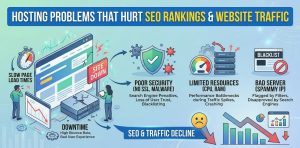
Many website owners focus heavily on content creation, keyword optimization, backlinks, and user experience while overlooking one of the most important foundations of search engine optimization: web hosting. Even the best content strategy can struggle to generate rankings if the underlying hosting environment creates performance bottlenecks, downtime, security vulnerabilities, or crawling issues. Search engines evaluate hundreds of ranking factors, and many of them are directly influenced by hosting quality. Poor hosting infrastructure can lead to slower page loads, reduced crawl efficiency, indexing challenges, increased bounce rates, and diminished user satisfaction. As search engines continue prioritizing user experience and website performance, hosting has become an increasingly important factor in maintaining strong visibility and sustainable organic traffic.
Understanding the Relationship Between Hosting and SEO
Web hosting serves as the foundation upon which every website operates. When a visitor accesses a website, the hosting server delivers all requested content including HTML files, images, scripts, stylesheets, and database information. Search engine crawlers rely on this same infrastructure when indexing content. If servers respond slowly, experience outages, or encounter technical failures, both users and search engines face difficulties accessing website content. These accessibility issues can negatively affect search rankings, crawl budgets, user engagement metrics, and ultimately overall website traffic. The stronger and more reliable the hosting environment, the better the website can support SEO objectives.
Server Downtime and Its Impact on Search Rankings
One of the most damaging hosting-related SEO problems is server downtime. Downtime occurs when a website becomes unavailable due to server failures, maintenance issues, resource exhaustion, hardware malfunctions, network disruptions, or hosting provider outages. When search engine crawlers repeatedly encounter inaccessible pages, they may reduce crawl frequency and temporarily remove certain URLs from search results. Extended periods of downtime can cause substantial ranking losses, traffic declines, and indexing issues. Frequent outages also create a poor user experience, leading to lost visitors, reduced trust, and missed business opportunities.
Slow Server Response Times Reduce Search Visibility
Search engines increasingly prioritize website speed as a ranking factor. A slow hosting environment often results in poor server response times, commonly measured through Time to First Byte (TTFB). When servers take too long to respond, page rendering slows down, negatively affecting user experience and Core Web Vitals metrics. Visitors expect websites to load quickly, and delays often lead to increased bounce rates and reduced engagement. Search engines interpret these signals as indicators of poor user satisfaction, which can contribute to ranking declines over time. Hosting environments with insufficient resources, overloaded shared servers, or outdated infrastructure frequently suffer from slow response times.
Poor Core Web Vitals Performance Due to Hosting Limitations
Google’s Core Web Vitals measure real-world user experience based on loading speed, interactivity, and visual stability. Hosting quality directly influences metrics such as Largest Contentful Paint (LCP), Interaction to Next Paint (INP), and Cumulative Layout Shift (CLS). While frontend optimization is important, hosting infrastructure significantly affects how quickly content is delivered to users. Servers with inadequate processing power, inefficient caching systems, or poor network connectivity often struggle to meet Core Web Vitals requirements. As these metrics increasingly influence SEO performance, hosting optimization becomes essential for maintaining competitive search rankings.
Resource Overloading on Shared Hosting Environments
Many website owners begin with low-cost shared hosting plans. While shared hosting can be economical, it introduces the risk of resource contention. Multiple websites operate on the same server and compete for CPU, memory, storage, and bandwidth resources. If one website experiences traffic spikes or excessive resource usage, neighboring websites may suffer performance degradation. This phenomenon, often called the “bad neighbor effect,” can result in slower loading speeds, temporary outages, and inconsistent website performance. These issues negatively impact both user experience and SEO outcomes.
Geographic Server Location and Website Performance
Server location influences website loading speed because data must travel between the server and the user. When servers are located far from the primary target audience, latency increases, resulting in slower page loads. Search engines consider user experience signals when determining rankings, making server proximity an important factor. Businesses targeting audiences in specific regions should select hosting providers with strategically located data centers or implement Content Delivery Networks (CDNs) to minimize latency and improve global performance.
DNS Issues Can Affect Website Accessibility
Domain Name System (DNS) services translate domain names into IP addresses, enabling users and search engines to access websites. Poor DNS performance, misconfigured records, or unreliable DNS providers can delay website access and create intermittent connectivity issues. Search engine crawlers encountering DNS failures may be unable to access website content consistently, affecting crawl efficiency and indexing. Reliable DNS infrastructure is therefore an essential component of SEO-friendly hosting environments.
Security Vulnerabilities and Their SEO Consequences
Website security has become a critical ranking consideration. Hosting environments lacking adequate security measures expose websites to malware infections, hacking attempts, unauthorized modifications, and spam injections. Compromised websites may receive security warnings in search results, experience deindexing, or suffer severe ranking penalties. Search engines prioritize user safety and may reduce visibility for websites that pose security risks. Strong hosting security, regular patching, malware monitoring, and proactive threat detection are essential for protecting SEO performance.
SSL Certificate Problems Can Harm Rankings
HTTPS has been a confirmed ranking signal for years. Websites operating without valid SSL certificates may display browser security warnings that discourage visitors from continuing. Expired certificates, misconfigured SSL installations, and mixed-content issues can also create trust concerns for both users and search engines. Secure hosting providers simplify SSL deployment and management, ensuring continuous HTTPS protection that supports user trust and SEO performance.
Limited Scalability During Traffic Surges
Successful SEO campaigns often generate significant traffic growth. However, websites hosted on inflexible infrastructure may struggle to handle sudden increases in visitors. Traffic spikes can overwhelm server resources, causing slowdowns, timeouts, and outages. Search engines monitoring website accessibility during these periods may detect performance issues that negatively affect rankings. Scalable hosting solutions allow websites to accommodate growth without sacrificing performance or reliability.
Inadequate Backup Systems Increase SEO Risks
Unexpected data loss caused by cyberattacks, software failures, human errors, or server crashes can significantly impact SEO. Lost content, missing databases, broken pages, and damaged site structures may take weeks or months to recover. Reliable hosting providers implement automated backups, disaster recovery strategies, and restoration mechanisms that help preserve website integrity and search visibility during unexpected incidents.
Poor Hosting Can Affect Crawl Budget Efficiency
Search engines allocate a crawl budget that determines how frequently they visit and index website pages. Websites experiencing server errors, slow responses, or accessibility issues may waste valuable crawl resources. As a result, important content updates may take longer to appear in search results. Optimized hosting environments improve crawl efficiency by providing fast, reliable access to website content, allowing search engines to index pages more effectively.
Database Performance Issues and SEO Impact
Dynamic websites depend heavily on database performance. Slow database queries, inefficient configurations, and overloaded database servers can delay page generation and increase loading times. E-commerce platforms, content management systems, and large-scale websites are especially vulnerable to database-related performance bottlenecks. Optimizing hosting infrastructure for database performance contributes directly to improved page speed, better user experience, and stronger SEO results.
Email Deliverability Problems and Brand Trust
Although email hosting does not directly influence search rankings, poor email infrastructure can indirectly impact website credibility and business operations. Lost inquiries, failed customer communications, and damaged brand reputation can reduce engagement and conversions. Reliable hosting providers typically offer robust email services that support overall business performance and customer trust.
How to Identify Hosting Problems Affecting SEO
Website owners should regularly monitor uptime, server response times, Core Web Vitals, page speed metrics, security incidents, crawl statistics, and indexing reports. Tools such as Google Search Console, Google PageSpeed Insights, uptime monitoring platforms, and server performance dashboards provide valuable insights into hosting-related issues. Proactive monitoring allows problems to be identified and resolved before they significantly affect rankings or traffic.
Best Practices for Choosing SEO-Friendly Hosting
Selecting the right hosting provider requires evaluating performance, uptime guarantees, scalability, security measures, server locations, support quality, backup systems, and infrastructure reliability. Modern websites benefit from SSD or NVMe storage, advanced caching technologies, Content Delivery Networks, proactive monitoring, automated backups, and robust security controls. Investing in quality hosting often delivers substantial long-term SEO benefits by improving performance, accessibility, and user satisfaction.
WEBSITE PERFORMANCE & SEO
Is Your Hosting Environment Secretly Hurting Your SEO Rankings?
Even the best SEO strategy can struggle if your website suffers from slow server response times, frequent downtime, poor Core Web Vitals, or hosting-related performance issues. Regularly monitoring your hosting infrastructure helps ensure optimal website speed, better user experience, improved search visibility, and sustainable organic traffic growth.
Conclusion: Hosting Is a Foundational SEO Investment
SEO success depends on far more than content and backlinks. Hosting infrastructure influences website speed, uptime, crawlability, security, scalability, and overall user experience. Even minor hosting issues can gradually erode rankings and traffic over time. Businesses that prioritize reliable, high-performance hosting create a stronger technical foundation for sustainable organic growth. By addressing hosting-related problems proactively, website owners can improve search visibility, enhance user experience, and maximize the long-term effectiveness of their SEO strategies.
Frequently Asked Questions (FAQs)
Can web hosting affect SEO rankings?
Yes. Web hosting directly impacts website speed, uptime, security, crawlability, and user experience. Poor hosting performance can negatively affect search engine rankings and organic traffic.
How does server downtime impact website SEO?
When a website experiences frequent downtime, search engine crawlers may be unable to access pages for indexing. Prolonged or repeated outages can reduce search visibility and lead to ranking declines.
Does slow hosting affect website traffic?
Yes. Slow hosting increases page load times, which can lead to higher bounce rates and lower user engagement. Search engines may interpret these signals as poor user experience, potentially affecting rankings and traffic.
What hosting features are important for SEO?
SEO-friendly hosting should provide high uptime, fast server response times, SSD or NVMe storage, SSL support, reliable security measures, automated backups, and scalable infrastructure.
Can shared hosting hurt SEO performance?
Shared hosting can affect SEO if server resources become overloaded. Performance issues caused by neighboring websites may result in slower page speeds, reduced reliability, and a weaker user experience.