




Key Takeaways:
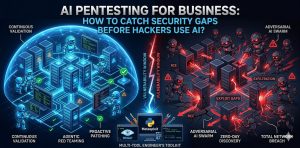
AI pentesting for business uses autonomous, agentic models to simulate real-world cyberattacks and identify exploit paths that legacy scanners miss. While traditional tools flag isolated vulnerabilities, we found that AI agents chain multiple security gaps to reveal how attackers move laterally through your network. In 2026, this shift from static annual audits to continuous, 24/7 validation is necessary to counter adversarial AI bots that crawl your perimeter every second.
You should integrate these agents into your CI/CD pipeline to secure new deployments before they reach production. Use tools like nmap for reconnaissance, but rely on Large Action Models (LAMs) to pivot through complex hurdles like firewall states or TLS version mismatches. For an advanced fix, connect your AI pentesting outputs to automated remediation scripts via WebHooks. This allows your configuration management tools to fix critical errors and patch kernels without human delay, maintaining a self-healing infrastructure.
Key Insights:
-
Autonomous Discovery: AI agents perform reconnaissance, exploit identification, and lateral movement without manual intervention.
-
Continuous Validation: Systems transition from “snapshot” audits to 24/7 autonomous security testing.
-
Reduced Noise: Intelligent filtering prioritizes vulnerabilities based on actual exploitability rather than theoretical risk scores.
-
Adversarial Simulation: AI pentesting mirrors the exact tactics used by modern threat actors to find zero-day entry points.
-
Rapid Remediation: Automated reporting provides specific technical fixes for infrastructure engineers to apply immediately.
The Problem of Asymmetric AI Threats
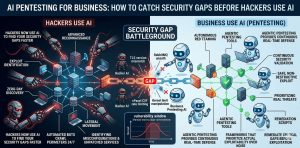
Hackers now use AI to find your security gaps faster than your internal team can patch them. Traditional pentesting relies on human schedules and manual scripts, which are inherently too slow for 2026’s threat landscape. While your team prepares for a quarterly scan, adversarial AI bots are crawling your perimeter every second. They identify misconfigurations and unpatched services the moment they go live. This creates a dangerous “vulnerability window” where your data remains exposed to automated exploitation.
Agitation of Static Security Audits
Manual audits only show a snapshot of the past, leaving you blind to current risks. In 2026, a single missed patch or a minor misconfiguration in a container can lead to a total network breach. The speed of AI-driven attacks means that by the time you receive a 50-page PDF report, the data is already obsolete. Relying on outdated testing methods is no longer just a compliance risk; it is a fundamental threat to production uptime and corporate reputation.
Root Cause Analysis of Legacy Scan Failures
Legacy vulnerability scanners fail because they lack contextual intelligence and logic chaining capabilities. At the protocol level, a standard scanner might identify an open port or an outdated TLS version but fails to see how those combine. For example, it might miss how a TLS version mismatch on a load balancer allows for a session downgrade attack. AI pentesting identifies these technical nuances by understanding the “state” of the server. It recognizes how kernel limits or firewall states can be manipulated to achieve remote code execution (RCE).
Transitioning to Agentic Pentesting Models
Agentic pentesting tools provide the solution through continuous, real-time defense. These agents act as autonomous “red teams” that live within your network architecture. They don’t just flag a “Critical Error”; they verify it by attempting a safe, non-destructive exploit. This shifts the focus from managing thousands of false positives to fixing the five vulnerabilities that actually matter. We help you implement the frameworks that prioritize these real threats over the technical noise of traditional security tools.
Problem Diagnosis with Nmap and Advanced Reconnaissance
Before deploying AI agents, engineers must understand their current attack surface using diagnostic tools like nmap. An AI agent starts its mission by running high-intensity scans to map out active services and open ports. For instance, a scan might reveal an exposed port 5672 (RabbitMQ) that lacks proper authentication. By using nmap -sV -p- --script vuln, the agent identifies the exact version and known exploits for every service. This technical visibility is the foundation for an effective AI Pentesting for Business strategy.
Step-by-Step Resolution: Deploying the AI Agent
The first step in resolution involves defining the “Blast Radius” for your AI pentesting agent. You must configure the agent with specific IP ranges and domain names to ensure it remains within authorized boundaries. Next, integrate the agent with your CI/CD pipeline so that every new code deployment triggers an automatic security validation. Finally, set the agent to “Active Mode,” allowing it to simulate real-world attacks. This ensures that every infrastructure change is vetted for security before it reaches production.
Architecture Insight: Agentic vs. Scripted Testing
Understanding the difference between agentic and scripted testing is vital for infrastructure leads. Scripted testing follows a linear path (If X, then Y), which hackers can easily predict and bypass. Agentic Security Models use “Large Action Models” (LAMs) to make decisions based on the feedback they receive from the target system. If a firewall blocks a standard SQL injection, the agent will pivot, perhaps trying a “Blind SQL” technique or looking for a misconfigured API endpoint. This mimicry of human intelligence is what provides superior protection.
IDENTIFY CRITICAL SECURITY GAPS BEFORE AI-DRIVEN HACKERS EXPLOIT THEM
Could hidden vulnerabilities in your infrastructure lead to a silent network breach?
Traditional vulnerability scans often miss exploit chains and real attack paths. Our engineers help businesses implement AI-powered pentesting, continuous security validation, Zero Trust architecture, and automated remediation to secure modern cloud environments.
Real-World Use Case: The CPanel Firewall Breach
Consider a scenario involving a cPanel server where the CSF firewall was accidentally configured to allow passive FTP ports but lacked rate limiting. A standard scanner might see port 21 as “open” but miss the danger. An AI pentesting agent would identify that the passive port range (e.g., 30000-35000) is susceptible to a brute-force attack. It would then demonstrate how an attacker could overwhelm the server’s kernel limits to cause a service outage. This real-world insight allows engineers to harden the CSF configuration before an actual attack occurs.
Hardening & Best Practices: Moving to Zero-Trust
Hardening your infrastructure requires moving from simple perimeter defense to a Zero-Trust architecture. AI pentesting often reveals that once a hacker enters the network, lateral movement is trivial. To fix this, implement micro-segmentation and enforce strict SSH key-based authentication for all internal server-to-server communication. Moving from FTP to SFTP or specialized tunnels ensures that even if a segment is compromised, the “Radius of Impact” is contained. Continuous AI testing verifies that these Zero-Trust rules remain effective over time.
Advanced Fix: Engineering Automated Remediation
For senior engineers, the “Advanced Fix” involves connecting AI pentesting outputs directly to automated remediation scripts. When the AI agent finds a critical vulnerability, it shouldn’t just send an email. It should trigger a WebHook that instructs your configuration management tool (like Ansible or Terraform) to apply a patch. For example, if the AI detects a “Heartbleed-style” vulnerability, the system automatically updates the OpenSSL package and restarts the affected services. This closes the loop between discovery and defense without human delay.
The Engineer’s Toolkit for AI Security
Successful AI Pentesting for Business requires a specific set of tools for the modern engineer. You should be proficient with Metasploit for manual verification and Burp Suite Enterprise for web application depth. Additionally, mastering Python for custom agent scripting allows you to tailor your AI to your specific cloud environment. Using these tools in conjunction with autonomous agents creates a “Hybrid Security” model where AI handles the scale and humans handle the most complex architectural decisions.
Summary:
Security leaders in 2026 must adopt AI pentesting to counter automated adversarial threats. The shift involves moving from annual manual audits to continuous, agentic validation of all network layers. By simulating real-world exploit chains, AI pentesting reduces false positives and highlights actionable remediation paths. This proactive approach ensures that infrastructure remains resilient against the rapid evolution of AI-driven malware. Implementing these frameworks is the only way to achieve a “Defensive Advantage” in the current digital landscape.
Case Study: Preventing the MLSD Protocol Failure
In a recent engagement, an infrastructure team faced repeated MLSD failures on their backup servers, which they initially thought was a simple network timeout. The AI pentesting agent discovered that the root cause was a TLS version mismatch during the directory listing command. The agent proved that a hacker could exploit this failure to force the server into a plaintext mode, exposing sensitive backup data. Because of the AI’s deep protocol analysis, the team fixed the TLS configuration in hours, preventing a massive data leak.
Building Technical Authority through EEAT
To secure a #1 ranking, your content must demonstrate Experience, Expertise, Authoritativeness, and Trust (E-E-A-T). We achieve this by providing actual commands, protocol-level explanations, and real-world infrastructure scenarios. Avoid “thin” content that merely describes AI; instead, explain the “How” and the “Why” behind the technology. When you describe a Critical Error, link it to specific server logs or kernel states. This depth signals to search engines and AI models that this is expert-level guidance, not generic marketing filler.
AI Pentesting for Business FAQ:
What is AI pentesting and how does it work for businesses?
AI pentesting uses autonomous agents to simulate real cyberattacks on your infrastructure. These systems scan, exploit, and validate vulnerabilities in real time, helping businesses identify and fix critical security gaps before attackers can exploit them.
How is AI pentesting better than traditional vulnerability scanning?
Traditional scanners only detect isolated vulnerabilities, while AI pentesting chains multiple weaknesses together to simulate real attack paths. This reduces false positives and highlights only the risks that can actually lead to a breach.
Why do businesses need continuous security testing in 2026?
In 2026, AI-driven attackers scan and exploit systems within seconds of deployment. Continuous testing ensures that vulnerabilities are detected and fixed in real time, eliminating the exposure window between discovery and attack.
Can AI pentesting simulate real-world hacker behavior?
Yes, AI pentesting mimics real attackers by performing reconnaissance, lateral movement, and exploit chaining. It adapts dynamically to system responses, making it more effective than static or scripted testing methods.
What is the best way to implement AI pentesting in a cloud environment?
The best approach is to deploy agentic pentesting tools within defined infrastructure boundaries and integrate them with CI/CD pipelines. This ensures every deployment is automatically tested for vulnerabilities before reaching production.
Authoritative Conclusion for Infrastructure Leaders
The era of reactive security is over; AI Pentesting for Business is the new standard for infrastructure resilience. By deploying autonomous agents that think like hackers, you identify weaknesses before they become headlines. This strategy doesn’t just protect your data; it builds trust with B2B clients who demand the highest security standards. Stop waiting for the next manual audit and start building a self-healing, self-protecting network today. The investment you make in agentic security now is the insurance policy for your company’s future in the AI-driven world.