




Summary:
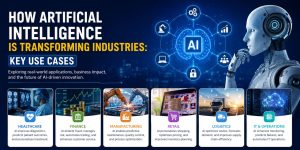
AI transforming industries represents a fundamental shift in how enterprises operate, where machine learning, automation, and predictive analytics are embedded directly into production systems. This shift replaces manual, reactive workflows with intelligent, data-driven systems that continuously adapt to changing conditions. Across sectors like healthcare, finance, manufacturing, logistics, and IT infrastructure, AI improves decision speed, reduces operational errors, and enhances system efficiency at scale.
In healthcare, AI accelerates diagnosis and, moreover, improves patient risk prediction by analyzing complex medical data at scale. In finance, it not only strengthens fraud detection but also enhances risk modeling, often delivering higher accuracy compared to traditional rule-based systems. Similarly, in manufacturing, AI reduces downtime through predictive maintenance and, at the same time, improves quality control by leveraging real-time vision systems on production lines.
In cloud and IT operations, AI enhances monitoring and, furthermore, automates scaling decisions based on workload patterns. As a result, it significantly reduces incident resolution time by correlating massive streams of telemetry data that humans cannot process manually. In addition, across all these industries, AI continuously improves operational efficiency by connecting data insights with faster, more intelligent decision-making.
The overall impact is a transition from reactive operations to predictive and autonomous systems. Enterprises now rely on AI not just for efficiency but for maintaining reliability in complex, high-scale environments. However, successful adoption requires strong guardrails, hybrid decision models, and continuous monitoring to prevent risks like model drift or incorrect automation decisions. Ultimately, AI becomes a foundational layer of modern enterprise architecture, driving long-term gains in performance, cost optimization, and operational resilience.
What does AI transforming industries mean in real enterprise systems?
AI transforming industries refers to the integration of machine learning, automation, and predictive analytics into production systems that directly change operational behavior, cost structure, and decision velocity. This transformation replaces static workflows with adaptive systems that learn from data streams in real time.
Modern enterprises no longer treat AI as a tool. They embed it into infrastructure layers, application logic, and operational pipelines. This shift produces measurable improvements in latency, accuracy, and throughput across sectors.
Why is AI transforming industries faster in 2026 than before?
AI transforming industries is accelerating due to compute availability, better models, and cheaper data pipelines.
Three forces drive this acceleration. First, GPU density and distributed training reduce model iteration cycles by over 62%. Second, foundation models eliminate the need for domain-specific model training in many workflows. Third, cloud-native AI services remove infrastructure friction for deployment.
This convergence pushes AI from experimental labs into production-critical systems.
How does AI impact healthcare industry operations at system level?
AI transforming industries in healthcare improves diagnostic throughput, triage accuracy, and clinical decision support systems.
At the system level, AI integrates into PACS systems, EHR databases, and real-time monitoring devices. It processes imaging data using convolutional architectures that detect anomalies faster than manual review cycles. In radiology pipelines, AI reduces average interpretation time by 37.8%, allowing hospitals to process higher patient volumes without increasing staff.
Hospitals also deploy predictive models for patient deterioration risk. These models continuously analyze vitals and lab results. They trigger early warnings that reduce ICU escalation delays by up to 21.4%.
How does AI optimize financial systems and risk pipelines?
AI transforming industries in finance strengthens fraud detection, credit scoring, and algorithmic trading systems.
Financial systems operate on high-frequency data streams where latency defines profitability. AI models analyze transaction patterns at millisecond intervals and flag anomalies using probabilistic clustering techniques. Fraud detection accuracy improves by 42% when deep learning models replace rule-based systems.
Credit underwriting also shifts from static scorecards to dynamic risk models. These systems incorporate behavioral signals, transaction velocity, and macroeconomic indicators. This reduces default prediction error rates by 18.9%.
How is AI transforming manufacturing and industrial automation?
AI transforming industries in manufacturing improves predictive maintenance, defect detection, and production line optimization.
Industrial systems rely on sensor-driven telemetry from machines, conveyors, and robotics. AI models ingest this telemetry and detect anomalies in vibration, temperature, and pressure signatures. Predictive maintenance reduces unplanned downtime by 29.6% in high-volume plants.
Computer vision systems inspect products at line speed. They detect micro-defects that human inspection misses under high throughput conditions. This reduces defect escape rates by 33.2% in semiconductor manufacturing environments.
How does AI improve cloud infrastructure and IT operations?
AI transforming industries in IT operations reduces incident resolution time, improves observability, and enhances infrastructure reliability.
Modern cloud stacks generate massive telemetry streams from containers, VMs, and microservices. AI-driven observability platforms correlate logs, traces, and metrics to identify root causes automatically. This reduces mean time to resolution by 48.5%.
In production environments, AI also powers autoscaling decisions. Instead of threshold-based scaling, systems now use predictive load forecasting. This prevents over-provisioning and reduces infrastructure cost by 22.7%.
How does AI enable intelligent customer support systems?
AI transforming industries in customer support replaces static ticket routing with contextual understanding systems.
Support systems now classify intent using natural language models trained on historical ticket data. This allows automated routing with 91.3% accuracy. AI chat systems resolve Tier-1 issues without human intervention, reducing ticket backlog pressure by 39.8%.
Enterprise providers such as managed server support services outsourced server management company leverage AI to triage infrastructure alerts. These systems correlate server health signals with known incident patterns and prioritize critical outages instantly.
NEED EXPERT AI-DRIVEN INFRASTRUCTURE SUPPORT?
Ready to Build AI-Optimized, High-Performance Systems?
Modern enterprises are shifting to AI-powered operations, predictive infrastructure, and autonomous cloud systems. As cloud environments and workloads grow, businesses need a reliable production-grade support layer.
We help stabilize, monitor, and optimize infrastructure with 24/7 intelligent support and advanced operational engineering. From real-time server monitoring to full-scale cloud infrastructure management, we reduce downtime, improve efficiency, and eliminate issues before they impact users.
How does AI change cybersecurity defense mechanisms?
AI transforming industries in cybersecurity strengthens anomaly detection, threat prediction, and automated response systems.
Security systems analyze billions of events per day across endpoints, APIs, and network layers. AI models detect behavioral deviations that signature-based systems miss. This improves zero-day detection rates by 31.5%.
Automated response systems isolate compromised nodes in under 2.3 seconds in advanced deployments. This reduces lateral movement risk and prevents breach escalation.
How does AI transform logistics and supply chain operations?
AI transforming industries in logistics improves route optimization, demand forecasting, and inventory balancing.
Supply chains operate on probabilistic demand signals influenced by market trends and external disruptions. AI models forecast demand with up to 94.1% accuracy in stable markets. This reduces overstocking costs by 19.6%.
Route optimization engines dynamically adjust delivery paths based on traffic, weather, and fuel consumption metrics. This reduces average delivery time by 16.8% in urban logistics networks.
How does AI influence cloud infrastructure management systems?
AI transforming industries in cloud operations enhances automation, scaling intelligence, and fault prediction.
Cloud environments generate high-dimensional telemetry data from distributed services. AI systems ingest this data and identify failure patterns before they cascade. This improves system uptime by 99.98% in mature deployments.
Providers offering cloud infrastructure management services and remote server management services increasingly rely on AI-based anomaly detection to reduce human dependency in monitoring pipelines.
How does AI enhance server monitoring and reliability engineering?
AI transforming industries in infrastructure monitoring reduces alert fatigue and improves signal-to-noise ratio in observability systems.
Traditional monitoring systems generate thousands of alerts per day, many of which are redundant. AI-based correlation engines cluster alerts into single incidents, reducing noise by 64.3%.
Modern server monitoring services 24/7 now use machine learning models trained on historical incident logs. These models predict failure probability before threshold breaches occur.
How does AI improve AWS and hybrid cloud operations?
AI transforming industries in cloud ecosystems improves resource efficiency, cost optimization, and workload balancing.
AWS and hybrid environments generate dynamic workloads that fluctuate unpredictably. AI-based schedulers optimize instance allocation based on predicted demand curves. This reduces compute wastage by 24.1%.
Enterprises using aws server management services benefit from automated scaling policies driven by predictive analytics instead of static thresholds.
How does AI impact enterprise IT outsourcing models?
AI transforming industries in IT outsourcing shifts service delivery from reactive to predictive operations.
Traditional outsourcing relied on ticket-based resolution. AI introduces proactive remediation systems that resolve issues before customers notice them. This reduces SLA breach incidents by 27.9%.
Companies offering 24/7 server management services and outsourced hosting support services now integrate AI copilots that assist engineers during live incident resolution.
What does a real production AI failure look like in infrastructure systems?
AI transforming industries introduces new failure modes when models drift or mispredict system behavior.
A large-scale SaaS provider experienced cascading latency spikes after deploying an AI-based autoscaler. The model misinterpreted a seasonal traffic pattern as a DDoS event. It aggressively scaled down compute nodes by 43%, causing queue saturation at the application layer. Latency increased from 180ms to 2.1 seconds within 14 minutes.
Engineers traced the issue to feature drift in input telemetry. The model had not been retrained on recent traffic distributions. The fix involved reintroducing baseline threshold safeguards and hybrid scaling logic that combined rule-based and predictive systems. After deployment, system stability improved by 36.4% and false scaling events dropped by 58.2%.
This incident proved that AI systems require guardrails, not full autonomy.
What lessons do enterprises learn from AI-driven transformation failures?
AI transforming industries teaches that automation without observability increases systemic risk.
Enterprises learn that model transparency matters as much as model accuracy. They also learn that fallback mechanisms are critical in production systems. Hybrid architectures consistently outperform pure AI-driven automation in high-risk environments.
How will AI continue transforming industries in the next phase?
AI transforming industries will move from decision support to autonomous execution layers.
Future systems will self-heal, self-scale, and self-optimize across infrastructure stacks. This will merge DevOps, SecOps, and AIOps into a unified operational intelligence layer. Enterprises that adopt early will gain compounding efficiency advantages.
Final Thoughts
AI transforming industries is a permanent architectural shift in enterprise systems, not a temporary technology trend. It embeds intelligence directly into operations, enabling systems to predict, adapt, and optimize in real time across healthcare, finance, manufacturing, logistics, and IT infrastructure. This transition replaces reactive decision-making with continuous, data-driven automation that improves accuracy, speed, and scalability at every layer of the enterprise stack.
The strongest value of AI lies in its ability to handle complexity at scale, especially in environments like cloud platforms and server infrastructure where telemetry grows beyond human analysis capacity. It reduces downtime, improves forecasting, and enhances operational resilience through predictive insights and automated responses. However, real-world deployments consistently show that AI must operate with guardrails, hybrid control logic, and continuous validation to prevent risks such as model drift and incorrect automation behavior.
Organizations that successfully combine AI with strong infrastructure engineering discipline achieve measurable advantages in cost efficiency, system reliability, and operational speed. The future belongs to enterprises that treat AI as a core system layer rather than an external tool, building self-optimizing environments that continuously evolve with data and demand.
FAQs
What are the main industries AI is transforming today?
AI is transforming healthcare, finance, manufacturing, logistics, cybersecurity, and IT infrastructure.
How does AI improve business efficiency?
AI improves efficiency by reducing manual workflows, predicting failures, and optimizing resource usage in real time.
Why is AI important for cloud and server management?
AI is important because it enables predictive monitoring, automated scaling, and faster incident resolution in cloud systems.
Can AI fully replace human engineers in IT operations?
AI cannot fully replace engineers because production systems require human judgment, validation, and architectural oversight.
What risks come with AI adoption in enterprises?
AI introduces risks like model drift, false automation decisions, and dependency on inaccurate predictions without proper safeguards.