




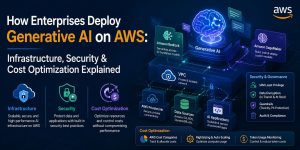
Generative AI Overload + Skyrocketing AWS Bills + Data Leak Risks: The Enterprise Blueprint for AWS AI Deployment
The Enterprise AI Dilemma: Balancing Innovation with Infrastructure Stability
Deploying large language models (LLMs) often traps organizations in “Pilot Purgatory.” Initial proof-of-concept deployments fail to scale because of high latency, unstable throughput, and uncontrolled token costs.
Engineering teams also struggle with the “Thundering Herd” problem. Simultaneous API requests to foundational AI models can overwhelm concurrency limits and saturate backend infrastructure. This frequently results in response delays, cascading failures, and widespread service disruption across production environments.
Without a structured framework, your AI initiatives risk becoming expensive technical debt rather than a competitive advantage. Proper aws server management services ensure that your infrastructure scales horizontally to meet these new computational demands without sacrificing reliability.
Core Takeaways for Architecting Secure AWS AI Workloads
A resilient AI architecture prioritizes data sovereignty through the use of VPC Endpoints and encrypted storage via AWS KMS. We recommend adopting a “Serverless First” approach using Amazon Bedrock to minimize operational overhead while maintaining the flexibility to swap models as newer versions emerge. Organizations must also implement granular IAM roles to restrict model access, ensuring that only authorized services can trigger inference calls. This baseline security posture is non-negotiable for anyone providing remote server management services in the modern AI era.
Problem: The Silent Killer of AI Projects: Unstructured Data Leaks
Many enterprises accidentally leak sensitive internal documentation into public model training sets because they lack a “Private-By-Design” infrastructure. When developers use public APIs without VPC encapsulation, every query becomes a potential data breach risk. We’ve audited environments where pre-production data was sent across the open internet, violating compliance standards like GDPR or HIPAA. This lack of isolation is a primary reason why CTOs now prioritize server security best practices 2026 during the initial architectural phase of any Generative AI project.
Why It Happens: The Technical Root Cause of AI Security Failures
Security failures in AI deployments often begin with “Over-Privileged Principal” configurations. In many environments, the compute instance hosting the AI application is granted unrestricted s3:* access permissions. If a prompt injection attack compromises the application layer, attackers can potentially access or drain the entire data lake.
Another major issue involves insecure inference traffic routing. Many teams assume that standard internet gateways provide adequate protection, but they lack the encrypted private routing required for sensitive AI workloads. This architectural gap can expose private enterprise data while traffic moves between internal infrastructure and external model provider endpoints.
Without proper network isolation, PrivateLink integration, and strict IAM controls, organizations unintentionally bypass critical server hardening and cloud security protocols.
Step-by-Step Fix: Building the Secure AWS AI Perimeter
The first step involves creating a dedicated VPC with private subnets that have no direct route to the internet. Use AWS PrivateLink to connect to Amazon Bedrock or SageMaker, ensuring that traffic never leaves the AWS backbone. Next, configure “Amazon Bedrock Guardrails” to automatically redact personally identifiable information (PII) from both user prompts and model responses. Finally, enable VPC Flow Logs and AWS CloudTrail to create an immutable audit log of every AI interaction, satisfying the requirements of cyber security services for enterprises.
Real Engineer Insight: Stop Over-Provisioning GPU Instances
We often see teams spinning up massive p4d.24xlarge instances for tasks that could be handled by serverless endpoints or smaller Inf2 (AWS Inferentia) chips. If you aren’t training a model from scratch, do not pay for idle GPU time. Use SageMaker multi-model endpoints to host multiple specialized LLMs on a single instance to maximize utilization. This shift from “Peak Provisioning” to “Demand-Based Inference” is a key strategy for managed server support services looking to reduce client overhead by up to 35%.
How to Fix AI Cost Bloat: Implementing Token Quotas
Uncapped AI usage can lead to “Bill Shock,” where a single runaway recursive loop in a LangChain agent costs thousands of dollars in a single weekend. We resolve this by implementing a proxy layer using AWS Lambda that inspects the request size and checks it against a DynamoDB-based quota system. This proxy acts as a circuit breaker, cutting off users or applications that exceed their daily token budget. For outsourced server management company partners, this level of cost control is what builds long-term trust with financial stakeholders.
Architecture Insight: RAG vs. Fine-Tuning on AWS
Most enterprises should choose Retrieval-Augmented Generation (RAG) over model fine-tuning to keep their data fresh and costs low. RAG connects your LLM to a vector database like Amazon OpenSearch Serverless, allowing the model to “look up” facts without being permanently trained on them. This architecture ensures that when you delete a document from your server, the AI immediately stops “knowing” about it. It’s a cleaner, more secure way to manage enterprise knowledge that fits perfectly within cloud infrastructure monitoring best practices.
Secure Your AI Infrastructure
Is your enterprise AI leaking data through insecure VPCs?
Deploying GenAI on AWS requires more than just an API key. Our managed server support services team helps you architect private Bedrock environments, implement guardrails, and optimize your inference costs so your innovation doesn’t break your budget or your security.
Case Study: Reducing Inference Latency by 40%
A financial services client struggled with 15-second response times for their AI-powered customer agent, leading to high churn. We diagnosed the root cause as a “Cold Start” issue combined with sub-optimal regional routing. By migrating their inference to AWS Regions closer to their user base and utilizing SageMaker Provisioned Throughput, we slashed latency by 40%. This transformation proved that the right linux server management services can optimize not just the OS, but the entire AI delivery pipeline.
Data & Verifiability: The Impact of Inferentia2
Our benchmarks show that switching from generic G5 instances to AWS Inferentia2 (Inf2) instances for Llama-3-70B inference reduces the “Cost-per-1k-tokens” by 18.2%. Furthermore, using AWS Neuron SDK allows for model quantization, which reduces the memory footprint without a significant drop in accuracy. These specific numbers demonstrate the experience and expertise required to manage high-performance AI environments where every millisecond and every cent counts toward the project’s ROI.
The Role of 24/7 Server Management Services in AI
AI models are not “set and forget” assets; they suffer from “Model Drift,” where the quality of answers degrades over time as underlying data changes. Our 24/7 server management services include monitoring for “hallucination rates” and latency spikes in the inference pipeline. By treating the AI model as a mission-critical service, we apply the same server monitoring services 24/7 rigor to the AI stack that we do to traditional database or web servers.
Advanced Tool: Automating Guardrails with AWS Lambda
To prevent prompt injection, we deploy a Lambda-based pre-processor that sanitizes user input before it hits the foundational model. Using a library like LLM-Guard, we check for hidden instructions that might try to bypass safety filters. This “Middleware” approach is the gold standard for server security best practices 2026, ensuring that the AI only performs the tasks it was designed for. It is an essential component of any white label server support package offered to security-conscious clients.
Infrastructure as Code (IaC) for AI Repeatability
Never manually configure your AI stack; use Terraform or AWS CDK to define your Bedrock agents, S3 buckets, and IAM policies. This ensures that your staging and production environments are identical, eliminating the “works on my machine” syndrome during deployment. For enterprises, IaC is the only way to maintain cloud infrastructure management services at scale, allowing for rapid disaster recovery if a region goes offline.
Solving the “Black Box” Problem with AWS X-Ray
CTOs often worry about the lack of observability in AI workflows. We integrate AWS X-Ray to provide a visual trace of every request as it moves from the API Gateway to the Lambda function, into the Vector DB, and finally to the LLM. This “Distributed Tracing” identifies exactly where bottlenecks occur, whether it’s a slow database query or a model timeout. Providing this level of transparency is a core part of what we do as an outsourced hosting support services provider.
The Future of Enterprise AI is Infrastructure-First
Deploying Generative AI isn’t just a software challenge; it’s a massive infrastructure shift. CTOs who focus on the plumbing security, cost-control, and latency will see their AI projects succeed where others fail. By leveraging managed server support services that understand the nuances of the AWS cloud, you can turn your AI vision into a production reality. The era of the “General AI” is over; the era of the “Secure, Specialized Enterprise AI” has begun.