




Quick Breakdown: Your Browser Is the New Security Hole
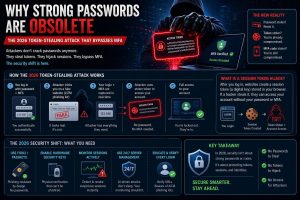
Strong passwords and traditional MFA have collapsed because modern Adversary-in-the-Middle (AiTM) and Browser-in-the-Browser (BitB) attacks steal authenticated session tokens directly from browser memory. We found that phishing kits like EvilProxy now bypass 6-digit SMS codes by acting as a live proxy to capture session cookies in real-time. To fix this and maintain production uptime, you should implement phishing-resistant FIDO2 hardware keys to cryptographically bind identities to physical devices.
You must also secure your infrastructure by moving to a Continuous Access Evaluation (CAE) model. We found that because stolen tokens are portable, you should use token binding to tie sessions to a device’s TPM and shorten token lifetimes for privileged accounts. By integrating 24/7 server monitoring to detect “impossible travel” anomalies, you can instantly revoke hijacked sessions and stop automated AI-driven botnets from gaining root access.
Identity Theft at the Speed of Light
Once a token-stealing attack bypasses MFA and the threat actor possesses your session token, they effectively become you. They do not need to know your password or bypass your MFA again; they are already in your Gmail, Google Drive, and cPanel accounts. Within 30 seconds, an automated script can change your recovery email and revoke your own access. For a Linux server management service, this means a single compromised engineer could grant a hacker root access to an entire data center fleet before the first security alert even triggers.
Why Standard MFA Fails the Handshake
The technical root cause of this failure lies in the lack of “Origin Binding” in traditionalMFAmethods like TOTP or SMS. When a server issues a session token (typically a JWT or secure cookie), it is often “portable.” Hackers exploit this by replaying the stolen token from their own infrastructure. Standard firewall-cmd rules cannot block this because the traffic appears as a legitimate, authenticated HTTPS session on port 443. This “MFA theater” protects the login event but leaves the resulting session completely unprotected.
Summary:
Modern security requires a shift from “Point-in-Time” authentication to Continuous Access Evaluation (CAE). The 2026 threat landscape proves that a token-stealing attack bypasses MFA so easily that push-notifications are no longer defensible. Key infrastructure defenses include:
-
Enforcing FIDO2/WebAuthn: Cryptographically binding credentials to the legitimate domain.
-
Implementing Token Binding: Tying session tokens to the TPM (Trusted Platform Module) of a specific device.
-
Shortening Token Lifetimes: Reducing idle timeouts to under 15 minutes for privileged accounts.
-
IP Anomaly Detection: Instantly revoking sessions that migrate across different ASNs or geographies.
Problem Diagnosis: Auditing Session Anomalies with Nmap and Logs
To identify if your team is being targeted by BitB attacks, engineers must monitor for “impossible travel” anomalies. Use nmap to audit for unauthorized reverse proxies on your network and review /var/log/auth.log for suspicious activity. If a user session originates from a residential ISP but suddenly switches to a headless data center IP, the session is likely hijacked. This level of granularity is essential for 24/7 server management services to prevent a minor breach from escalating into a full-scale infrastructure wipeout.
Step-by-Step Resolution: Transitioning to FIDO2 Hardware Keys
The only definitive fix for AiTM attacks is the implementation of FIDO2/WebAuthn. Unlike traditional MFA, FIDO2 requires a hardware-level cryptographic handshake that is bound to the specific domain. If a user attempts to authenticate on a phishing site, the YubiKey will refuse to sign the challenge because the origins do not match. This “Origin Bound” security prevents token-stealing at the protocol level, ensuring that even if a user is tricked into entering their password, the session remains secure.
Architecture Insight: Moving to Token Binding and Device Trust
To truly secure Linux servers from hackers, you must implement Token Protection in your Conditional Access policies. This architecture ties the session token to the hardware signature of the device used during login. If a hacker steals the token and attempts to use it from a different machine, the server rejects it because the hardware-bound identity is missing. This shift is the gold standard because it ensures that even if a token-stealing attack bypasses MFA, the stolen session cannot be used on an unauthorized device.
STOP TOKEN-STEALING ATTACKS BEFORE THEY BYPASS YOUR MFA
Could stolen session tokens give hackers full access to your servers and cloud accounts?
Modern AiTM and browser-based attacks can bypass traditional MFA by hijacking authenticated sessions in real time. Our engineers help secure infrastructure using FIDO2 authentication, Zero Trust identity controls, token monitoring, and 24/7 threat detection.
Real-World Use Case: The 2026 “ConsentFix” OAuth Breach
A major fintech provider recently suffered a breach when attackers utilized ConsentFix, a sophisticated evolution in token theft. Attackers tricked users into granting OAuth consent to a malicious app, capturing refresh tokens that bypassed MFA entirely. The breach was only mitigated after their outsourced server management company implemented OAuth governance, auditing every third-party application and enforcing mandatory session revocation for any application requesting high-risk permissions without an accompanying hardware-key signature.
Hardening Best Practices: Enforcing Continuous Authentication
In 2026, authentication is no longer a one-time gate; it is an ongoing process. Continuous Authentication models re-evaluate session trust every time a high-risk action occurs such as modifying a kernel parameter or accessing a production database. By integrating server monitoring services 24/7 with your identity provider, you can trigger an automatic re-authentication challenge if a server detects apache server high cpu usage fix attempts or unauthorized visudo edits, effectively locking the door mid-session if an anomaly is detected.
The Engineer’s Toolkit: Commands for Identity Hardening
Senior engineers utilize the following toolkit to audit and secure identity perimeters:
-
Audit Active Sessions: Use
worwho -ato identify all active TTY/PTS sessions and their source IPs. -
Monitor Network Sockets: Run
ss -atpto check for persistent connections to unknown external IPs on port 443. -
Force Token Revocation: In cloud environments, use CLI tools (e.g.,
az ad signed-in-user session-revocation) to instantly kill all active sessions during a suspected breach. -
Inspect Auth Logs:
grep "Failed password" /var/log/auth.log | awk '{print $11}' | sort | uniq -cto identify brute-force patterns targeting legacy entry points.
Why Businesses Need Server Monitoring in 2026
Why businesses need server monitoring is now a question of survival in an AI-amplified threat environment. An AI-native WAF can detect the signature of a BitB login attempt before the user even submits their credentials. By leveraging white label server support, companies gain access to high-end cloud infrastructure monitoring tools that track session entropy and token usage, ensuring that a single stolen cookie doesn’t lead to a catastrophic “MySQL Too Many Connections” crash or total data loss.
Securing cPanel and Web Hosting Environments
For hosting providers, cpanel security hardening guide standards must now include “Hardware-Backed MFA” as the default. Admins should disable all SMS and push notification fallbacks, as these are the primary downgrade paths hackers exploit. Monitor and fix 100% disk space errors on Linux servers, as hijacked accounts often host high-volume phishing kits that generate massive log files and temporary session data, exhausting system resources.
Benefits of Outsourcing Technical Support for Identity Security
Keeping up with Adversary-in-the-Middle evolution requires specialized research that internal teams rarely have time for. The benefits of outsourcing technical support include 24/7 access to engineers who understand the nuances of PQC (Post-Quantum Cryptography) and Zero-Trust identity planes. A managed server support services provider ensures your aws server management services are configured with the latest Token Binding protections, preventing your infrastructure from becoming a playground for automated AI-driven botnets.
FAQ: The 2026 Security Shift
Are strong passwords enough in 2026?
No. A “Strong Password” is easily bypassed by token-stealing attacks that hijack your authenticated state after you log in.
How does FIDO2 stop phishing?
It binds your login to the specific website URL. A hardware key like a YubiKey will not talk to a fake website, even if it looks identical to the real one.
What is a session token hijack?
It is an attack where a hacker steals the “authenticated” cookie from your browser, allowing them to enter your account without ever needing your password or MFA.
Why is 24/7 server management necessary for security?
Because AI-driven attacks move in seconds. You need automated server health monitoring tools to revoke compromised sessions instantly.
Can hackers bypass my Authenticator app?
Yes. Modern AiTM kits capture the code as you type it into the fake site and use it to log in on their machine simultaneously.
Authoritative Conclusion: Moving Beyond “One-Time” Security
The 2026 threat landscape has rendered the “Strong Password” era obsolete. As token-stealing attacks become the default entry point for hackers, the only way to secure Linux servers from hackers is to adopt a hardware-backed, zero-trust identity model. By moving away from portable tokens and embracing continuous authentication, CTOs can protect their cloud infrastructure management from the next generation of AI-driven exploits. Secure identity is no longer an event it is a continuous state of cryptographic verification.