




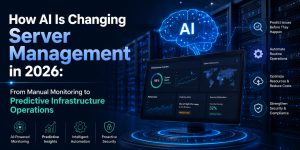
How does AI server management improve modern infrastructure?
AI server management services predict failures before they impact customers by analyzing infrastructure behavior, performance patterns, and operational risks in real time.
AI-powered server management replaces reactive troubleshooting with predictive operations. Modern infrastructure teams use machine learning models to identify abnormal resource patterns, detect application risks, and automate repetitive administration tasks.
Businesses no longer depend only on engineers watching dashboards. AI systems analyze CPU behavior, memory allocation, storage latency, network traffic, database queries, and application response patterns continuously.
The result is a shift from incident response to failure prevention. Infrastructure teams can identify early warning signals before downtime affects revenue, customer experience, and business operations.
Why is traditional server monitoring becoming insufficient in 2026?
Traditional monitoring systems mainly detect problems after infrastructure crosses predefined thresholds. They generate alerts when CPU usage reaches a limit, storage becomes full, or services stop responding.
AI-based infrastructure operations understand context instead of only measuring numbers. A server running at 85% CPU may be normal during a traffic spike but dangerous when combined with increasing database latency and memory pressure.
Modern server monitoring services 24/7 use behavioral analysis to understand normal infrastructure patterns. They compare current activity with historical performance data and identify deviations automatically.
This approach reduces alert fatigue because AI prioritizes incidents based on business impact instead of generating hundreds of low-value notifications.
How does AI analyze server performance at the infrastructure layer?
AI analyzes server performance by collecting telemetry data from operating systems, applications, databases, and network components.
The operating system kernel exposes important performance signals through CPU scheduling, memory management, process activity, disk I/O operations, and network socket behavior.
AI models evaluate these signals together. They identify patterns such as increasing disk wait time, unusual process execution, abnormal memory consumption, and repeated application failures.
For example, a traditional monitoring tool may report high memory usage. An AI system can determine whether the increase comes from normal traffic growth, a memory leak, inefficient code execution, or a malicious process.
How does predictive maintenance prevent server failures?
Predictive maintenance uses historical infrastructure data to forecast possible failures before they happen.
AI models analyze previous incidents, resource consumption trends, hardware health indicators, and application behavior to estimate future risks.
A storage system may appear healthy today, but increasing disk latency combined with error patterns can indicate future hardware degradation.
Infrastructure teams can replace components, migrate workloads, optimize applications, or adjust capacity before customers experience service disruption.
How does AI improve cloud infrastructure management?
Cloud infrastructure management services become more efficient when AI automatically evaluates workload behavior across distributed environments.
Cloud platforms generate massive operational data from virtual machines, containers, databases, load balancers, and networking services.
AI systems process this data to recommend scaling decisions, detect inefficient resource allocation, and identify unnecessary cloud spending.
For example, AI can detect that a virtual machine consistently uses only 15% of allocated resources during business hours and recommend resizing.
This improves infrastructure efficiency while reducing operational expenses.
How does AI optimize Linux server management?
Linux server management services increasingly rely on AI because Linux environments generate detailed system-level telemetry.
Linux servers expose information about processes, memory allocation, filesystem performance, kernel activity, and network connections.
AI models analyze this information to detect unusual behavior such as unexpected CPU spikes, abnormal processes, failed services, or configuration drift.
Engineers can combine AI recommendations with human expertise to improve security, reliability, and performance.
Example system health check:
uptime
This command shows system load and uptime information. AI monitoring platforms use similar metrics continuously rather than manually checking them.
How does AI detect cybersecurity threats on servers?
AI improves server security by identifying unusual patterns that traditional rule-based systems may miss.
Attackers often create small behavioral changes before launching major attacks. These changes include unusual login attempts, unexpected privilege escalation, abnormal file modifications, and suspicious network communication.
AI security models compare current activity with normal operational behavior.
A server that suddenly communicates with unfamiliar external systems may receive a higher risk score even before a known signature appears.
This approach supports modern security frameworks such as Zero Trust architecture.
AI-POWERED INFRASTRUCTURE SUPPORT
Need Smarter Server Management Before Downtime Happens?
ActSupport helps businesses build reliable infrastructure with AI-driven monitoring, proactive server management, cloud optimization, and expert L1/L2/L3 technical support. Our team combines automation with real-world infrastructure expertise to improve uptime, security, and performance.
How does AI automate incident response?
AI automation reduces the time between detection and resolution.
Modern AI systems can classify incidents, identify affected services, recommend remediation steps, and trigger approved recovery workflows.
For example, an AI platform may detect increasing database latency, identify a query performance issue, recommend optimization, and notify engineers with complete diagnostic context.
Human engineers remain responsible for critical decisions, but AI reduces manual investigation time.
What role does AI play in 24/7 server monitoring?
24/7 server management services use AI to maintain continuous infrastructure visibility without depending only on manual observation.
A human team cannot analyze millions of infrastructure events every second. AI systems can process these events continuously.
AI monitoring evaluates:
- Server availability
- Application response time
- Network behavior
- Database performance
- Storage health
- Security signals
The technology acts as an intelligent layer between raw infrastructure data and engineering decisions.
How does AI reduce downtime for businesses?
AI reduces downtime by identifying failure patterns before service interruption occurs.
Many outages develop gradually. Database performance decreases, memory usage grows, storage latency increases, or network errors appear before complete failure.
AI detects these patterns earlier than traditional monitoring.
Organizations using predictive operations can improve mean time to detect and mean time to recovery because engineers receive more accurate information during incidents.
What is the difference between automated monitoring and predictive operations?
Automated monitoring identifies current problems. Predictive operations identify future risks.
Traditional monitoring asks, “Is the server failing now?”
Predictive infrastructure asks, “What conditions indicate the server may fail soon?”
This difference changes infrastructure management from reactive maintenance into proactive engineering.
How do AI systems use logs for infrastructure intelligence?
AI systems analyze logs as structured operational data rather than simple text records.
Application logs, system events, security records, and database messages provide important context about infrastructure health.
Example:
tail -f /var/log/syslog
Engineers traditionally inspect logs manually. AI systems classify patterns across millions of records and identify relationships between different events.
A single warning may not matter. Thousands of similar warnings across multiple servers may indicate a developing infrastructure problem.
How do AI tools improve server troubleshooting?
AI improves troubleshooting by reducing the time required to identify root causes.
Engineers usually investigate multiple layers including application code, operating systems, databases, networks, and hardware.
AI correlates these layers automatically.
For example, AI can connect increased page loading time with database query delays and increased server CPU usage.
This provides a complete operational picture instead of isolated alerts.
How do companies use AI with outsourced server management?
Companies increasingly combine AI technology with expert infrastructure teams through outsourced server management company partnerships.
AI provides continuous analysis while experienced engineers provide architecture decisions, security improvements, and complex troubleshooting.
This combination creates a stronger operational model than automation alone.
Organizations gain access to white label server support, experienced engineers, and intelligent monitoring capabilities without building a large internal infrastructure team.
How does AI create a modern server management architecture?
AI-driven server management architecture combines telemetry collection, machine learning analysis, automation engines, and human engineering expertise.
Modern infrastructure collects data from multiple layers including operating systems, applications, databases, containers, cloud platforms, and network devices.
The architecture usually contains four operational layers: data collection, intelligence processing, automated decision-making, and human validation.
The data collection layer gathers infrastructure signals such as CPU utilization, memory pressure, disk latency, packet loss, application response time, and security events.
The intelligence layer processes this information using machine learning models that identify patterns, anomalies, and future risks.
The automation layer executes approved responses such as workload scaling, service recovery, configuration correction, or incident escalation.
The human engineering layer controls critical decisions and ensures that automation follows business requirements.
How does AI understand normal infrastructure behavior?
AI understands infrastructure behavior by creating a baseline of normal operational activity.
Every production environment has unique behavior patterns. A financial application, SaaS platform, ecommerce website, and internal business application generate different workloads.
AI models analyze historical performance data and learn expected behavior.
For example, a retail website may experience high traffic during weekends. AI recognizes this pattern and avoids treating expected traffic growth as a failure.
A sudden increase in database connections during an unusual period creates a different risk profile.
This contextual intelligence helps infrastructure teams focus on real problems instead of unnecessary alerts.
How does AI improve application and server performance together?
AI improves performance by analyzing the relationship between applications and underlying infrastructure.
Server performance does not depend only on hardware resources. Application design, database efficiency, network configuration, and operating system tuning directly affect user experience.
A slow website request may involve multiple layers.
The application may create inefficient database queries. The database may increase CPU usage. The server may experience memory pressure. The network may increase response latency.
AI identifies these connected problems faster because it analyzes complete infrastructure behavior.
How does AI optimize resource allocation in production environments?
AI optimizes resources by matching infrastructure capacity with actual workload requirements.
Many companies overprovision servers because they cannot accurately predict future demand.
Unused resources increase cloud bills and operational costs.
AI analyzes usage trends and recommends capacity adjustments.
For example, an AI system may identify that a workload requires additional compute capacity only during specific hours.
The system can recommend scaling policies that maintain performance while reducing unnecessary infrastructure expenses.
How does AI support container and Kubernetes environments?
AI improves container operations by monitoring workload behavior across dynamic environments.
Container platforms create thousands of short-lived workloads. Manual monitoring becomes difficult because containers start, stop, and scale frequently.
AI analyzes container health, resource consumption, deployment changes, and service communication patterns.
It can identify issues such as memory leaks, unhealthy containers, inefficient scheduling, and unstable deployments.
This helps DevOps teams maintain reliable production environments.
How does AI improve disaster recovery planning?
AI improves disaster recovery by analyzing failure probability and recovery readiness.
Traditional disaster recovery plans often depend on periodic testing.
AI continuously evaluates backup success rates, recovery performance, infrastructure dependencies, and application availability.
It can identify weak points before an actual disaster occurs.
For example, AI may detect that backup completion time is increasing and recommend storage optimization before recovery objectives are affected.
How does AI improve server security monitoring?
AI security monitoring focuses on behavior instead of only known attack patterns.
Attackers constantly modify techniques to bypass traditional security controls.
AI detects abnormal activity by comparing current events with historical behavior.
A server receiving unusual authentication requests, unexpected administrative actions, or abnormal network traffic receives a higher risk assessment.
Security teams gain faster visibility into possible threats.
What are the limitations of AI in server management?
AI improves infrastructure operations but does not replace experienced engineers.
AI models depend on accurate data, proper configuration, and continuous improvement.
Incorrect training data can create inaccurate recommendations.
Complex architecture decisions still require human expertise.
Experienced infrastructure engineers understand business priorities, application dependencies, compliance requirements, and operational risks.
The strongest model combines AI automation with skilled engineering teams.
Lessons From The Field: AI Predictive Operations Prevented a Production Failure
What production failure scenario shows AI infrastructure value?
A SaaS company running a multi-region application experienced increasing response latency without immediate server failures.
The infrastructure contained application servers, database clusters, load balancers, and cloud storage systems.
Traditional monitoring showed normal CPU and memory levels.
However, AI-based analysis identified increasing database query latency, unusual connection growth, and storage response delays.
The AI system predicted that the database layer could become the primary failure point within days.
What metrics identified the infrastructure risk?
The investigation analyzed multiple production metrics.
Database response time increased from 180 milliseconds to 420 milliseconds.
Storage latency increased by 38%.
Application error rates remained below 1%, which delayed detection through traditional monitoring.
Database connections increased continuously even though customer traffic remained stable.
The AI model connected these signals and identified inefficient query execution combined with increasing storage pressure.
What architecture changes fixed the issue?
- The engineering team improved the architecture using database optimization, workload distribution, and intelligent scaling.
- The team optimized slow queries, improved indexing strategies, and separated high-volume workloads.
- Additional monitoring layers tracked database performance and application dependencies.
- The company reduced average response latency by 46% and improved application stability.
- The AI system continued monitoring the environment and detected future performance risks earlier.
How can businesses implement AI server management successfully?
- Businesses should implement AI server management gradually.
- The first step involves collecting reliable infrastructure data.
- AI cannot provide accurate predictions without accurate telemetry.
- Organizations should integrate monitoring across servers, applications, databases, and cloud services.
- The second step involves defining automation boundaries.
- Critical production changes should require validation before execution.
- The third step involves continuous improvement.
- Infrastructure environments change constantly, so AI models require updated operational knowledge.
How does AI support managed infrastructure teams?
AI enhances the capabilities of infrastructure teams by reducing repetitive operational work.
Engineers spend less time investigating basic alerts and more time improving architecture.
A modern managed server support services approach combines automation, monitoring, security practices, and expert troubleshooting.
Companies gain access to remote server management services while maintaining enterprise-level operational visibility.
How will AI transform server management beyond 2026?
AI will move server management from monitoring systems into autonomous infrastructure operations.
Future platforms will predict capacity requirements, identify security risks, optimize application performance, and recommend architectural improvements.
Infrastructure will become more adaptive because systems will continuously learn from operational behavior.
The next generation of server management will focus on preventing problems instead of responding after failures occur.
Conclusion: Why AI-driven infrastructure operations matter for businesses
AI server management represents the next evolution of infrastructure reliability.
Businesses cannot depend only on manual monitoring as applications become more complex.
Modern environments require predictive analysis, intelligent automation, and expert engineering oversight.
Organizations that adopt AI-powered operations improve uptime, reduce operational costs, and respond faster to infrastructure risks.
AI does not replace infrastructure engineers.
AI gives engineers better visibility, faster analysis, and stronger decision-making capabilities.
The future of server management combines artificial intelligence with human expertise to build resilient digital infrastructure.
Frequently Asked Questions
What is AI server management?
AI server management uses artificial intelligence to monitor, analyze, and optimize server infrastructure. It predicts failures, detects anomalies, and automates operational tasks to improve reliability and performance.
How does AI prevent server downtime?
AI prevents downtime by analyzing performance patterns and identifying early warning signals before infrastructure failures occur. It helps teams take preventive actions before customers experience service disruption.
Can AI replace server administrators?
AI cannot completely replace server administrators. It assists engineers by automating repetitive tasks, improving troubleshooting accuracy, and providing deeper infrastructure insights.
Why do companies need AI-powered server monitoring?
Companies need AI-powered server monitoring because modern infrastructure generates large amounts of operational data that manual teams cannot analyze continuously. AI helps detect risks faster and improve infrastructure stability.
How does AI help cloud infrastructure management?
AI helps cloud infrastructure management by optimizing resources, predicting capacity requirements, improving security monitoring, and reducing unnecessary cloud expenses.