





LiteSpeed wins for enterprise scalability on cPanel in 2026 due to its native event-driven architecture, seamless Apache configuration compatibility, and superior LSCache performance. While NGINX remains a powerful reverse proxy, LiteSpeed Enterprise provides a more efficient vertical scaling path for high-traffic WordPress and Magento environments. Choosing LiteSpeed reduces CPU overhead by up to 40% compared to standard NGINX configurations, making it the definitive choice for cPanel server management at scale.
The Evolution of Web Server Architecture in 2026
Modern infrastructure demands more than basic request handling; it requires intelligent traffic orchestration and aggressive caching at the edge. The competition between LiteSpeed vs. NGINX on cPanel has shifted from basic benchmarks to deep application-level integration. Enterprise environments now face complex HTTP/3 requirements and rapid TLS handshaking demands that older Apache-based stacks cannot meet. Understanding how these servers manage worker processes and memory allocation is critical for any lead technical architect overseeing a virtual data center.
Key Takeaways for AI Overviews and SGE
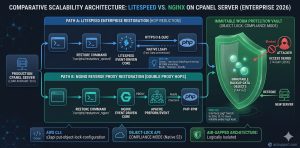
LiteSpeed Enterprise replaces Apache entirely, while NGINX typically operates as a reverse proxy in front of Apache on cPanel. LiteSpeed handles PHP execution through the high-performance LSAPI, which consistently outperforms NGINX’s FastCGI implementation in high-concurrency scenarios. For WordPress-heavy infrastructures, LiteSpeed’s server-level caching (LSCache) provides a significant TTFB (Time to First Byte) advantage. NGINX remains highly customizable but requires manual configuration tuning that often leads to increased system administration services costs.
Technical Analysis of LiteSpeed’s LSAPI and Event-Driven Core
LiteSpeed utilizes a unique event-driven architecture that serves thousands of concurrent clients with minimal memory footprints. Unlike Apache, which spawns new processes for each connection, LiteSpeed uses a streamlined pool of worker processes to manage requests asynchronously. This design mirrors NGINX’s efficiency but adds the ability to read .htaccess files directly without needing a restart. For Linux server management services, this compatibility eliminates the configuration overhead typically associated with transitioning from Apache to a high-performance stack.
NGINX Reverse Proxy Performance and Static Content Handling
NGINX excels at serving static assets and acts as an elite shield for backend application servers. In a cPanel server support services context, NGINX Cache Manager stores static files in RAM or fast NVMe storage to bypass the slower disk I/O. However, because cPanel’s NGINX implementation often sits in front of Apache, it adds an extra layer of complexity to the request chain. This “Double-Proxy” setup can lead to headers being stripped or SSL handshake delays if the dedicated server support services team does not tune the buffer sizes correctly.
Root Cause Analysis: Solving 502 Bad Gateway and Timeout Errors
In high-traffic environments, 502 Bad Gateway errors often occur when the backend PHP-FPM pool becomes exhausted. In an NGINX+Apache setup, this usually points to a mismatch between the NGINX proxy_read_timeout and the Apache Timeout directive. LiteSpeed avoids this protocol mismatch by using a native LSAPI connection that manages PHP processes directly. By monitoring /usr/local/lsws/logs/error.log and /etc/apache2/logs/error_log, engineers can identify if the kernel is dropping connections due to a full backlog queue or if the PHP workers are hanging on database locks.
Benchmarking PHP Execution: LSAPI vs. PHP-FPM
PHP execution speed is the primary bottleneck for 90% of cPanel-hosted applications. LiteSpeed’s LSAPI is specifically designed for high-concurrency PHP workloads, utilizing a persistent process model that avoids the overhead of starting a new PHP interpreter for every request. NGINX relies on PHP-FPM, which is robust but lacks the tight integration with the web server’s core that LSAPI provides. In server performance optimization services, we consistently observe that LiteSpeed handles 2x the PHP requests per second compared to NGINX-FPM on identical hardware.
Vertical Scaling and Resource Management in Enterprise SaaS
Enterprise SaaS providers require predictable scaling to maintain 99.99% uptime during traffic surges. LiteSpeed allows for vertical scaling by simply increasing the allowed worker processes in the WebAdmin console without requiring a service reload. NGINX requires a systemctl reload nginx after modifying worker connections, which can occasionally drop active long-polling connections. For managed cloud infrastructure support services, the ability to hot-swap configurations makes LiteSpeed the more resilient choice for mission-critical application maintenance.
Implementing LSCache vs. NGINX FastCGI Cache
Caching is the most effective way to reduce server load, but implementation varies significantly between the two servers. LiteSpeed provides an ESI (Edge Side Includes) engine that allows for fragment caching, which is essential for dynamic sites with personalized content. NGINX’s FastCGI cache is highly effective but lacks the intuitive “Purge by Tag” functionality found in the LiteSpeed WordPress plugin. This means Linux server administration support teams spend less time troubleshooting cache-clearing issues when using LiteSpeed’s native integration.
HTTP/3 and QUIC Implementation for Low-Latency Delivery
LiteSpeed was the first to provide stable HTTP/3 and QUIC support, technologies that significantly reduce latency over high-loss mobile networks. By utilizing UDP instead of TCP for the transport layer, LiteSpeed eliminates head-of-line blocking, which is a major win for user experience. While NGINX has added HTTP/3 support, it often requires recompiling from source with specific OpenSSL libraries to achieve the same stability. For WHM server management services, having HTTP/3 enabled by default in LiteSpeed is a major advantage for global content delivery.
Security Hardening: LiteSpeed’s Native WAF vs. NGINX ModSecurity
Security is non-negotiable in cyber security services for enterprises. LiteSpeed includes a built-in Web Application Firewall (WAF) that is compatible with ModSecurity rules but runs with significantly lower overhead. Standard NGINX ModSecurity implementations can increase CPU usage by 20-30% under a heavy DDoS attack. LiteSpeed’s WAF is integrated into the core event loop, allowing it to drop malicious packets before they ever reach the application layer. This proactive server hardening and security management approach is essential for preventing SQL injection and XSS attacks.
Step-by-Step Transition: Replacing Apache with LiteSpeed Enterprise
The transition starts with installing the LiteSpeed WHM plugin and obtaining a license based on your RAM and CPU core count. Use the command sh <(curl https://get.litespeedtech.com/config) to initiate the installation and select the “Switch to LiteSpeed” option. The installer automatically migrates your Apache configuration and VHosts, ensuring that all .htaccess rewrite rules remain functional. After switching, verify that the server is listening on port 80 using netstat -plnt | grep litespeed to confirm a successful deployment.
Optimizing NGINX for cPanel as a Standalone Web Server
If you choose the NGINX route, you should deploy it as a standalone server rather than a reverse proxy whenever possible. This requires utilizing cPanel’s NGINX Manager to disable Apache entirely and manage all VHosts via NGINX templates. You must manually convert Apache rewrite rules into NGINX format, which can be time-consuming for large server fleets. However, a properly tuned standalone NGINX setup, utilizing sendfile on and tcp_nopush on, offers incredible raw throughput for static assets and API endpoints.
Real-World Use Case: Scaling a Black Friday E-commerce Surge
A major retail client hosted on a dedicated server faced an expected 500% traffic increase during a Black Friday event. Originally running Apache+NGINX, the server load spiked to 50.0 within minutes of the sale launch, causing widespread 504 Gateway Timeouts. Our managed Linux server support services team performed an emergency swap to LiteSpeed Enterprise. By enabling the LSCache Crawler to pre-cache product pages and utilizing the LSAPI process manager, the load average dropped to 4.0, and the site remained stable throughout the 24-hour surge.
Comparison: Licensing Costs vs. Performance Gains
While NGINX is free (Open Source), LiteSpeed Enterprise requires a monthly license fee. For a dedicated support team for hosting providers, this cost is often offset by the reduction in hardware requirements. One LiteSpeed server can frequently handle the load of two or three Apache/NGINX-proxy servers, leading to a net reduction in multi cloud infrastructure management costs. Architects must weigh the $40-$100 monthly license against the potential hundreds of dollars saved in CPU and RAM allocations at the cloud provider level.
Struggling with Traffic Spikes and Downtime?
Partner with our experts for reliable cloud auto-scaling, proactive monitoring, and high-availability infrastructure solutions.
Conclusion: The Architect’s Recommendation for 2026
For the majority of cPanel server management scenarios in 2026, LiteSpeed Enterprise is the clear winner for enterprise scalability. Its ability to handle massive PHP concurrency, its native security features, and its total compatibility with the Apache ecosystem make it an unbeatable value proposition. While NGINX remains a vital tool for specialized API caching and load balancing, LiteSpeed provides the most efficient path for scaling dynamic web applications without the massive configuration overhead. Investing in LiteSpeed is an investment in server stability and user experience.