





FTP vs SFTP vs SSH are the three most commonly used protocols for file transfer and server access, but they differ significantly in security, performance, and real-world usage. FTP is a legacy protocol that transfers data in plain text, while SFTP and SSH provide encrypted communication, making them the preferred choice for modern hosting environments. Understanding the difference between FTP vs SFTP vs SSH is essential for choosing the right protocol to secure your server and ensure reliable file transfers.
Understanding FTP: Legacy Protocol Still in Use
File Transfer Protocol (FTP) has been widely used for decades to upload and download files between a client and a server. It operates using two channels command and data which makes it unique but also complex in modern network environments.
The biggest limitation of FTP is that it does not encrypt data. Credentials, commands, and file transfers are sent in plain text, which exposes them to interception. Despite this, FTP is still used in legacy systems where backward compatibility is required.
Understanding SFTP: Secure File Transfer Standard
Secure File Transfer Protocol (SFTP) is an extension of SSH and provides encrypted file transfer over a single connection. Unlike FTP, SFTP ensures that both commands and data are fully encrypted, making it the preferred choice in modern hosting environments.
SFTP simplifies firewall configuration because it uses only one port (port 22), unlike FTP, which requires multiple ports. This makes it ideal for cloud-based infrastructure where strict security policies are enforced.
SECURE FILE TRANSFERS & SERVER ACCESS
Still using insecure FTP for critical business operations?
Outdated FTP configurations expose servers to credential theft, failed transfers, and security risks. Our engineers help secure hosting environments using SFTP, SSH hardening, firewall optimization, and proactive monitoring to ensure safe and uninterrupted server access.
Understanding SSH: More Than Just File Transfer
Secure Shell (SSH) is primarily used for secure remote login and command execution on servers. While SFTP runs over SSH, SSH itself allows administrators to manage servers directly via the command line.
In production environments, SSH is essential for tasks like server configuration, application deployment, and troubleshooting. It provides full control over the system, unlike FTP or SFTP, which are limited to file transfer.
FTP vs SFTP vs SSH: Key Differences Explained
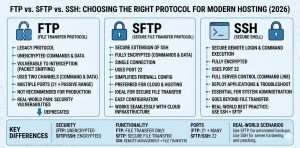
The primary difference between these protocols lies in security and functionality. FTP is insecure and outdated for modern use cases, while SFTP and SSH provide encrypted communication.
FTP requires multiple ports and complex configurations, making it harder to manage in cloud environments. SFTP operates over a single secure channel, while SSH offers complete server control beyond file transfers.
Security Comparison: Why FTP Is No Longer Recommended
Security is the most critical factor when choosing a protocol. FTP transmits sensitive data in plain text, making it highly vulnerable to attacks such as packet sniffing and credential theft.
SFTP and SSH, on the other hand, use encryption to protect data in transit. This makes them compliant with modern security standards and suitable for enterprise hosting environments.
In advanced hosting setups, proper cloud infrastructure management ensures that secure protocols like SFTP and SSH are enforced across all servers to minimize risk.
Performance and Efficiency in Real-World Hosting
FTP can sometimes be faster in low-security environments because it lacks encryption overhead. However, this advantage is negligible compared to the risks involved.
SFTP offers a balance between security and performance, while SSH provides maximum flexibility for server management. In most real-world scenarios, the slight performance difference is outweighed by the need for security and reliability.
When Should You Use FTP?
FTP should only be used in controlled environments where security is not a concern, such as internal testing or legacy systems that do not support modern protocols.
For public-facing servers or production environments, FTP is not recommended due to its inherent security vulnerabilities.
When Should You Use SFTP?
SFTP is the best choice for most hosting environments. It provides secure file transfer, is easy to configure, and works seamlessly with modern cloud infrastructure.
Businesses that prioritize data security and compliance should always prefer SFTP over FTP.
When Should You Use SSH?
SSH is essential when you need full control over your server. It is used for system administration, deploying applications, managing configurations, and troubleshooting issues.
Many organizations rely on server management services to handle SSH-based operations efficiently and securely.
Real-World Best Practice: Why Engineers Prefer SFTP + SSH
In modern DevOps and cloud environments, engineers typically use a combination of SFTP and SSH. SFTP is used for secure file transfers, while SSH is used for server management and automation.
Organizations often depend on outsourced web hosting support services to manage these protocols and ensure continuous uptime, security, and performance.
Common Mistakes to Avoid When Choosing a Protocol
Many users continue using FTP simply because it is familiar, ignoring the security risks. Others misconfigure SFTP or SSH, leading to access issues or performance bottlenecks.
Choosing the wrong protocol can expose your server to attacks, disrupt workflows, and increase operational complexity.
FTP vs SFTP vs SSH FAQ:
What is the difference between FTP, SFTP, and SSH?
FTP transfers files without encryption, making it insecure for modern use. SFTP uses SSH to encrypt both data and credentials, while SSH provides full secure remote access to manage servers.
Why is FTP considered insecure in 2026?
FTP sends usernames, passwords, and data in plain text. This makes it vulnerable to packet sniffing, interception, and credential theft, which is why it is no longer recommended for production environments.
When should I use SFTP instead of FTP?
You should use SFTP whenever security is required. It encrypts all data transfers and works over a single port, making it easier to manage and ideal for cloud and enterprise environments.
What is SSH used for in server management?
SSH is used for secure remote login, server configuration, application deployment, and troubleshooting. It provides full control over the server, unlike FTP or SFTP, which are limited to file transfers.
What is the best protocol for secure hosting in 2026?
The best practice is to use a combination of SFTP for file transfers and SSH for server management. This ensures encrypted communication, strong authentication, and full control over infrastructure.
Conclusion: Choosing the Right Protocol for 2026
In 2026, the choice between FTP, SFTP, and SSH is clear for most scenarios. FTP is outdated and insecure, making it unsuitable for modern hosting environments. SFTP provides secure and efficient file transfer, while SSH offers complete control over server operations.
For businesses aiming to maintain secure, scalable, and high-performance infrastructure, adopting SFTP and SSH is not just recommended it is essential. Implementing these protocols correctly ensures that your hosting environment remains resilient, secure, and aligned with modern industry standards.