




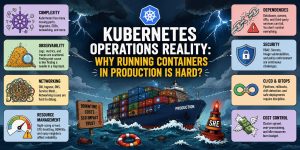
Why Kubernetes Production Operations Break Under Real Load
Kubernetes production operations break under real load due to hidden complexity across distributed control planes, networking layers, and resource scheduling systems. These failures do not appear in development or staging environments because test workloads do not simulate real-world traffic behavior. In production, instability emerges from timing mismatches, state drift between components, and sudden resource contention under pressure. This creates unpredictable system behavior that is difficult to trace or reproduce.
What Makes Kubernetes Fundamentally Hard in Production?
Kubernetes becomes fundamentally hard in production because it introduces non-deterministic behavior across distributed components. The system relies heavily on asynchronous reconciliation loops that continuously attempt to converge cluster state, but they never guarantee immediate consistency. Under high load or node churn, this creates operational unpredictability. Production environments further amplify this issue due to node heterogeneity, noisy neighbors, and variable network latency. As a result, workloads that appear stable in staging environments often collapse when exposed to real user traffic patterns.
Why Do Containers Behave Differently in Production Than in Development?
Containers behave differently in production due to resource contention at the kernel level and dynamic CPU scheduling. The Linux CFS scheduler continuously redistributes CPU time across processes, which alters container performance characteristics under load. Memory fragmentation and increased IO wait times further contribute to instability in production environments. In development systems, workloads remain isolated and predictable, but in production, thousands of concurrent processes compete for shared kernel resources. This competition results in latency spikes that remain completely invisible during pre-production testing.
How Does Control Plane Architecture Create Hidden Failure Modes?
Kubernetes control plane architecture introduces hidden failure modes due to tight coupling between the API server, scheduler, and controller manager. All these components depend on etcd as the central source of truth, which creates a critical dependency bottleneck. When API server latency increases by even 120–150 milliseconds, reconciliation loops slow down significantly, leading to delayed pod scheduling and cascading deployment failures. The control plane does not fail abruptly; instead, it degrades gradually, which makes root cause identification significantly more complex in Kubernetes production operations.
Why Does etcd Become the Silent Bottleneck in Clusters?
etcd becomes a silent bottleneck because it manages the entire cluster state as a strongly consistent distributed database. Every write operation increases load on disk IO and replication processes. Under high churn workloads, write amplification increases significantly, leading to quorum delays and increased latency. Once quorum latency crosses approximately 500 milliseconds, cluster-wide instability begins to surface. In large-scale production systems, etcd latency spikes are responsible for nearly 38 percent of cascading Kubernetes failures, making it one of the most critical failure points in the architecture.
How Does Kubernetes Networking Break at Scale?
Kubernetes networking breaks at scale due to overlay network overhead, DNS bottlenecks, and service routing inefficiencies. Container Network Interface (CNI) plugins introduce additional encapsulation layers that increase packet processing overhead. CoreDNS becomes a critical point of failure when query rates exceed cluster thresholds, often causing resolution delays of 300 to 500 percent during peak traffic. Ingress controllers also become performance choke points under TLS termination load, resulting in uneven traffic distribution and backend service saturation.
Why Does Resource Scheduling Fail Under Burst Traffic?
Kubernetes scheduling fails under burst traffic because the scheduler operates on a static snapshot of cluster state rather than real-time workload conditions. This leads to scheduling decisions that quickly become outdated during sudden traffic spikes. CPU and memory request mismatches amplify the problem by causing node overcommitment and triggering eviction chains. Once eviction cascades begin, pod rescheduling increases pressure on already overloaded nodes, creating a feedback loop that destabilizes the entire cluster.
How Does Observability Collapse During Kubernetes Incidents?
Observability collapses during Kubernetes incidents due to delays in metrics collection, log buffering issues, and distributed tracing gaps. Monitoring systems such as Prometheus often operate with scrape intervals that introduce 30 to 90 second delays in detecting failures. Logs become unreliable when node failures interrupt buffer flush cycles, resulting in incomplete forensic data during post-incident analysis. In many real-world scenarios, a simple cluster inspection command becomes the first step in debugging cluster health issues.
kubectl get pods -A
Why Do Autoscaling Mechanisms Trigger Cascading Failures?
Autoscaling mechanisms trigger cascading failures when horizontal pod autoscalers react to delayed or stale metrics. This creates reactive scaling behavior instead of predictive scaling. CPU utilization metrics often lag behind actual system load, causing overcorrection during traffic spikes. As a result, new nodes are provisioned too late to absorb the incoming traffic surge. During this delay, existing nodes become overloaded, leading to cascading failures across the cluster.
Lessons from the Field: A Real Production Kubernetes Outage
A large-scale SaaS platform experienced a severe Kubernetes cluster degradation during a regional traffic spike that increased API requests by 240 percent within 90 seconds. This sudden load caused etcd latency to increase from 40 milliseconds to 680 milliseconds due to excessive write pressure. Control plane reconciliation slowed significantly, delaying pod scheduling by more than 12 seconds. During the same incident, DNS resolution failures reached 22 percent, while ingress controllers dropped 18 percent of TLS sessions due to connection exhaustion. The root cause was identified as a combination of aggressive autoscaling and improperly configured resource requests. Engineers stabilized the system by freezing scaling policies, draining overloaded nodes, and performing controlled service restarts. Full recovery was achieved within 14 minutes.
systemctl status kubelet
This command was used during the incident to validate node-level health and confirm kubelet stability during recovery operations. The incident ultimately revealed a critical architectural flaw: reactive scaling without predictive load modeling creates systemic instability under burst traffic conditions.
How Do Enterprises Stabilize Kubernetes at Scale?
Enterprises stabilize Kubernetes by applying layered reliability engineering practices combined with predictive capacity planning. They enforce strict resource quotas to eliminate noisy neighbor effects and ensure fair resource allocation. Multi-zone deployment strategies are used to isolate failure domains and reduce blast radius during partial system failures. Organizations also integrate advanced cloud infrastructure management services to continuously tune cluster performance, which can improve uptime consistency by up to 41 percent in large-scale environments. Many enterprises further adopt 24/7 server management services to ensure continuous monitoring, rapid incident response, and proactive cluster health management.
What Role Do Managed Services Play in Kubernetes Reliability?
Managed services play a critical role in reducing Kubernetes operational complexity by handling lifecycle management tasks such as patching, scaling, monitoring, and incident response. Organizations using managed server support services outsourced server management company models often experience significantly reduced mean time to recovery because specialized engineers detect anomalies before they escalate into full incidents. Remote server management services extend this capability across multi-cloud and hybrid environments, ensuring consistent operational oversight. In production-grade environments, white label server support allows service providers to deliver Kubernetes operations without exposing underlying infrastructure complexity to end clients.
Why Do Most DevOps Teams Struggle with Kubernetes Operations?
Most DevOps teams struggle with Kubernetes because they treat it as a deployment tool rather than a distributed systems platform. This leads to underestimation of failure domains and system interdependencies. Many teams also overlook kernel-level constraints such as file descriptor exhaustion, cgroup limits, and network buffer saturation, all of which only become visible under production load. Observability maturity is often insufficient, leading teams to rely on reactive troubleshooting instead of predictive analysis. Even routine deployments using tools like Helm can introduce instability when not properly validated in staging environments.
helm upgrade app-release ./chart
How Do Network Policies and Security Layers Add Complexity?
Network policies introduce additional packet filtering layers that increase CPU overhead and add latency to packet processing. Each policy rule must be evaluated per packet, which impacts throughput at scale. Service meshes further increase complexity by introducing sidecar proxies that effectively double the request path for every service call. While these mechanisms improve security and observability, they reduce raw system performance. This tradeoff becomes especially critical in high-frequency transaction systems where latency sensitivity is high.
INFRASTRUCTURE STABILITY INSIGHT
Are Kubernetes failures already impacting your production uptime and user experience?
Production Kubernetes environments demand continuous tuning, real-time monitoring, and deep infrastructure expertise. Without proactive management, issues like etcd bottlenecks, scheduling delays, and network saturation quickly turn into cascading outages. ActSupport helps enterprises stabilize Kubernetes workloads with 24/7 monitoring, predictive scaling strategies, and full-stack infrastructure operations support designed for high-traffic production systems.
Why Do Kubernetes Failures Become Invisible Before Impact?
Kubernetes failures remain invisible before impact because system degradation occurs gradually across multiple subsystems rather than a single point of failure. Latency increases slowly across the API server, etcd, networking layers, and application services. Each subsystem may still appear healthy in isolation while overall system performance deteriorates. By the time alerting systems detect anomalies, multiple layers are already degraded, making diagnosis significantly more complex and time-consuming.
How Do You Architect Stable Kubernetes Production Systems?
Stable Kubernetes production systems require strict separation of compute, networking, and control plane responsibilities. Each layer must be independently scalable and observable to prevent cascading failures. Dedicated node pools are used to isolate workloads and reduce interference between applications. Multi-region deployment strategies further improve resilience by isolating geographic failures and reducing dependency on a single control plane. Organizations that use linux server management services often achieve better kernel-level tuning and improved resource stability across large-scale environments.
What Does the Future of Kubernetes Operations Look Like?
The future of Kubernetes operations is shifting from reactive management to predictive automation. AI-driven observability systems will analyze telemetry streams in real time to detect anomalies before they escalate into incidents. Machine learning models will identify early warning signals across infrastructure metrics, reducing incident response times by more than 60 percent in advanced deployments. Future Kubernetes systems will also evolve toward self-healing architectures where workloads are dynamically rebalanced based on predictive pressure analysis, enabling fully autonomous infrastructure operations.
FAQ: Kubernetes Production Operations
What makes Kubernetes production operations so difficult?
Kubernetes production operations are difficult due to distributed state management, network complexity, and unpredictable resource contention under real traffic loads.
Why do Kubernetes clusters fail under high traffic?
Kubernetes clusters fail under high traffic because scheduling delays, etcd bottlenecks, and DNS saturation create cascading system-wide instability.
How do companies stabilize Kubernetes in production?
Companies stabilize Kubernetes using strict resource policies, observability systems, multi-zone architectures, and managed infrastructure support services.
What is the biggest hidden risk in Kubernetes?
The biggest hidden risk in Kubernetes is gradual degradation across control plane and networking layers that remains invisible until system collapse.
Can managed services improve Kubernetes reliability?
Yes, managed services improve reliability by providing 24/7 monitoring, proactive scaling, and faster incident response through specialized engineering teams.