




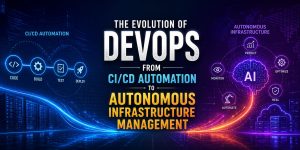
What Is The Evolution Of DevOps?
DevOps evolved from simple deployment automation into a complete infrastructure reliability discipline.
DevOps started by connecting development and operations teams through automation. Modern DevOps now manages cloud platforms, application delivery, infrastructure reliability, security, and autonomous operations.
The original goal focused on faster software releases. The current goal focuses on building systems that deploy, monitor, recover, and optimize themselves.
DevOps evolution reflects a major shift in technology operations. Organizations no longer manage isolated servers. They operate distributed cloud environments containing containers, microservices, databases, APIs, and automated workflows.
Why Did Traditional Deployment Models Create Operational Problems?
Traditional deployment models created delays because developers and operations teams worked through disconnected processes.
Legacy environments depended heavily on manual server configuration, scheduled releases, and human intervention. Engineers performed repetitive tasks that increased deployment risks.
A small configuration difference between testing and production environments could create application failures. Teams often discovered infrastructure problems only after releases reached customers.
Manual processes also increased recovery time. Engineers needed to identify problems, reproduce failures, and manually restore services.
This operational model could not support modern applications requiring frequent deployments and global availability.
How Did CI/CD Change Software Delivery?
CI/CD automation transformed software delivery by creating repeatable and faster release workflows.
Continuous Integration introduced automated code validation. Developers could merge changes frequently without waiting for large release cycles.
Continuous Delivery introduced automated deployment pipelines. Teams could move applications from development environments into production environments with fewer manual steps.
CI/CD reduced human errors because automation controlled build processes, testing workflows, and deployment procedures.
However, CI/CD solved only one part of the operational challenge. It improved application delivery but did not fully solve infrastructure reliability.
Why Is CI/CD Automation Not Enough For Modern Infrastructure?
CI/CD pipelines cannot guarantee production reliability without strong infrastructure operations.
A successful deployment does not always mean a healthy production environment.
Applications depend on multiple infrastructure layers including compute resources, networking systems, databases, storage platforms, and security controls.
A deployment pipeline can release code successfully while the underlying infrastructure experiences resource exhaustion, network latency, or database bottlenecks.
Modern organizations require DevOps infrastructure management that connects deployment automation with continuous operational control.
How Did DevOps Expand Beyond CI/CD?
DevOps expanded by combining automation, monitoring, security, and infrastructure engineering practices.
Modern DevOps manages the complete application lifecycle.
Teams now automate infrastructure provisioning, configuration management, security validation, performance monitoring, and incident response.
Infrastructure became programmable through technologies such as Infrastructure as Code. Engineers started defining servers, networks, and cloud resources through version-controlled configurations.
This approach created repeatable environments and reduced configuration drift.
Why Did Cloud Computing Accelerate DevOps Evolution?
Cloud computing accelerated DevOps adoption by introducing dynamic infrastructure environments.
Traditional data centers required physical hardware planning and manual provisioning. Cloud platforms introduced on-demand resources and automated scaling capabilities.
However, cloud flexibility also introduced new operational complexity.
Teams now manage distributed systems across multiple regions, availability zones, containers, and managed services.
Organizations need advanced operational strategies to maintain performance, security, and cost efficiency.
This requirement increased demand for cloud infrastructure management services that provide continuous optimization and reliability.
How Does Infrastructure As Code Improve DevOps Operations?
Infrastructure as Code improves DevOps operations by creating consistent and repeatable infrastructure environments.
Infrastructure as Code replaces manual configuration with automated definitions.
Engineers can create identical environments for development, testing, and production.
This reduces configuration drift and improves disaster recovery capabilities.
However, Infrastructure as Code requires proper governance. Poorly managed automation can create technical debt when teams ignore version control, documentation, and validation processes.
Why Did Monitoring Become A Core DevOps Requirement?
Monitoring became essential because modern applications require continuous visibility into infrastructure behavior.
Earlier monitoring systems focused mainly on uptime checks.
Modern DevOps requires deeper visibility into application latency, resource usage, database performance, network conditions, and deployment impact.
A server can remain online while delivering poor user experience.
High CPU utilization, memory pressure, disk latency, and network congestion can degrade performance before complete failure occurs.
Organizations use server monitoring services 24/7 to identify performance issues before they become customer-facing incidents.
OPTIMIZE YOUR DEVOPS OPERATIONS
Is your infrastructure ready for the next stage of DevOps evolution?
Modern applications require more than CI/CD automation. ActSupport helps businesses build reliable cloud operations with DevOps automation, infrastructure monitoring, performance optimization, and proactive support to maintain scalable, secure, and high-performing production environments.
✓ DevOps Automation & CI/CD Optimization
✓ Cloud Infrastructure Monitoring & Performance Engineering
✓ 24/7 Production Support & Reliability Management
How Does Observability Improve DevOps Reliability?
Observability improves DevOps reliability by explaining why systems behave differently under changing conditions.
Monitoring tells teams when something fails. Observability helps teams understand the reason behind the failure.
Modern observability combines metrics, logs, and distributed traces.
A single user request may travel through multiple microservices. Engineers need visibility across the entire request path.
Without observability, troubleshooting becomes guesswork.
How Did DevOps Move Toward Automation-Driven Operations?
DevOps moved toward automation-driven operations by reducing repetitive human intervention.
Modern infrastructure teams automate provisioning, scaling, security checks, backups, monitoring responses, and recovery workflows.
Automation improves consistency because systems follow predefined processes.
However, automation requires operational intelligence. Poor automation can repeat mistakes faster.
Reliable DevOps combines automation with monitoring, validation, and continuous improvement.
What Role Does Kubernetes Play In DevOps Evolution?
Kubernetes represents a major step in DevOps evolution by managing containerized applications at scale.
Containers changed application deployment by packaging software with required dependencies.
Kubernetes introduced automated scheduling, service discovery, scaling, and self-healing capabilities.
However, Kubernetes also introduced operational complexity.
Production Kubernetes environments require expertise in networking, storage, security policies, workload management, and cluster optimization.
Running containers is easy. Operating container platforms reliably requires deep infrastructure knowledge.
Why Are Autonomous Infrastructure Systems Emerging?
Autonomous infrastructure systems are emerging because manual operations cannot scale with modern cloud complexity.
- Large environments generate enormous amounts of operational data.
- Infrastructure teams must analyze performance metrics, security events, deployment patterns, and resource consumption continuously.
- AI-driven operations analyze infrastructure patterns, identify performance anomalies, and recommend improvements before failures occur.
- Autonomous systems reduce operational workload by detecting issues earlier and improving decision-making.
How Does AI Change Modern DevOps Operations?
AI changes DevOps by introducing predictive analysis and intelligent automation.
Traditional automation follows predefined rules.
- AI-driven operations learn from historical infrastructure behavior and identify patterns.
- AI can analyze resource trends, deployment impacts, and system dependencies.
- This enables predictive maintenance instead of reactive troubleshooting.
- The future of DevOps focuses on systems that understand operational conditions and recommend optimization actions automatically.
How Does Autonomous Infrastructure Management Work?
Autonomous infrastructure management combines automation, observability, and intelligent decision systems.
Autonomous platforms continuously collect infrastructure information.
They analyze resource utilization, application behavior, and system dependencies.
They can recommend scaling actions, detect configuration problems, and identify optimization opportunities.
Human engineers remain responsible for architecture decisions, but automated systems handle repetitive operational tasks.
How Do Managed DevOps Services Support Autonomous Operations?
Managed DevOps services help businesses operate complex infrastructure without building large internal teams.
Professional DevOps teams manage automation pipelines, cloud infrastructure, monitoring systems, security controls, and operational improvements.
Organizations gain access to experienced engineers who maintain reliability across production environments.
A strong managed DevOps services approach combines human expertise with automation capabilities.
Lessons From The Field: Production Infrastructure Transformation
A production failure often reveals gaps between deployment automation and infrastructure reliability.
A SaaS platform experienced repeated performance degradation after successful CI/CD deployments.
The investigation showed that application releases completed correctly, but infrastructure capacity planning remained manual.
Database connections reached saturation during peak traffic. Container workloads competed for memory resources. Monitoring detected uptime but missed latency degradation.
Engineers redesigned the architecture using automated scaling policies, improved observability, optimized resource allocation, and implemented proactive infrastructure monitoring.
The new architecture reduced response latency by 42%, improved deployment confidence, and reduced emergency production interventions by 55%.
The incident proved that CI/CD automation alone cannot guarantee operational reliability.
How Can Organizations Prepare For Autonomous DevOps?
Organizations prepare for autonomous DevOps by improving automation maturity and infrastructure visibility.
Teams must standardize deployment workflows, improve monitoring coverage, document infrastructure dependencies, and automate repetitive operations.
Autonomous infrastructure requires clean operational data.
Poor documentation and inconsistent configurations limit automation effectiveness.
Organizations must treat infrastructure as an evolving engineering system.
What Is The Future Of DevOps?
The future of DevOps focuses on autonomous, predictive, and self-optimizing infrastructure operations.
DevOps will continue moving from manual intervention toward intelligent management.
Future platforms will predict failures, optimize resources, and automate recovery processes.
Organizations that adopt mature DevOps practices will achieve better reliability, faster delivery, and improved operational efficiency.
The evolution from CI/CD automation to autonomous infrastructure management represents the next phase of cloud engineering.
FAQ
What is the evolution of DevOps?
DevOps evolved from CI/CD automation into a complete operational approach that manages application delivery, infrastructure, security, monitoring, and reliability.
Why is CI/CD automation not enough for modern applications?
CI/CD automation improves software delivery but does not manage infrastructure performance, scalability, security, or production reliability.
How does autonomous infrastructure management work?
Autonomous infrastructure management uses automation, monitoring, and intelligent analysis to optimize systems and detect operational issues.
Why do businesses need managed DevOps services?
Businesses need managed DevOps services to maintain reliable cloud operations, improve automation, and manage complex infrastructure environments.
What role does AI play in DevOps?
AI helps DevOps teams analyze infrastructure patterns, detect performance anomalies, and improve operational decision-making.