




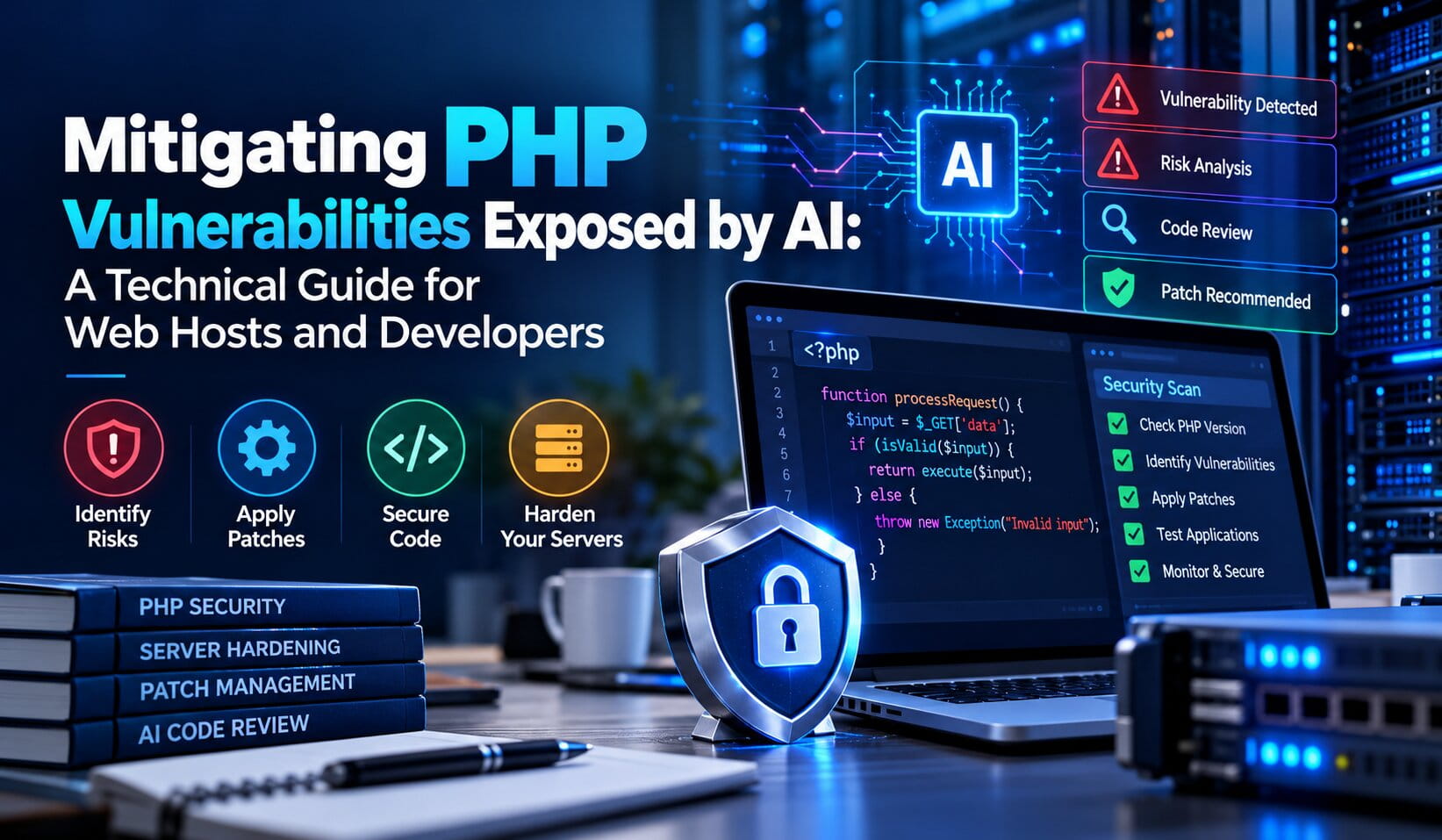
Why AI-Driven Threats Make PHP Security a Priority for Web Hosts
PHP powers websites, content management systems, APIs, and hosting platforms worldwide. However, vulnerabilities in PHP runtimes and application code can expose businesses to remote code execution, unauthorized access, and service disruption. As AI accelerates code generation and vulnerability research, web hosts and developers need stronger processes to identify weaknesses and implement effective remediation.
Recent PHP security disclosures highlight this urgency. On October 21, 2026, the PHP project released security updates for two critical vulnerabilities, CVE-2026-109618 and CVE-2026-109619. Both were rated CVSS 9.2 and could potentially allow unauthenticated remote code execution on affected PHP installations.
For hosting providers, managed service providers (MSPs), SaaS businesses, and development teams, mitigating PHP vulnerabilities requires more than updating individual applications. It involves coordinated patch management, runtime verification, application testing, and continuous infrastructure monitoring.
Understanding PHP Vulnerability Risks in the AI Era
AI is changing software development and security research. Developers can generate PHP functions, database queries, and API integrations faster, but generated code may contain insecure assumptions or incomplete validation. Attackers can also use AI-assisted techniques to analyze code, investigate application behavior, and accelerate vulnerability discovery.
Not every PHP vulnerability originates from AI-generated code. Runtime vulnerabilities can exist independently of application logic and affect applications that use the vulnerable PHP engine.
This distinction matters because application-level fixes and runtime security patches address different problems. Organizations must assess both layers rather than assuming that secure application code eliminates runtime risk.
Recent PHP Vulnerabilities: What Web Hosts Should Know
The October 2026 PHP security release addresses two critical vulnerabilities:
- CVE-2026-109618: Remote code execution associated with memory corruption during out-of-memory handling.
- CVE-2026-109619: Remote code execution associated with stale internal global state.
The PHP project released the following security-fixed versions:
- PHP 8.5.12
- PHP 8.4.27
- PHP 8.3.36
- PHP 8.2.35
The vulnerabilities affect PHP installations serving web requests, including PHP-FPM, Apache with mod_php, php-cgi, FrankenPHP, and LiteSpeed. The official advisory identifies mod_php as a particularly high-risk configuration.
Web hosts should consult the official PHP security advisory and the CERT-EU technical advisory to verify affected versions and remediation requirements.
Five Technical Steps to Mitigate PHP Vulnerabilities
1. Inventory PHP Runtimes Across Hosting Infrastructure
Web hosts may operate hundreds of websites across shared hosting servers, virtual private servers, dedicated servers, and cloud environments. A general server inventory may not reveal every PHP runtime or bundled application.
Identify PHP versions, execution handlers, installed extensions, application dependencies, and exposed services. Include separate PHP versions configured for individual websites.
Prioritize internet-facing systems running affected versions. If third-party software bundles its own PHP runtime, verify the vendor’s remediation guidance instead of assuming that updating the system-wide PHP package is sufficient.
2. Apply Security Patches and Upgrade Unsupported Versions
Patching is the primary remediation for PHP runtime vulnerabilities. Security teams should identify the appropriate fixed release, evaluate vendor packaging, schedule deployment, and verify that the patched runtime is serving production traffic.
For the October 2026 vulnerabilities, affected installations should be updated to the appropriate fixed PHP release or receive a verified vendor-provided security patch.
Older PHP branches that no longer receive upstream security updates require particular attention. Plan migration to a supported branch and test application compatibility before deployment.
If an internet-facing system cannot be patched promptly and remains vulnerable to a critical flaw, follow the security advisory’s containment guidance. This may require isolating the system from public access until remediation is complete.
3. Review Application Code and AI-Generated Functions
Runtime patching does not resolve vulnerabilities in custom PHP code. Developers must independently review application logic for weaknesses such as SQL injection, cross-site scripting, insecure file uploads, broken authorization, and unsafe dynamic code execution.
Use prepared database statements, context-appropriate output encoding, server-side validation, and explicit authorization checks.
AI-generated code should undergo the same security review and testing as manually written code. Static application security testing (SAST), dependency scanning, and authorized dynamic application security testing (DAST) can help identify weaknesses before deployment.
4. Harden PHP and Web Server Configurations
Security hardening reduces unnecessary exposure and limits the consequences of application compromise. Review file permissions, PHP execution settings, enabled extensions, temporary directories, credentials, and web server access controls.
Disable unnecessary services and extensions, protect configuration files, and enforce least-privilege access for application processes. Review PHP-FPM pools and other runtime isolation settings where applicable.
Test configuration changes against application requirements. Security settings should complement, not replace, the official PHP security patches.
5. Monitor, Investigate, and Verify Remediation
A successful patch deployment should be followed by validation. Confirm the running PHP version, test essential application functionality, and review logs for unexpected errors or suspicious activity.
Monitor unusual requests, unexplained file modifications, unfamiliar administrator accounts, unexpected scheduled tasks, and abnormal resource consumption.
If a server may have been compromised, investigate before declaring the incident resolved. Preserve relevant evidence, contain affected systems where appropriate, rotate potentially exposed credentials, and restore services only after addressing the underlying compromise.
How ACTSupport Can Help Web Hosts and Developers
Managing PHP vulnerabilities across multiple websites and servers can place considerable pressure on internal IT teams. ACTSupport provides technical support services for businesses that need assistance maintaining applications and hosting infrastructure.
Depending on the environment and agreed service scope, ACTSupport can help with the following activities.
PHP Security Assessment
ACTSupport can help review PHP environments, identify potentially outdated components, assess reported application vulnerabilities, and prioritize remediation according to exposure and business risk.
PHP Patching and Upgrade Support
Updating PHP may require compatibility checks for applications, frameworks, plugins, and extensions. ACTSupport can assist with security-update planning, implementation, compatibility troubleshooting, and post-update functionality testing.
Application Vulnerability Troubleshooting
For supported PHP applications and web environments, ACTSupport can help investigate insecure queries, input-validation issues, file-handling weaknesses, and other application-level problems.
Server Security Hardening
ACTSupport can assist with reviewing server permissions, PHP configuration, web server settings, access controls, and unnecessary services. Appropriate logging and monitoring can also help administrators investigate suspicious activity.
Ongoing Application and Infrastructure Support
Security is an ongoing responsibility. Regular maintenance, dependency reviews, vulnerability assessments, and monitoring help businesses reduce avoidable exposure and respond more effectively to emerging threats.
For hosting providers and MSPs, additional technical support can help internal teams manage maintenance workloads and resolve application issues efficiently.
✓
Need help assessing or securing your PHP environment?
Contact ACTSupport to discuss your PHP patching, application support, and server security requirements.
Build a Repeatable PHP Vulnerability Management Process
Effective PHP security requires a documented process rather than reactive patching alone. Organizations should maintain an accurate asset inventory, monitor official security advisories, establish risk-based patching priorities, and test security fixes before and after deployment.
Developers should integrate security testing into development pipelines and review AI-generated code before production release. Hosting teams should maintain visibility across all PHP runtimes, including those bundled with third-party products.
By combining runtime patching, secure development, configuration hardening, and continuous monitoring, businesses can improve their ability to respond to emerging vulnerabilities and maintain more resilient PHP environments.
Frequently Asked Questions
What does PHP vulnerability mitigation involve?
PHP vulnerability mitigation involves identifying affected PHP runtimes and applications, applying verified security updates, correcting insecure application code, hardening server configurations, and monitoring systems for suspicious activity.
Which PHP versions are affected by the October 2026 security vulnerabilities?
The fixed versions are PHP 8.5.12, 8.4.27, 8.3.36, and 8.2.35. Earlier versions in these branches may be affected. PHP 8.1 and older branches are no longer supported upstream and require vendor guidance or migration to a supported release.
Can a PHP vulnerability allow remote code execution?
Yes. Certain PHP vulnerabilities can allow attackers to execute unauthorized code on affected servers. The potential impact depends on the vulnerability and runtime configuration. The October 2026 PHP vulnerabilities demonstrate why timely patching is essential.
How can web hosts identify vulnerable PHP installations?
Web hosts should inventory server and website configurations, check active PHP runtimes and execution handlers, inspect bundled software, and compare installed versions against official security advisories. Automated asset management and vulnerability scanning can improve visibility across large hosting environments.
Is updating PHP enough to secure a website?
No. Updating PHP addresses vulnerabilities fixed in the runtime but does not automatically resolve insecure application code, vulnerable plugins, outdated dependencies, weak authentication, or compromised credentials. Comprehensive remediation must address each relevant layer.
How does AI affect PHP vulnerability management?
AI can accelerate code generation, vulnerability discovery, and security testing. It can also introduce insecure code when generated output is insufficiently reviewed. Organizations should combine automated analysis with human review and validate security findings before applying fixes.
Can ACTSupport help with PHP security patching and troubleshooting?
ACTSupport can assist businesses with PHP environment assessment, patch and upgrade support, application troubleshooting, server configuration reviews, and ongoing technical support, subject to the hosting environment and agreed service scope.
What should businesses do if they suspect a PHP server has been compromised?
Preserve logs and relevant evidence, restrict or isolate affected systems where appropriate, investigate suspicious activity, rotate potentially exposed credentials, and restore from trusted backups only after addressing the underlying compromise. Apply security patches and verify the environment before returning it to normal operation.
✓
Protect your hosting infrastructure with a proactive PHP security strategy
Contact ACTSupport to discuss application remediation, PHP maintenance, and server support.


